Aufgabe NT 1 · Abitur NRW Geschichte GK · Nachtermin · bilingual Englisch 2022
Thema: Nationalsozialismus: Ideologie, Herrschaft und Verbrechen · Aus der Prüfung GK · Nachtermin · bilingual Englisch (2022)
Aufgabenstellung
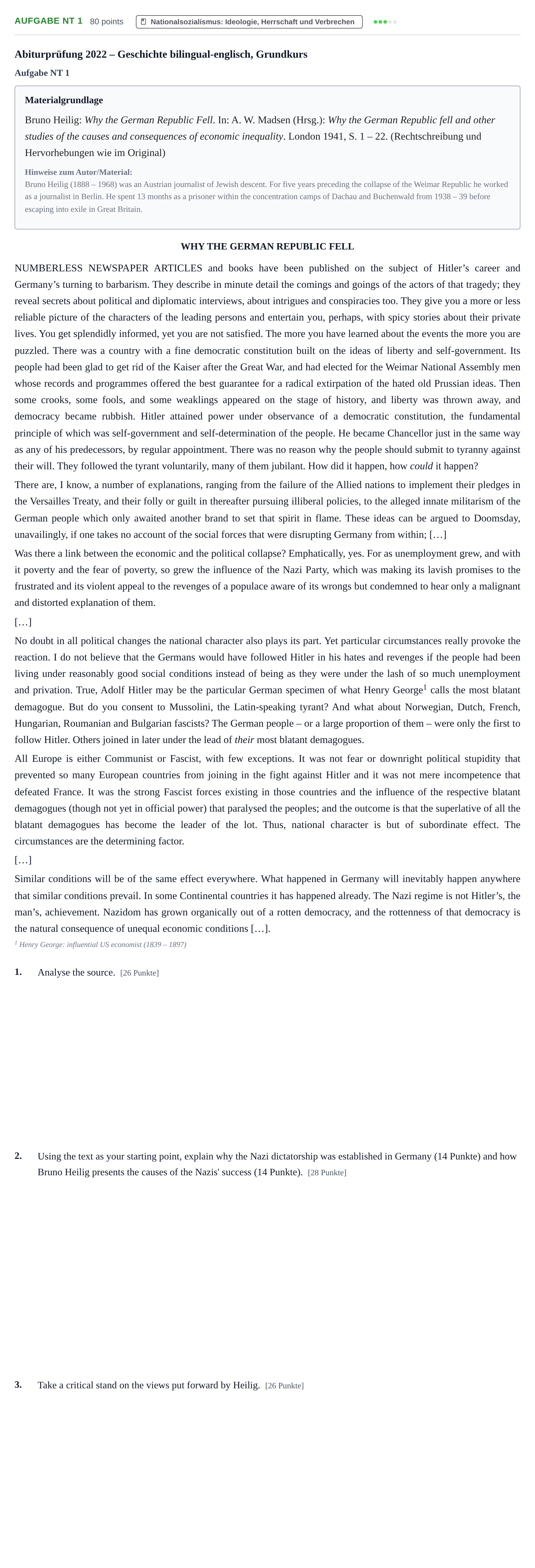
Abiturprüfung 2022 – Geschichte bilingual-englisch, Grundkurs
Aufgabe NT 1
Materialgrundlage
Bruno Heilig: Why the German Republic Fell. In: A. W. Madsen (Hrsg.): Why the German Republic fell and other studies of the causes and consequences of economic inequality. London 1941, S. 1 – 22. (Rechtschreibung und Hervorhebungen wie im Original)
Hinweise zum Autor/Material:
Bruno Heilig (1888 – 1968) was an Austrian journalist of Jewish descent. For five years preceding the collapse of the Weimar Republic he worked as a journalist in Berlin. He spent 13 months as a prisoner within the concentration camps of Dachau and Buchenwald from 1938 – 39 before escaping into exile in Great Britain.
WHY THE GERMAN REPUBLIC FELL
NUMBERLESS NEWSPAPER ARTICLES and books have been published on the subject of Hitler’s career and Germany’s turning to barbarism. They describe in minute detail the comings and goings of the actors of that tragedy; they reveal secrets about political and diplomatic interviews, about intrigues and conspiracies too. They give you a more or less reliable picture of the characters of the leading persons and entertain you, perhaps, with spicy stories about their private lives. You get splendidly informed, yet you are not satisfied. The more you have learned about the events the more you are puzzled. There was a country with a fine democratic constitution built on the ideas of liberty and self-government. Its people had been glad to get rid of the Kaiser after the Great War, and had elected for the Weimar National Assembly men whose records and programmes offered the best guarantee for a radical extirpation of the hated old Prussian ideas. Then some crooks, some fools, and some weaklings appeared on the stage of history, and liberty was thrown away, and democracy became rubbish. Hitler attained power under observance of a democratic constitution, the fundamental principle of which was self-government and self-determination of the people. He became Chancellor just in the same way as any of his predecessors, by regular appointment. There was no reason why the people should submit to tyranny against their will. They followed the tyrant voluntarily, many of them jubilant. How did it happen, how could it happen?
There are, I know, a number of explanations, ranging from the failure of the Allied nations to implement their pledges in the Versailles Treaty, and their folly or guilt in thereafter pursuing illiberal policies, to the alleged innate militarism of the German people which only awaited another brand to set that spirit in flame. These ideas can be argued to Doomsday, unavailingly, if one takes no account of the social forces that were disrupting Germany from within; […]
Was there a link between the economic and the political collapse? Emphatically, yes. For as unemployment grew, and with it poverty and the fear of poverty, so grew the influence of the Nazi Party, which was making its lavish promises to the frustrated and its violent appeal to the revenges of a populace aware of its wrongs but condemned to hear only a malignant and distorted explanation of them.
[…]
No doubt in all political changes the national character also plays its part. Yet particular circumstances really provoke the reaction. I do not believe that the Germans would have followed Hitler in his hates and revenges if the people had been living under reasonably good social conditions instead of being as they were under the lash of so much unemployment and privation. True, Adolf Hitler may be the particular German specimen of what Henry George 1 calls the most blatant demagogue. But do you consent to Mussolini, the Latin-speaking tyrant? And what about Norwegian, Dutch, French, Hungarian, Roumanian and Bulgarian fascists? The German people – or a large proportion of them – were only the first to follow Hitler. Others joined in later under the lead of their most blatant demagogues.
All Europe is either Communist or Fascist, with few exceptions. It was not fear or downright political stupidity that prevented so many European countries from joining in the fight against Hitler and it was not mere incompetence that defeated France. It was the strong Fascist forces existing in those countries and the influence of the respective blatant demagogues (though not yet in official power) that paralysed the peoples; and the outcome is that the superlative of all the blatant demagogues has become the leader of the lot. Thus, national character is but of subordinate effect. The circumstances are the determining factor.
[…]
Similar conditions will be of the same effect everywhere. What happened in Germany will inevitably happen anywhere that similar conditions prevail. In some Continental countries it has happened already. The Nazi regime is not Hitler’s, the man’s, achievement. Nazidom has grown organically out of a rotten democracy, and the rottenness of that democracy is the natural consequence of unequal economic conditions […].
1 Henry George: influential US economist (1839 – 1897)
1.
Analyse the source. [26 Punkte]
2.
Using the text as your starting point, explain why the Nazi dictatorship was established in Germany (14 Punkte) and how Bruno Heilig presents the causes of the Nazis' success (14 Punkte). [28 Punkte]
3.
Take a critical stand on the views put forward by Heilig. [26 Punkte]
Lösung
Nach den offiziellen Korrekturhinweisen
1. Analyse the source. (26 Punkte)
Lösung: Analyse of the primary source (essay by Bruno Heilig, 1941).
2. Using the text as your starting point, explain why the Nazi dictatorship was established in Germany (14 Punkte) and how Bruno Heilig presents the causes of the Nazis' success (14 Punkte). (28 Punkte)
Lösung: Explanation of the historical reasons for the establishment of the Nazi dictatorship in Germany and Heilig's depiction of the causes.
3. Take a critical stand on the views put forward by Heilig. (26 Punkte)
Lösung: Critical assessment and balanced judgement on Bruno Heilig's monocausal / socio-economic thesis.
Die ausführliche Erklärung Schritt für Schritt (mit KI) gibt es mit Premium. Premium
Löse sie direkt hier: automatische Korrektur, Hinweise und Lösung Schritt für Schritt.
‹ Aufgabe 3 · GK · Haupttermin · bilingual Französisch 2022 · Aufgabe HT 2 · LK · Haupttermin 2022 ›
Mehr Aufgaben zu Nationalsozialismus: Ideologie, Herrschaft und Verbrechen
- Aufgabe 2 · GK · Nachtermin · bilingual Englisch 2023
- Aufgabe 2 · LK · Haupttermin 2023
- Aufgabe 4 · GK · Haupttermin 2022
- Aufgabe 4 · GK · Haupttermin · bilingual Englisch 2022
- Aufgabe 3 · GK · Haupttermin · bilingual Französisch 2022
- Aufgabe HT 2 · LK · Haupttermin 2022
- Aufgabe 2 · LK · Nachtermin 2022
- Aufgabe 2 · GK · Nachtermin 2021
- Aufgabe 2 · GK · Nachtermin · bilingual Englisch 2021
- Aufgabe 2 · LK · Haupttermin 2021