Aufgabe 2 · Abitur NRW Geschichte GK · Nachtermin · bilingual Englisch 2023
Thema: Nationalsozialismus: Ideologie, Herrschaft und Verbrechen · Aus der Prüfung GK · Nachtermin · bilingual Englisch (2023)
Aufgabenstellung
Abiturprüfung 2023 · Geschichte bilingual-englisch, Grundkurs
Aufgabe 2
Materialgrundlage
Burgess Clive: Whither Hitler? In: Saturday review of politics, literature, science and art, London, v. 157, 11. August 1934, S. 953.
Hinweise zum Autor und zum Material:
The Saturday Review of politics, literature, science and art was a British liberal-conservative weekly newspaper that was published from 1855 to 1938. By the 1930s it had lost its influence and was in decline.
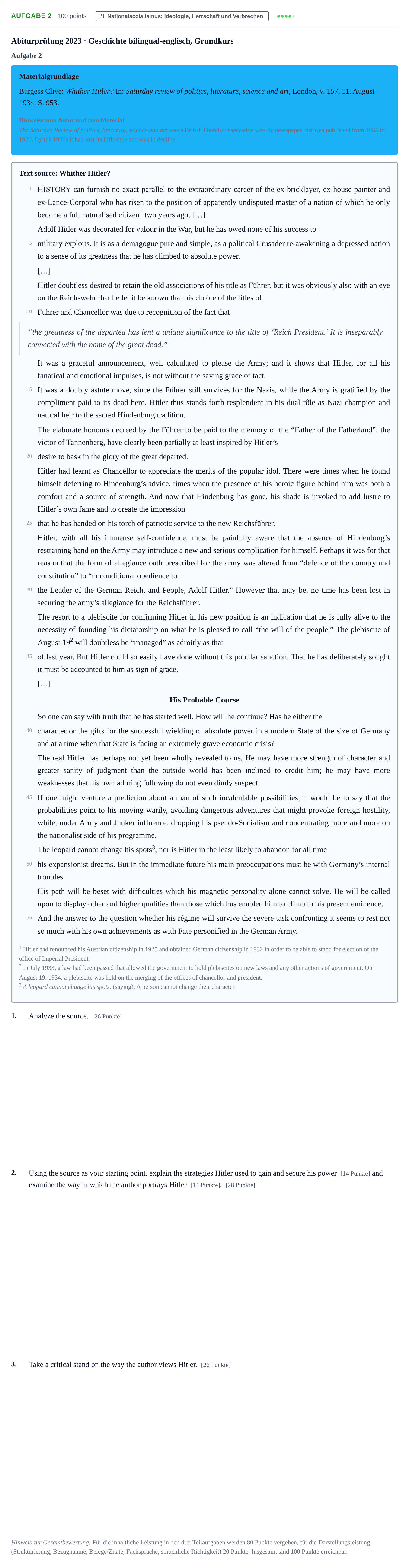
Text source: Whither Hitler?
1 HISTORY can furnish no exact parallel to the extraordinary career of the ex-bricklayer, ex-house painter and ex-Lance-Corporal who has risen to the position of apparently undisputed master of a nation of which he only became a full naturalised citizen 1 two years ago. […]
Adolf Hitler was decorated for valour in the War, but he has owed none of his success to
5 military exploits. It is as a demagogue pure and simple, as a political Crusader re-awakening a depressed nation to a sense of its greatness that he has climbed to absolute power.
[…]
Hitler doubtless desired to retain the old associations of his title as Führer, but it was obviously also with an eye on the Reichswehr that he let it be known that his choice of the titles of
10 Führer and Chancellor was due to recognition of the fact that
“the greatness of the departed has lent a unique significance to the title of ‘Reich President.’ It is inseparably connected with the name of the great dead.”
It was a graceful announcement, well calculated to please the Army; and it shows that Hitler, for all his fanatical and emotional impulses, is not without the saving grace of tact.
15 It was a doubly astute move, since the Führer still survives for the Nazis, while the Army is gratified by the compliment paid to its dead hero. Hitler thus stands forth resplendent in his dual rôle as Nazi champion and natural heir to the sacred Hindenburg tradition.
The elaborate honours decreed by the Führer to be paid to the memory of the “Father of the Fatherland”, the victor of Tannenberg, have clearly been partially at least inspired by Hitler’s
20 desire to bask in the glory of the great departed.
Hitler had learnt as Chancellor to appreciate the merits of the popular idol. There were times when he found himself deferring to Hindenburg’s advice, times when the presence of his heroic figure behind him was both a comfort and a source of strength. And now that Hindenburg has gone, his shade is invoked to add lustre to Hitler’s own fame and to create the impression
25 that he has handed on his torch of patriotic service to the new Reichsführer.
Hitler, with all his immense self-confidence, must be painfully aware that the absence of Hindenburg’s restraining hand on the Army may introduce a new and serious complication for himself. Perhaps it was for that reason that the form of allegiance oath prescribed for the army was altered from “defence of the country and constitution” to “unconditional obedience to
30 the Leader of the German Reich, and People, Adolf Hitler.” However that may be, no time has been lost in securing the army’s allegiance for the Reichsführer.
The resort to a plebiscite for confirming Hitler in his new position is an indication that he is fully alive to the necessity of founding his dictatorship on what he is pleased to call “the will of the people.” The plebiscite of August 19 2 will doubtless be “managed” as adroitly as that
35 of last year. But Hitler could so easily have done without this popular sanction. That he has deliberately sought it must be accounted to him as sign of grace.
[…]
His Probable Course
So one can say with truth that he has started well. How will he continue? Has he either the
40 character or the gifts for the successful wielding of absolute power in a modern State of the size of Germany and at a time when that State is facing an extremely grave economic crisis?
The real Hitler has perhaps not yet been wholly revealed to us. He may have more strength of character and greater sanity of judgment than the outside world has been inclined to credit him; he may have more weaknesses that his own adoring following do not even dimly suspect.
45 If one might venture a prediction about a man of such incalculable possibilities, it would be to say that the probabilities point to his moving warily, avoiding dangerous adventures that might provoke foreign hostility, while, under Army and Junker influence, dropping his pseudo-Socialism and concentrating more and more on the nationalist side of his programme.
The leopard cannot change his spots 3, nor is Hitler in the least likely to abandon for all time
50 his expansionist dreams. But in the immediate future his main preoccupations must be with Germany’s internal troubles.
His path will be beset with difficulties which his magnetic personality alone cannot solve. He will be called upon to display other and higher qualities than those which has enabled him to climb to his present eminence.
55 And the answer to the question whether his régime will survive the severe task confronting it seems to rest not so much with his own achievements as with Fate personified in the German Army.
1 Hitler had renounced his Austrian citizenship in 1925 and obtained German citizenship in 1932 in order to be able to stand for election of the office of Imperial President.
2 In July 1933, a law had been passed that allowed the government to hold plebiscites on new laws and any other actions of government. On August 19, 1934, a plebiscite was held on the merging of the offices of chancellor and president.
3 A leopard cannot change his spots. (saying): A person cannot change their character.
1.
Analyze the source. [26 Punkte]
2.
Using the source as your starting point, explain the strategies Hitler used to gain and secure his power [14 Punkte] and examine the way in which the author portrays Hitler [14 Punkte]. [28 Punkte]
3.
Take a critical stand on the way the author views Hitler. [26 Punkte]
Hinweis zur Gesamtbewertung: Für die inhaltliche Leistung in den drei Teilaufgaben werden 80 Punkte vergeben, für die Darstellungsleistung (Strukturierung, Bezugnahme, Belege/Zitate, Fachsprache, sprachliche Richtigkeit) 20 Punkte. Insgesamt sind 100 Punkte erreichbar.
Lösung
Nach den offiziellen Korrekturhinweisen
1. Analyze the source. [26 Punkte]
Lösung: Comprehensive textual and structural analysis of the source according to standard historical criteria.
2. Using the source as your starting point, explain the strategies Hitler used to gain and secure his power (14 Punkte) and examine the way in which the author portrays Hitler (14 Punkte). [28 Punkte]
Lösung: Historical explanation of Hitler's rise and consolidation of power, followed by an examination of the author's portrayal of Hitler.
3. Take a critical stand on the way the author views Hitler. [26 Punkte]
Lösung: Differentiated critical evaluation of Clive's contemporary perspective and predictions from a historical standpoint.
Die ausführliche Erklärung Schritt für Schritt (mit KI) gibt es mit Premium. Premium
Löse sie direkt hier: automatische Korrektur, Hinweise und Lösung Schritt für Schritt.
‹ Aufgabe 2 (GE GK NT 2) · GK · Nachtermin 2023 · Aufgabe 2 · LK · Haupttermin 2023 ›
Mehr Aufgaben zu Nationalsozialismus: Ideologie, Herrschaft und Verbrechen
- Aufgabe 2 (GE GK NT 2) · GK · Nachtermin 2023
- Aufgabe 2 · LK · Haupttermin 2023
- Aufgabe 4 · GK · Haupttermin 2022
- Aufgabe 4 · GK · Haupttermin · bilingual Englisch 2022
- Aufgabe 3 · GK · Haupttermin · bilingual Französisch 2022
- Aufgabe NT 1 · GK · Nachtermin · bilingual Englisch 2022
- Aufgabe HT 2 · LK · Haupttermin 2022
- Aufgabe 2 · LK · Nachtermin 2022
- Aufgabe 2 · GK · Nachtermin 2021
- Aufgabe 2 · GK · Nachtermin · bilingual Englisch 2021