Aufgabe 2 · Abitur NRW Geschichte GK · Nachtermin · bilingual Englisch 2021
Thema: Nationalsozialismus: Ideologie, Herrschaft und Verbrechen · Aus der Prüfung GK · Nachtermin · bilingual Englisch (2021)
Aufgabenstellung
Abiturprüfung 2021 – Geschichte bilingual-englisch, Grundkurs
Aufgabenstellung: Aufgabe 2
Materialgrundlage
Anonymous: The Seizing Of Germany. In: The Times, 2. März 1933.
(Rechtschreibung und Hervorhebungen wie im Original)
Hinweise zum Material: The (London) Times (founded in 1785): a widely influential British daily national newspaper published in London, reaching a circulation of 187,000 copies in 1930.
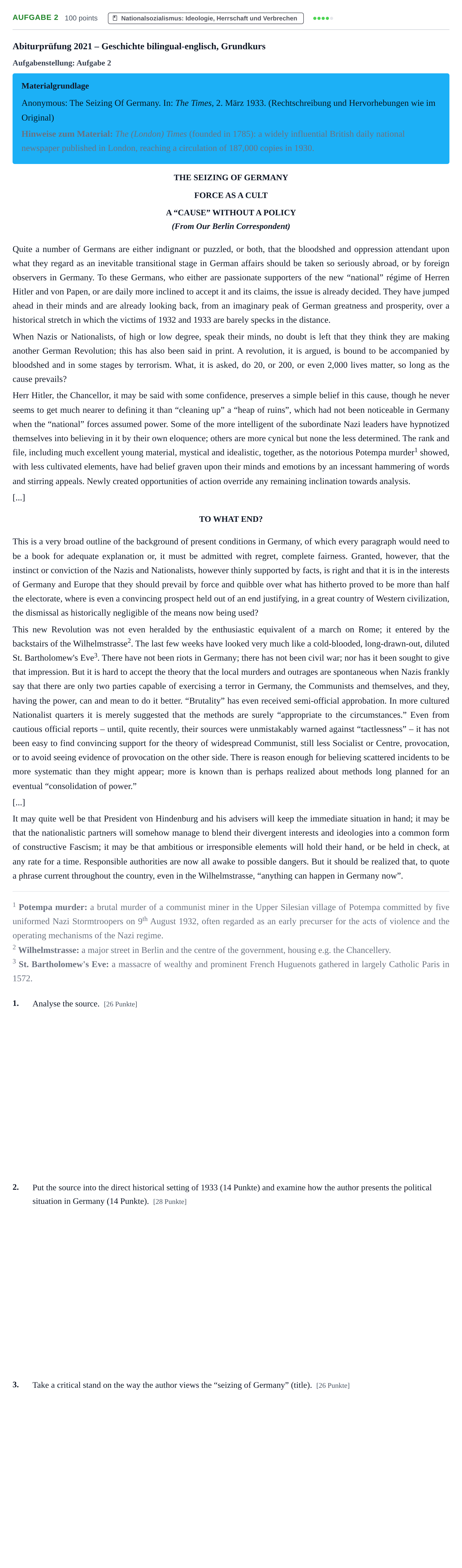
THE SEIZING OF GERMANY
FORCE AS A CULT
A “CAUSE” WITHOUT A POLICY
(From Our Berlin Correspondent)
1 Quite a number of Germans are either indignant or puzzled, or both, that the bloodshed and oppression attendant upon what they regard as an inevitable transitional stage in German affairs should be taken so seriously abroad, or by foreign observers in Germany. To these Germans, who either are passionate supporters of the new “national” régime of Herren 5 Hitler and von Papen, or are daily more inclined to accept it and its claims, the issue is already decided. They have jumped ahead in their minds and are already looking back, from an imaginary peak of German greatness and prosperity, over a historical stretch in which the victims of 1932 and 1933 are barely specks in the distance.
When Nazis or Nationalists, of high or low degree, speak their minds, no doubt is left that 10 they think they are making another German Revolution; this has also been said in print. A revolution, it is argued, is bound to be accompanied by bloodshed and in some stages by terrorism. What, it is asked, do 20, or 200, or even 2,000 lives matter, so long as the cause prevails?
Herr Hitler, the Chancellor, it may be said with some confidence, preserves a simple belief 15 in this cause, though he never seems to get much nearer to defining it than “cleaning up” a “heap of ruins”, which had not been noticeable in Germany when the “national” forces assumed power. Some of the more intelligent of the subordinate Nazi leaders have hypnotized themselves into believing in it by their own eloquence; others are more cynical but none the less determined. The rank and file, including much excellent young material, 20 mystical and idealistic, together, as the notorious Potempa murder 1 showed, with less cultivated elements, have had belief graven upon their minds and emotions by an incessant hammering of words and stirring appeals. Newly created opportunities of action override any remaining inclination towards analysis.
[...]
TO WHAT END?
25 This is a very broad outline of the background of present conditions in Germany, of which every paragraph would need to be a book for adequate explanation or, it must be admitted with regret, complete fairness. Granted, however, that the instinct or conviction of the Nazis and Nationalists, however thinly supported by facts, is right and that it is in the interests of 30 Germany and Europe that they should prevail by force and quibble over what has hitherto proved to be more than half the electorate, where is even a convincing prospect held out of an end justifying, in a great country of Western civilization, the dismissal as historically negligible of the means now being used?
This new Revolution was not even heralded by the enthusiastic equivalent of a march on 35 Rome; it entered by the backstairs of the Wilhelmstrasse 2. The last few weeks have looked very much like a cold-blooded, long-drawn-out, diluted St. Bartholomew's Eve 3. There have not been riots in Germany; there has not been civil war; nor has it been sought to give that impression. But it is hard to accept the theory that the local murders and outrages are spontaneous when Nazis frankly say that there are only two parties capable of exercising a 40 terror in Germany, the Communists and themselves, and they, having the power, can and mean to do it better. “Brutality” has even received semi-official approbation. In more cultured Nationalist quarters it is merely suggested that the methods are surely “appropriate to the circumstances.” Even from cautious official reports – until, quite recently, their sources were unmistakably warned against “tactlessness” – it has not been easy to find 45 convincing support for the theory of widespread Communist, still less Socialist or Centre, provocation, or to avoid seeing evidence of provocation on the other side. There is reason enough for believing scattered incidents to be more systematic than they might appear; more is known than is perhaps realized about methods long planned for an eventual “consolidation of power.”
50 [...]
It may quite well be that President von Hindenburg and his advisers will keep the immediate situation in hand; it may be that the nationalistic partners will somehow manage to blend their divergent interests and ideologies into a common form of constructive Fascism; it may be that ambitious or irresponsible elements will hold their hand, or be held 55 in check, at any rate for a time. Responsible authorities are now all awake to possible dangers. But it should be realized that, to quote a phrase current throughout the country, even in the Wilhelmstrasse, “anything can happen in Germany now”.
1 Potempa murder: a brutal murder of a communist miner in the Upper Silesian village of Potempa committed by five uniformed Nazi Stormtroopers on 9 th August 1932, often regarded as an early precurser for the acts of violence and the operating mechanisms of the Nazi regime.
2 Wilhelmstrasse: a major street in Berlin and the centre of the government, housing e.g. the Chancellery.
3 St. Bartholomew's Eve: a massacre of wealthy and prominent French Huguenots gathered in largely Catholic Paris in 1572.
1.
Analyse the source. [26 Punkte]
2.
Put the source into the direct historical setting of 1933 (14 Punkte) and examine how the author presents the political situation in Germany (14 Punkte). [28 Punkte]
3.
Take a critical stand on the way the author views the “seizing of Germany” (title). [26 Punkte]
Lösung
Nach den offiziellen Korrekturhinweisen
1. Analyse the source.
Lösung: Formal analysis and structured summary of the source's content and line of thought.
2. Put the source into the direct historical setting of 1933 (14 Punkte) and examine how the author presents the political situation in Germany (14 Punkte).
Lösung: Contextualisation within the events of January–March 1933 and analysis of the presentation of violence, lack of transparency, and abuse of power.
3. Take a critical stand on the way the author views the “seizing of Germany” (title).
Lösung: Critical assessment of the author's perspective on the Nazi takeover and 'seizing of Germany'.
Die ausführliche Erklärung Schritt für Schritt (mit KI) gibt es mit Premium. Premium
Löse sie direkt hier: automatische Korrektur, Hinweise und Lösung Schritt für Schritt.
‹ Aufgabe 2 · GK · Nachtermin 2021 · Aufgabe 2 · LK · Haupttermin 2021 ›