Aufgabe 3 · Abitur NRW Geschichte GK · Haupttermin · bilingual Englisch 2023
Thema: Imperialismus und Erster Weltkrieg · Aus der Prüfung GK · Haupttermin · bilingual Englisch (2023)
Aufgabenstellung
Abiturprüfung 2023 – Geschichte bilingual-englisch, Grundkurs
Aufgabe 3
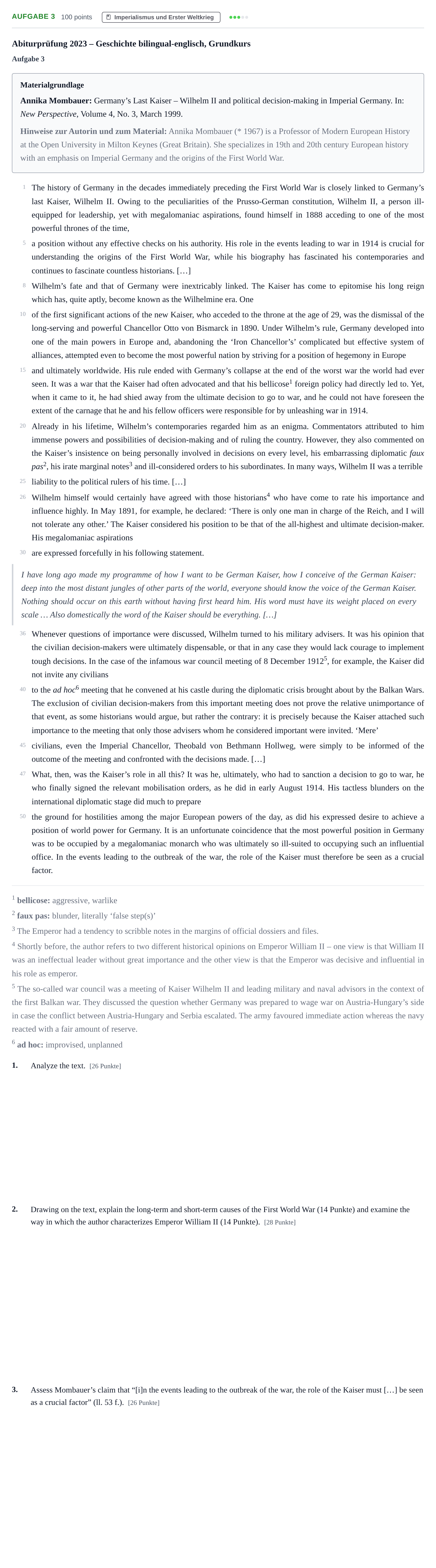
Materialgrundlage
Annika Mombauer: Germany’s Last Kaiser – Wilhelm II and political decision-making in Imperial Germany. In: New Perspective, Volume 4, No. 3, March 1999.
Hinweise zur Autorin und zum Material: Annika Mombauer (* 1967) is a Professor of Modern European History at the Open University in Milton Keynes (Great Britain). She specializes in 19th and 20th century European history with an emphasis on Imperial Germany and the origins of the First World War.
1 The history of Germany in the decades immediately preceding the First World War is closely linked to Germany’s last Kaiser, Wilhelm II. Owing to the peculiarities of the Prusso-German constitution, Wilhelm II, a person ill-equipped for leadership, yet with megalomaniac aspirations, found himself in 1888 acceding to one of the most powerful thrones of the time,
5 a position without any effective checks on his authority. His role in the events leading to war in 1914 is crucial for understanding the origins of the First World War, while his biography has fascinated his contemporaries and continues to fascinate countless historians. […]
8 Wilhelm’s fate and that of Germany were inextricably linked. The Kaiser has come to epitomise his long reign which has, quite aptly, become known as the Wilhelmine era. One
10 of the first significant actions of the new Kaiser, who acceded to the throne at the age of 29, was the dismissal of the long-serving and powerful Chancellor Otto von Bismarck in 1890. Under Wilhelm’s rule, Germany developed into one of the main powers in Europe and, abandoning the ‘Iron Chancellor’s’ complicated but effective system of alliances, attempted even to become the most powerful nation by striving for a position of hegemony in Europe
15 and ultimately worldwide. His rule ended with Germany’s collapse at the end of the worst war the world had ever seen. It was a war that the Kaiser had often advocated and that his bellicose 1 foreign policy had directly led to. Yet, when it came to it, he had shied away from the ultimate decision to go to war, and he could not have foreseen the extent of the carnage that he and his fellow officers were responsible for by unleashing war in 1914.
20 Already in his lifetime, Wilhelm’s contemporaries regarded him as an enigma. Commentators attributed to him immense powers and possibilities of decision-making and of ruling the country. However, they also commented on the Kaiser’s insistence on being personally involved in decisions on every level, his embarrassing diplomatic faux pas 2, his irate marginal notes 3 and ill-considered orders to his subordinates. In many ways, Wilhelm II was a terrible
25 liability to the political rulers of his time. […]
26 Wilhelm himself would certainly have agreed with those historians 4 who have come to rate his importance and influence highly. In May 1891, for example, he declared: ‘There is only one man in charge of the Reich, and I will not tolerate any other.’ The Kaiser considered his position to be that of the all-highest and ultimate decision-maker. His megalomaniac aspirations
30 are expressed forcefully in his following statement.
I have long ago made my programme of how I want to be German Kaiser, how I conceive of the German Kaiser: deep into the most distant jungles of other parts of the world, everyone should know the voice of the German Kaiser. Nothing should occur on this earth without having first heard him. His word must have its weight placed on every scale … Also domestically the word of the Kaiser should be everything. […]
36 Whenever questions of importance were discussed, Wilhelm turned to his military advisers. It was his opinion that the civilian decision-makers were ultimately dispensable, or that in any case they would lack courage to implement tough decisions. In the case of the infamous war council meeting of 8 December 1912 5, for example, the Kaiser did not invite any civilians
40 to the ad hoc 6 meeting that he convened at his castle during the diplomatic crisis brought about by the Balkan Wars. The exclusion of civilian decision-makers from this important meeting does not prove the relative unimportance of that event, as some historians would argue, but rather the contrary: it is precisely because the Kaiser attached such importance to the meeting that only those advisers whom he considered important were invited. ‘Mere’
45 civilians, even the Imperial Chancellor, Theobald von Bethmann Hollweg, were simply to be informed of the outcome of the meeting and confronted with the decisions made. […]
47 What, then, was the Kaiser’s role in all this? It was he, ultimately, who had to sanction a decision to go to war, he who finally signed the relevant mobilisation orders, as he did in early August 1914. His tactless blunders on the international diplomatic stage did much to prepare
50 the ground for hostilities among the major European powers of the day, as did his expressed desire to achieve a position of world power for Germany. It is an unfortunate coincidence that the most powerful position in Germany was to be occupied by a megalomaniac monarch who was ultimately so ill-suited to occupying such an influential office. In the events leading to the outbreak of the war, the role of the Kaiser must therefore be seen as a crucial factor.
1 bellicose: aggressive, warlike
2 faux pas: blunder, literally ‘false step(s)’
3 The Emperor had a tendency to scribble notes in the margins of official dossiers and files.
4 Shortly before, the author refers to two different historical opinions on Emperor William II – one view is that William II was an ineffectual leader without great importance and the other view is that the Emperor was decisive and influential in his role as emperor.
5 The so-called war council was a meeting of Kaiser Wilhelm II and leading military and naval advisors in the context of the first Balkan war. They discussed the question whether Germany was prepared to wage war on Austria-Hungary’s side in case the conflict between Austria-Hungary and Serbia escalated. The army favoured immediate action whereas the navy reacted with a fair amount of reserve.
6 ad hoc: improvised, unplanned
1.
Analyze the text. [26 Punkte]
2.
Drawing on the text, explain the long-term and short-term causes of the First World War (14 Punkte) and examine the way in which the author characterizes Emperor William II (14 Punkte). [28 Punkte]
3.
Assess Mombauer’s claim that “[i]n the events leading to the outbreak of the war, the role of the Kaiser must […] be seen as a crucial factor” (ll. 53 f.). [26 Punkte]
Lösung
Nach den offiziellen Korrekturhinweisen
1. Analyze the text. (26 Punkte)
Lösung: Individuelle Analyse des Textes von Annika Mombauer gemäß den Kriterien der Aufgabenstellung (formale Erschließung, Thema, Intention, gedanklicher Aufbau und Kernaussagen).
2. Drawing on the text, explain the long-term and short-term causes of the First World War (14 Punkte) and examine the way in which the author characterizes Emperor William II (14 Punkte). (28 Punkte)
Lösung: Individuelle historische Erläuterung der Kriegsursachen sowie detaillierte Untersuchung der Darstellung Wilhelms II. durch Mombauer.
3. Assess Mombauer’s claim that “[i]n the events leading to the outbreak of the war, the role of the Kaiser must […] be seen as a crucial factor” (ll. 53 f.). (26 Punkte)
Lösung: Differenzierte und kriterienorientierte historische Beurteilung der These Annika Mombauers zur entscheidenden Rolle Wilhelms II.
Die ausführliche Erklärung Schritt für Schritt (mit KI) gibt es mit Premium. Premium
Löse sie direkt hier: automatische Korrektur, Hinweise und Lösung Schritt für Schritt.
Aufgabe HT 1 · GK · Haupttermin · bilingual Französisch 2023 ›
Mehr Aufgaben zu Imperialismus und Erster Weltkrieg
- Aufgabe HT 1 · GK · Haupttermin · bilingual Französisch 2023
- Aufgabe 1 (GE GK NT 1) · GK · Nachtermin 2023
- Aufgabe 1 · GK · Nachtermin · bilingual Englisch 2023
- Aufgabe 1 · LK · Haupttermin 2023
- Aufgabe 3 · GK · Haupttermin · bilingual Englisch 2022
- Aufgabe 1 · GK · Haupttermin · bilingual Französisch 2022
- Aufgabe 3 · GK · Nachtermin 2022
- Aufgabe NT 3 · GK · Nachtermin · bilingual Englisch 2022
- Aufgabe 4 · LK · Nachtermin 2022
- Aufgabe GE BIL E GK HT 1 · GK · Haupttermin · bilingual Englisch 2021