Aufgabe GE BIL E GK HT 1 · Abitur NRW Geschichte GK · Haupttermin · bilingual Englisch 2021
Thema: Imperialismus und Erster Weltkrieg · Aus der Prüfung GK · Haupttermin · bilingual Englisch (2021)
Aufgabenstellung
Abiturprüfung 2021 · Geschichte bilingual-englisch, Grundkurs
Aufgabenstellung · GE BIL E GK HT 1
Materialgrundlage
Frederick D. Lugard: The Extension of British Influence (and Trade) in Africa.
(Rechtschreibung und Hervorhebungen wie im Original)
Hinweise zum Autor und zum Material:
Frederick John Dealtry Lugard (1858 – 1945) made a career in the colonial services, starting out as a mercenary and explorer, later serving in high offices in Africa (especially in Nigeria) and Asia.
The text is the published version of a speech originally delivered before the mostly aristocratic members of the Royal Colonial Institute on 12th November 1895.
Royal Colonial Institute: A highly influential interest group founded in 1868 to promote colonial interests, presided over by the Prince of Wales.
[...]
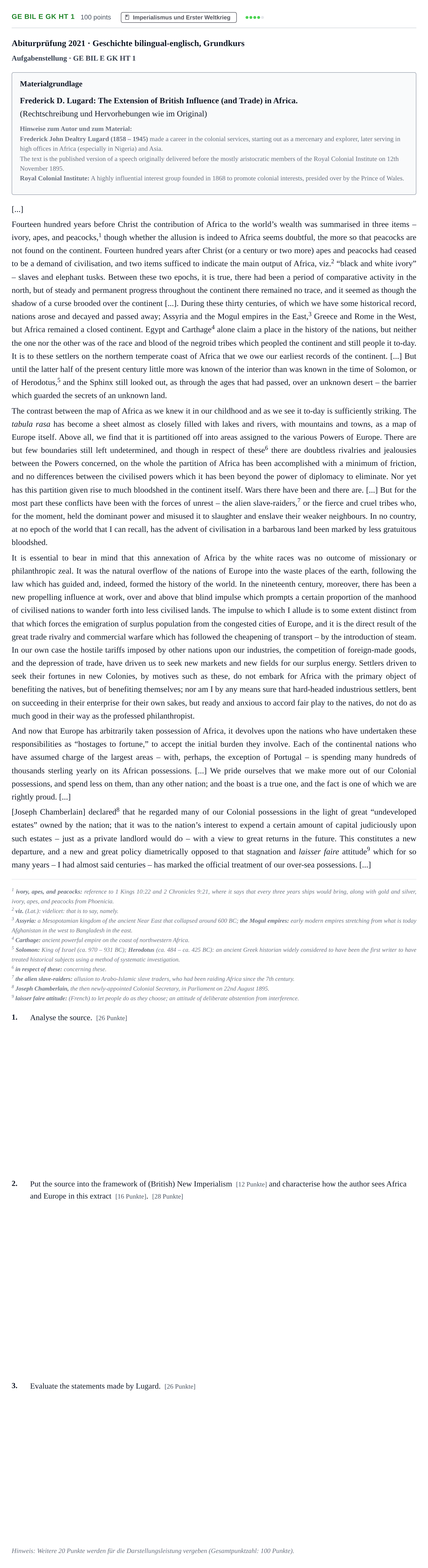
Fourteen hundred years before Christ the contribution of Africa to the world’s wealth was summarised in three items – ivory, apes, and peacocks, 1 though whether the allusion is indeed to Africa seems doubtful, the more so that peacocks are not found on the continent. Fourteen hundred years after Christ (or a century or two more) apes and peacocks had ceased to be a demand of civilisation, and two items sufficed to indicate the main output of Africa, viz. 2 “black and white ivory” – slaves and elephant tusks. Between these two epochs, it is true, there had been a period of comparative activity in the north, but of steady and permanent progress throughout the continent there remained no trace, and it seemed as though the shadow of a curse brooded over the continent [...]. During these thirty centuries, of which we have some historical record, nations arose and decayed and passed away; Assyria and the Mogul empires in the East, 3 Greece and Rome in the West, but Africa remained a closed continent. Egypt and Carthage 4 alone claim a place in the history of the nations, but neither the one nor the other was of the race and blood of the negroid tribes which peopled the continent and still people it to-day. It is to these settlers on the northern temperate coast of Africa that we owe our earliest records of the continent. [...] But until the latter half of the present century little more was known of the interior than was known in the time of Solomon, or of Herodotus, 5 and the Sphinx still looked out, as through the ages that had passed, over an unknown desert – the barrier which guarded the secrets of an unknown land.
The contrast between the map of Africa as we knew it in our childhood and as we see it to-day is sufficiently striking. The tabula rasa has become a sheet almost as closely filled with lakes and rivers, with mountains and towns, as a map of Europe itself. Above all, we find that it is partitioned off into areas assigned to the various Powers of Europe. There are but few boundaries still left undetermined, and though in respect of these 6 there are doubtless rivalries and jealousies between the Powers concerned, on the whole the partition of Africa has been accomplished with a minimum of friction, and no differences between the civilised powers which it has been beyond the power of diplomacy to eliminate. Nor yet has this partition given rise to much bloodshed in the continent itself. Wars there have been and there are. [...] But for the most part these conflicts have been with the forces of unrest – the alien slave-raiders, 7 or the fierce and cruel tribes who, for the moment, held the dominant power and misused it to slaughter and enslave their weaker neighbours. In no country, at no epoch of the world that I can recall, has the advent of civilisation in a barbarous land been marked by less gratuitous bloodshed.
It is essential to bear in mind that this annexation of Africa by the white races was no outcome of missionary or philanthropic zeal. It was the natural overflow of the nations of Europe into the waste places of the earth, following the law which has guided and, indeed, formed the history of the world. In the nineteenth century, moreover, there has been a new propelling influence at work, over and above that blind impulse which prompts a certain proportion of the manhood of civilised nations to wander forth into less civilised lands. The impulse to which I allude is to some extent distinct from that which forces the emigration of surplus population from the congested cities of Europe, and it is the direct result of the great trade rivalry and commercial warfare which has followed the cheapening of transport – by the introduction of steam. In our own case the hostile tariffs imposed by other nations upon our industries, the competition of foreign-made goods, and the depression of trade, have driven us to seek new markets and new fields for our surplus energy. Settlers driven to seek their fortunes in new Colonies, by motives such as these, do not embark for Africa with the primary object of benefiting the natives, but of benefiting themselves; nor am I by any means sure that hard-headed industrious settlers, bent on succeeding in their enterprise for their own sakes, but ready and anxious to accord fair play to the natives, do not do as much good in their way as the professed philanthropist.
And now that Europe has arbitrarily taken possession of Africa, it devolves upon the nations who have undertaken these responsibilities as “hostages to fortune,” to accept the initial burden they involve. Each of the continental nations who have assumed charge of the largest areas – with, perhaps, the exception of Portugal – is spending many hundreds of thousands sterling yearly on its African possessions. [...] We pride ourselves that we make more out of our Colonial possessions, and spend less on them, than any other nation; and the boast is a true one, and the fact is one of which we are rightly proud. [...]
[Joseph Chamberlain] declared 8 that he regarded many of our Colonial possessions in the light of great “undeveloped estates” owned by the nation; that it was to the nation’s interest to expend a certain amount of capital judiciously upon such estates – just as a private landlord would do – with a view to great returns in the future. This constitutes a new departure, and a new and great policy diametrically opposed to that stagnation and laisser faire attitude 9 which for so many years – I had almost said centuries – has marked the official treatment of our over-sea possessions. [...]
1 ivory, apes, and peacocks: reference to 1 Kings 10:22 and 2 Chronicles 9:21, where it says that every three years ships would bring, along with gold and silver, ivory, apes, and peacocks from Phoenicia.
2 viz. (Lat.): videlicet: that is to say, namely.
3 Assyria: a Mesopotamian kingdom of the ancient Near East that collapsed around 600 BC; the Mogul empires: early modern empires stretching from what is today Afghanistan in the west to Bangladesh in the east.
4 Carthage: ancient powerful empire on the coast of northwestern Africa.
5 Solomon: King of Israel (ca. 970 – 931 BC); Herodotus (ca. 484 – ca. 425 BC): an ancient Greek historian widely considered to have been the first writer to have treated historical subjects using a method of systematic investigation.
6 in respect of these: concerning these.
7 the alien slave-raiders: allusion to Arabo-Islamic slave traders, who had been raiding Africa since the 7th century.
8 Joseph Chamberlain, the then newly-appointed Colonial Secretary, in Parliament on 22nd August 1895.
9 laisser faire attitude: (French) to let people do as they choose; an attitude of deliberate abstention from interference.
1.
Analyse the source. [26 Punkte]
2.
Put the source into the framework of (British) New Imperialism [12 Punkte] and characterise how the author sees Africa and Europe in this extract [16 Punkte]. [28 Punkte]
3.
Evaluate the statements made by Lugard. [26 Punkte]
Hinweis: Weitere 20 Punkte werden für die Darstellungsleistung vergeben (Gesamtpunktzahl: 100 Punkte).
Lösung
Nach den offiziellen Korrekturhinweisen
1. Analyse the source. (26 Punkte)
Lösung: Individuelle Analyse der Quelle gemäß den Kriterien der Abiturvorgaben.
2. Put the source into the framework of (British) New Imperialism (12 Punkte) and characterise how the author sees Africa and Europe in this extract (16 Punkte). (28 Punkte)
Lösung: Individuelle historische Kontextualisierung und Charakterisierung der Sichtweisen.
3. Evaluate the statements made by Lugard. (26 Punkte)
Lösung: Individuelle historische Bewertung und Urteilsbildung.
Die ausführliche Erklärung Schritt für Schritt (mit KI) gibt es mit Premium. Premium
Löse sie direkt hier: automatische Korrektur, Hinweise und Lösung Schritt für Schritt.
‹ Aufgabe 4 · LK · Nachtermin 2022 · Aufgabe 1 · GK · Haupttermin · bilingual Französisch 2021 ›
Mehr Aufgaben zu Imperialismus und Erster Weltkrieg
- Aufgabe 3 · GK · Haupttermin · bilingual Englisch 2022
- Aufgabe 1 · GK · Haupttermin · bilingual Französisch 2022
- Aufgabe 3 · GK · Nachtermin 2022
- Aufgabe NT 3 · GK · Nachtermin · bilingual Englisch 2022
- Aufgabe 4 · LK · Nachtermin 2022
- Aufgabe 1 · GK · Haupttermin · bilingual Französisch 2021
- Aufgabe 3 · GK · Nachtermin 2021
- Aufgabe 1 · GK · Nachtermin · bilingual Englisch 2021
- Aufgabe 3 · GK · Nachtermin · bilingual Englisch 2021