Aufgabe 1 · Abitur NRW Geschichte GK · Nachtermin · bilingual Englisch 2023
Thema: Imperialismus und Erster Weltkrieg · Aus der Prüfung GK · Nachtermin · bilingual Englisch (2023)
Aufgabenstellung
Abiturprüfung 2023 · Geschichte bilingual-englisch, Grundkurs
Aufgabenstellung:
1. Analyse the source. (26 Punkte)
2. Put the source into the context of the relations between Britain and Germany during the era of European imperialism (14 Punkte) and determine how the author views Germany (14 Punkte). (28 Punkte)
3. Take a stance on how the author assesses the political situation. (26 Punkte)
(Darstellungsleistung: 20 Punkte · Gesamtpunktzahl: 100 Punkte)
Materialgrundlage
Anonymous: England and Germany. In: The Saturday Review, 11. September 1897 (No. 2185, Vol. 84), S. 278–279.
Hinweise zum Material: The Saturday Review (of Politics, Literature, Science, and Art): a London weekly newspaper established in 1855. Around the turn of the century it published several articles with an anti-German stance.
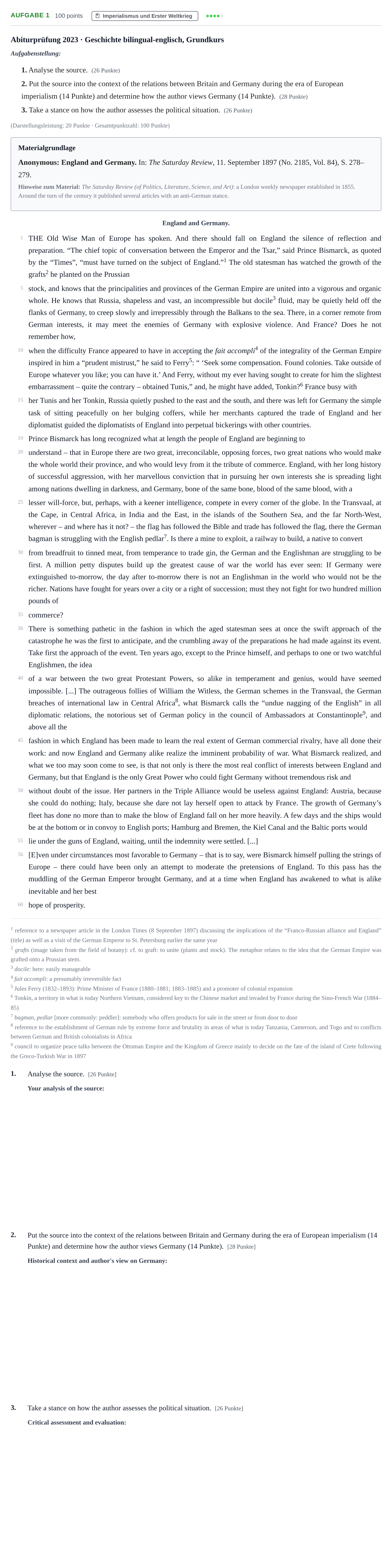
England and Germany.
1 THE Old Wise Man of Europe has spoken. And there should fall on England the silence of reflection and preparation. “The chief topic of conversation between the Emperor and the Tsar,” said Prince Bismarck, as quoted by the “Times”, “must have turned on the subject of England.” 1 The old statesman has watched the growth of the grafts 2 he planted on the Prussian
5 stock, and knows that the principalities and provinces of the German Empire are united into a vigorous and organic whole. He knows that Russia, shapeless and vast, an incompressible but docile 3 fluid, may be quietly held off the flanks of Germany, to creep slowly and irrepressibly through the Balkans to the sea. There, in a corner remote from German interests, it may meet the enemies of Germany with explosive violence. And France? Does he not remember how,
10 when the difficulty France appeared to have in accepting the fait accompli 4 of the integrality of the German Empire inspired in him a “prudent mistrust,” he said to Ferry 5: “ ‘Seek some compensation. Found colonies. Take outside of Europe whatever you like; you can have it.’ And Ferry, without my ever having sought to create for him the slightest embarrassment – quite the contrary – obtained Tunis,” and, he might have added, Tonkin? 6 France busy with
15 her Tunis and her Tonkin, Russia quietly pushed to the east and the south, and there was left for Germany the simple task of sitting peacefully on her bulging coffers, while her merchants captured the trade of England and her diplomatist guided the diplomatists of England into perpetual bickerings with other countries.
19 Prince Bismarck has long recognized what at length the people of England are beginning to
20 understand – that in Europe there are two great, irreconcilable, opposing forces, two great nations who would make the whole world their province, and who would levy from it the tribute of commerce. England, with her long history of successful aggression, with her marvellous conviction that in pursuing her own interests she is spreading light among nations dwelling in darkness, and Germany, bone of the same bone, blood of the same blood, with a
25 lesser will-force, but, perhaps, with a keener intelligence, compete in every corner of the globe. In the Transvaal, at the Cape, in Central Africa, in India and the East, in the islands of the Southern Sea, and the far North-West, wherever – and where has it not? – the flag has followed the Bible and trade has followed the flag, there the German bagman is struggling with the English pedlar 7. Is there a mine to exploit, a railway to build, a native to convert
30 from breadfruit to tinned meat, from temperance to trade gin, the German and the Englishman are struggling to be first. A million petty disputes build up the greatest cause of war the world has ever seen: If Germany were extinguished to-morrow, the day after to-morrow there is not an Englishman in the world who would not be the richer. Nations have fought for years over a city or a right of succession; must they not fight for two hundred million pounds of
35 commerce?
36 There is something pathetic in the fashion in which the aged statesman sees at once the swift approach of the catastrophe he was the first to anticipate, and the crumbling away of the preparations he had made against its event. Take first the approach of the event. Ten years ago, except to the Prince himself, and perhaps to one or two watchful Englishmen, the idea
40 of a war between the two great Protestant Powers, so alike in temperament and genius, would have seemed impossible. [...] The outrageous follies of William the Witless, the German schemes in the Transvaal, the German breaches of international law in Central Africa 8, what Bismarck calls the “undue nagging of the English” in all diplomatic relations, the notorious set of German policy in the council of Ambassadors at Constantinople 9, and above all the
45 fashion in which England has been made to learn the real extent of German commercial rivalry, have all done their work: and now England and Germany alike realize the imminent probability of war. What Bismarck realized, and what we too may soon come to see, is that not only is there the most real conflict of interests between England and Germany, but that England is the only Great Power who could fight Germany without tremendous risk and
50 without doubt of the issue. Her partners in the Triple Alliance would be useless against England: Austria, because she could do nothing; Italy, because she dare not lay herself open to attack by France. The growth of Germany’s fleet has done no more than to make the blow of England fall on her more heavily. A few days and the ships would be at the bottom or in convoy to English ports; Hamburg and Bremen, the Kiel Canal and the Baltic ports would
55 lie under the guns of England, waiting, until the indemnity were settled. [...]
56 [E]ven under circumstances most favorable to Germany – that is to say, were Bismarck himself pulling the strings of Europe – there could have been only an attempt to moderate the pretensions of England. To this pass has the muddling of the German Emperor brought Germany, and at a time when England has awakened to what is alike inevitable and her best
60 hope of prosperity.
1 reference to a newspaper article in the London Times (8 September 1897) discussing the implications of the “Franco-Russian alliance and England” (title) as well as a visit of the German Emperor to St. Petersburg earlier the same year
2 grafts (image taken from the field of botany): cf. to graft: to unite (plants and stock). The metaphor relates to the idea that the German Empire was grafted onto a Prussian stem.
3 docile: here: easily manageable
4 fait accompli: a presumably irreversible fact
5 Jules Ferry (1832–1893): Prime Minister of France (1880–1881; 1883–1885) and a promoter of colonial expansion
6 Tonkin, a territory in what is today Northern Vietnam, considered key to the Chinese market and invaded by France during the Sino-French War (1884–85)
7 bagman, pedlar [more commonly: peddler]: somebody who offers products for sale in the street or from door to door
8 reference to the establishment of German rule by extreme force and brutality in areas of what is today Tanzania, Cameroon, and Togo and to conflicts between German and British colonialists in Africa
9 council to organize peace talks between the Ottoman Empire and the Kingdom of Greece mainly to decide on the fate of the island of Crete following the Greco-Turkish War in 1897
1.
Analyse the source. [26 Punkte]
2.
Put the source into the context of the relations between Britain and Germany during the era of European imperialism (14 Punkte) and determine how the author views Germany (14 Punkte). [28 Punkte]
3.
Take a stance on how the author assesses the political situation. [26 Punkte]
Lösung
Nach den offiziellen Korrekturhinweisen
1. Analyse the source.
Lösung: Comprehensive source analysis encompassing formal aspects (anonymous author, British readership of the Saturday Review, leading article from 11 September 1897, High Imperialism), core theme (deterioration of Anglo-German relations), author's intention (warning of conflict and call for war preparation), and detailed progression of arguments (Bismarckian diplomacy redirecting Russia and France, emerging global commercial rivalry, inevitability of war due to Wilhelm II's aggressive course, and Britain's supposed naval invulnerability).
2. Put the source into the context of the relations between Britain and Germany during the era of European imperialism (14 Punkte) and determine how the author views Germany (14 Punkte).
Lösung: Historical contextualization within the era of European imperialism (Bismarck's balance of power and complex alliance system up to 1890 vs. Wilhelm II's 'Neuer Kurs', pursuit of 'a place in the sun', naval buildup, and deterioration of British-German relations) combined with an analysis of the author's view on Germany (admiration and respect for Bismarck's diplomatic genius vs. harsh contempt and condemnation of Wilhelm II and the political elite; ambivalent recognition of German talent and industrial vigor paired with existential commercial and imperial rivalry).
3. Take a stance on how the author assesses the political situation.
Lösung: Critical stance weighing elements of agreement (validity of Bismarck's diplomatic skill vs. the destructive instability of Wilhelm II's 'Neuer Kurs', reality of fierce economic and naval competition) against necessary relativizations (one-sided warmongering, exaggeration of British military invulnerability, neglect of Britain's and other European powers' own imperial aggression), culminating in a differentiated overall historical judgement.
Die ausführliche Erklärung Schritt für Schritt (mit KI) gibt es mit Premium. Premium
Löse sie direkt hier: automatische Korrektur, Hinweise und Lösung Schritt für Schritt.
‹ Aufgabe 1 (GE GK NT 1) · GK · Nachtermin 2023 · Aufgabe 1 · LK · Haupttermin 2023 ›
Mehr Aufgaben zu Imperialismus und Erster Weltkrieg
- Aufgabe 3 · GK · Haupttermin · bilingual Englisch 2023
- Aufgabe HT 1 · GK · Haupttermin · bilingual Französisch 2023
- Aufgabe 1 (GE GK NT 1) · GK · Nachtermin 2023
- Aufgabe 1 · LK · Haupttermin 2023
- Aufgabe 3 · GK · Haupttermin · bilingual Englisch 2022
- Aufgabe 1 · GK · Haupttermin · bilingual Französisch 2022
- Aufgabe 3 · GK · Nachtermin 2022
- Aufgabe NT 3 · GK · Nachtermin · bilingual Englisch 2022
- Aufgabe 4 · LK · Nachtermin 2022
- Aufgabe GE BIL E GK HT 1 · GK · Haupttermin · bilingual Englisch 2021