Aufgabe 3 · Abitur NRW Geschichte GK · Haupttermin · bilingual Englisch 2022
Thema: Imperialismus und Erster Weltkrieg · Aus der Prüfung GK · Haupttermin · bilingual Englisch (2022)
Aufgabenstellung
Abiturprüfung 2022 – Geschichte bilingual-englisch, Grundkurs
Materialgrundlage
Erik Grimmer-Solem: Learning Empire. Globalization and the German Quest for World Status, 1875 – 1919, Cambridge 2019, S. 173 – 176.
(Rechtschreibung und Hervorhebungen wie im Original)
Hinweise zum Autor/Material:
Erik Grimmer-Solem (*1964) is a professor in the departments of History and German Studies at Wesleyan University, Connecticut. His field of expertise is modern German history with specializations in economic history, economic thought, social reform, and imperialism.
Zugelassene Hilfsmittel: Ein- und zweisprachiges Wörterbuch
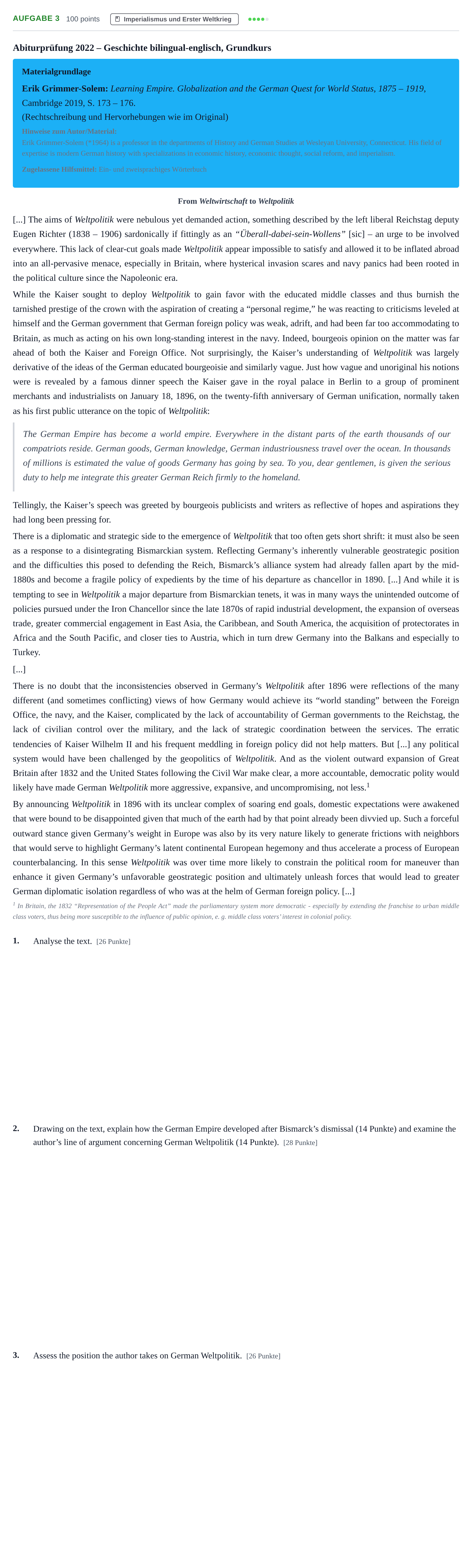
From Weltwirtschaft to Weltpolitik
[...] The aims of Weltpolitik were nebulous yet demanded action, something described by the left liberal Reichstag deputy Eugen Richter (1838 – 1906) sardonically if fittingly as an “Überall-dabei-sein-Wollens” [sic] – an urge to be involved everywhere. This lack of clear-cut goals made Weltpolitik appear impossible to satisfy and allowed it to be inflated abroad into an all-pervasive menace, especially in Britain, where hysterical invasion scares and navy panics had been rooted in the political culture since the Napoleonic era.
While the Kaiser sought to deploy Weltpolitik to gain favor with the educated middle classes and thus burnish the tarnished prestige of the crown with the aspiration of creating a “personal regime,” he was reacting to criticisms leveled at himself and the German government that German foreign policy was weak, adrift, and had been far too accommodating to Britain, as much as acting on his own long-standing interest in the navy. Indeed, bourgeois opinion on the matter was far ahead of both the Kaiser and Foreign Office. Not surprisingly, the Kaiser’s understanding of Weltpolitik was largely derivative of the ideas of the German educated bourgeoisie and similarly vague. Just how vague and unoriginal his notions were is revealed by a famous dinner speech the Kaiser gave in the royal palace in Berlin to a group of prominent merchants and industrialists on January 18, 1896, on the twenty-fifth anniversary of German unification, normally taken as his first public utterance on the topic of Weltpolitik:
The German Empire has become a world empire. Everywhere in the distant parts of the earth thousands of our compatriots reside. German goods, German knowledge, German industriousness travel over the ocean. In thousands of millions is estimated the value of goods Germany has going by sea. To you, dear gentlemen, is given the serious duty to help me integrate this greater German Reich firmly to the homeland.
Tellingly, the Kaiser’s speech was greeted by bourgeois publicists and writers as reflective of hopes and aspirations they had long been pressing for.
There is a diplomatic and strategic side to the emergence of Weltpolitik that too often gets short shrift: it must also be seen as a response to a disintegrating Bismarckian system. Reflecting Germany’s inherently vulnerable geostrategic position and the difficulties this posed to defending the Reich, Bismarck’s alliance system had already fallen apart by the mid-1880s and become a fragile policy of expedients by the time of his departure as chancellor in 1890. [...] And while it is tempting to see in Weltpolitik a major departure from Bismarckian tenets, it was in many ways the unintended outcome of policies pursued under the Iron Chancellor since the late 1870s of rapid industrial development, the expansion of overseas trade, greater commercial engagement in East Asia, the Caribbean, and South America, the acquisition of protectorates in Africa and the South Pacific, and closer ties to Austria, which in turn drew Germany into the Balkans and especially to Turkey.
[...]
There is no doubt that the inconsistencies observed in Germany’s Weltpolitik after 1896 were reflections of the many different (and sometimes conflicting) views of how Germany would achieve its “world standing” between the Foreign Office, the navy, and the Kaiser, complicated by the lack of accountability of German governments to the Reichstag, the lack of civilian control over the military, and the lack of strategic coordination between the services. The erratic tendencies of Kaiser Wilhelm II and his frequent meddling in foreign policy did not help matters. But [...] any political system would have been challenged by the geopolitics of Weltpolitik. And as the violent outward expansion of Great Britain after 1832 and the United States following the Civil War make clear, a more accountable, democratic polity would likely have made German Weltpolitik more aggressive, expansive, and uncompromising, not less. 1
By announcing Weltpolitik in 1896 with its unclear complex of soaring end goals, domestic expectations were awakened that were bound to be disappointed given that much of the earth had by that point already been divvied up. Such a forceful outward stance given Germany’s weight in Europe was also by its very nature likely to generate frictions with neighbors that would serve to highlight Germany’s latent continental European hegemony and thus accelerate a process of European counterbalancing. In this sense Weltpolitik was over time more likely to constrain the political room for maneuver than enhance it given Germany’s unfavorable geostrategic position and ultimately unleash forces that would lead to greater German diplomatic isolation regardless of who was at the helm of German foreign policy. [...]
1 In Britain, the 1832 “Representation of the People Act” made the parliamentary system more democratic - especially by extending the franchise to urban middle class voters, thus being more susceptible to the influence of public opinion, e. g. middle class voters’ interest in colonial policy.
1.
Analyse the text. [26 Punkte]
2.
Drawing on the text, explain how the German Empire developed after Bismarck’s dismissal (14 Punkte) and examine the author’s line of argument concerning German Weltpolitik (14 Punkte). [28 Punkte]
3.
Assess the position the author takes on German Weltpolitik. [26 Punkte]
Lösung
Nach den offiziellen Korrekturhinweisen
1. Analyse the text. [26 Punkte]
Lösung: Individuelle Ausarbeitung entsprechend den Kriterien der Analyse einer historischen Darstellung.
2. Drawing on the text, explain how the German Empire developed after Bismarck’s dismissal (14 Punkte) and examine the author’s line of argument concerning German Weltpolitik (14 Punkte). [28 Punkte]
Lösung: Individuelle Ausarbeitung zur historischen Kontextualisierung sowie zur Argumentationsanalyse.
3. Assess the position the author takes on German Weltpolitik. [26 Punkte]
Lösung: Individuelle historische Urteilsbildung unter Abwägung von Stärken und Schwächen der Thesen Grimmer-Solems.
Die ausführliche Erklärung Schritt für Schritt (mit KI) gibt es mit Premium. Premium
Löse sie direkt hier: automatische Korrektur, Hinweise und Lösung Schritt für Schritt.
‹ Aufgabe 1 · LK · Haupttermin 2023 · Aufgabe 1 · GK · Haupttermin · bilingual Französisch 2022 ›
Mehr Aufgaben zu Imperialismus und Erster Weltkrieg
- Aufgabe 3 · GK · Haupttermin · bilingual Englisch 2023
- Aufgabe HT 1 · GK · Haupttermin · bilingual Französisch 2023
- Aufgabe 1 (GE GK NT 1) · GK · Nachtermin 2023
- Aufgabe 1 · GK · Nachtermin · bilingual Englisch 2023
- Aufgabe 1 · LK · Haupttermin 2023
- Aufgabe 1 · GK · Haupttermin · bilingual Französisch 2022
- Aufgabe 3 · GK · Nachtermin 2022
- Aufgabe NT 3 · GK · Nachtermin · bilingual Englisch 2022
- Aufgabe 4 · LK · Nachtermin 2022
- Aufgabe GE BIL E GK HT 1 · GK · Haupttermin · bilingual Englisch 2021