Aufgabe NT 3 · Abitur NRW Geschichte GK · Nachtermin · bilingual Englisch 2022
Thema: Imperialismus und Erster Weltkrieg · Aus der Prüfung GK · Nachtermin · bilingual Englisch (2022)
Aufgabenstellung
Abiturprüfung 2022 – Geschichte bilingual-englisch, Grundkurs
Aufgabenstellung:
Materialgrundlage:
John Darwin: Unfinished Empire. The global expansion of Britain, London 2013, S. 327 – 330.
(Rechtschreibung und Hervorhebungen wie im Original)
Hinweise zum Autor:
John Darwin (born 1948): a renowned British historian specialising in the history of the British Empire. He teaches at the universities of Reading and Oxford.
DEFENDING EMPIRE: THE ‘BRITISH PEACE’, 1815 – 1914
[...]
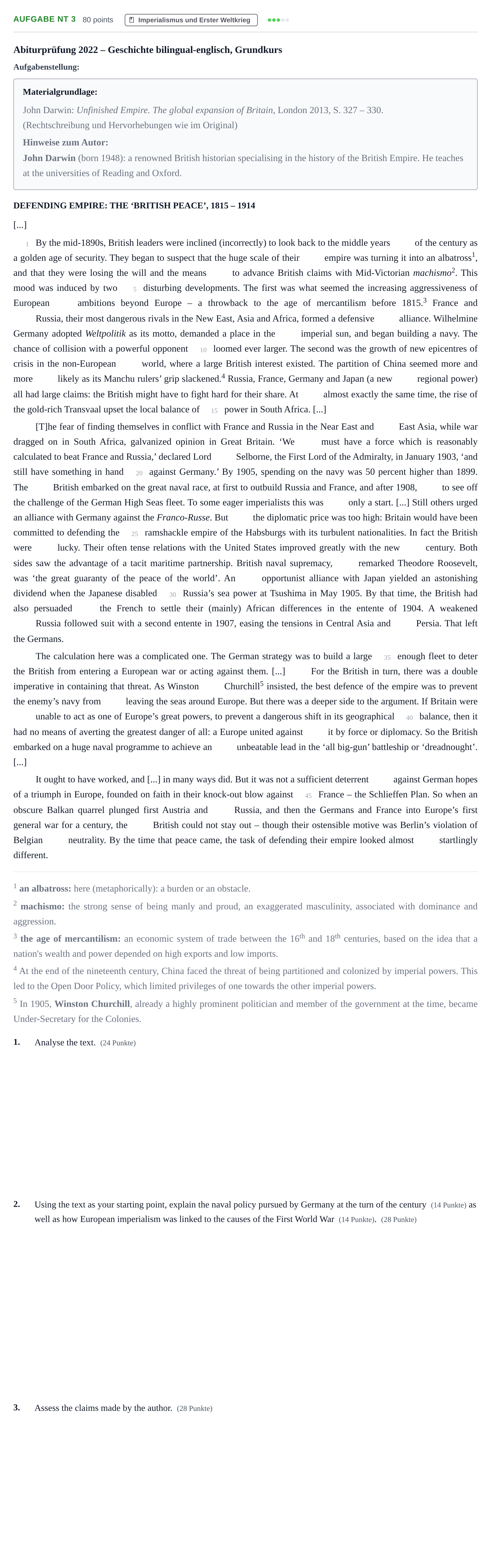
1 By the mid-1890s, British leaders were inclined (incorrectly) to look back to the middle years
of the century as a golden age of security. They began to suspect that the huge scale of their
empire was turning it into an albatross 1, and that they were losing the will and the means
to advance British claims with Mid-Victorian machismo 2. This mood was induced by two
5 disturbing developments. The first was what seemed the increasing aggressiveness of European
ambitions beyond Europe – a throwback to the age of mercantilism before 1815. 3 France and
Russia, their most dangerous rivals in the New East, Asia and Africa, formed a defensive
alliance. Wilhelmine Germany adopted Weltpolitik as its motto, demanded a place in the
imperial sun, and began building a navy. The chance of collision with a powerful opponent
10 loomed ever larger. The second was the growth of new epicentres of crisis in the non-European
world, where a large British interest existed. The partition of China seemed more and more
likely as its Manchu rulers’ grip slackened. 4 Russia, France, Germany and Japan (a new
regional power) all had large claims: the British might have to fight hard for their share. At
almost exactly the same time, the rise of the gold-rich Transvaal upset the local balance of
15 power in South Africa. [...]
[T]he fear of finding themselves in conflict with France and Russia in the Near East and
East Asia, while war dragged on in South Africa, galvanized opinion in Great Britain. ‘We
must have a force which is reasonably calculated to beat France and Russia,’ declared Lord
Selborne, the First Lord of the Admiralty, in January 1903, ‘and still have something in hand
20 against Germany.’ By 1905, spending on the navy was 50 percent higher than 1899. The
British embarked on the great naval race, at first to outbuild Russia and France, and after 1908,
to see off the challenge of the German High Seas fleet. To some eager imperialists this was
only a start. [...] Still others urged an alliance with Germany against the Franco-Russe. But
the diplomatic price was too high: Britain would have been committed to defending the
25 ramshackle empire of the Habsburgs with its turbulent nationalities. In fact the British were
lucky. Their often tense relations with the United States improved greatly with the new
century. Both sides saw the advantage of a tacit maritime partnership. British naval supremacy,
remarked Theodore Roosevelt, was ‘the great guaranty of the peace of the world’. An
opportunist alliance with Japan yielded an astonishing dividend when the Japanese disabled
30 Russia’s sea power at Tsushima in May 1905. By that time, the British had also persuaded
the French to settle their (mainly) African differences in the entente of 1904. A weakened
Russia followed suit with a second entente in 1907, easing the tensions in Central Asia and
Persia. That left the Germans.
The calculation here was a complicated one. The German strategy was to build a large
35 enough fleet to deter the British from entering a European war or acting against them. [...]
For the British in turn, there was a double imperative in containing that threat. As Winston
Churchill 5 insisted, the best defence of the empire was to prevent the enemy’s navy from
leaving the seas around Europe. But there was a deeper side to the argument. If Britain were
unable to act as one of Europe’s great powers, to prevent a dangerous shift in its geographical
40 balance, then it had no means of averting the greatest danger of all: a Europe united against
it by force or diplomacy. So the British embarked on a huge naval programme to achieve an
unbeatable lead in the ‘all big-gun’ battleship or ‘dreadnought’. [...]
It ought to have worked, and [...] in many ways did. But it was not a sufficient deterrent
against German hopes of a triumph in Europe, founded on faith in their knock-out blow against
45 France – the Schlieffen Plan. So when an obscure Balkan quarrel plunged first Austria and
Russia, and then the Germans and France into Europe’s first general war for a century, the
British could not stay out – though their ostensible motive was Berlin’s violation of Belgian
neutrality. By the time that peace came, the task of defending their empire looked almost
startlingly different.
1 an albatross: here (metaphorically): a burden or an obstacle.
2 machismo: the strong sense of being manly and proud, an exaggerated masculinity, associated with dominance and aggression.
3 the age of mercantilism: an economic system of trade between the 16 th and 18 th centuries, based on the idea that a nation's wealth and power depended on high exports and low imports.
4 At the end of the nineteenth century, China faced the threat of being partitioned and colonized by imperial powers. This led to the Open Door Policy, which limited privileges of one towards the other imperial powers.
5 In 1905, Winston Churchill, already a highly prominent politician and member of the government at the time, became Under-Secretary for the Colonies.
1.
Analyse the text. (24 Punkte)
2.
Using the text as your starting point, explain the naval policy pursued by Germany at the turn of the century (14 Punkte) as well as how European imperialism was linked to the causes of the First World War (14 Punkte). (28 Punkte)
3.
Assess the claims made by the author. (28 Punkte)
Lösung
Nach den offiziellen Korrekturhinweisen
1. Analyse the text.
Lösung: Text analysis identifying the formal aspects and summarizing the main arguments.
2. Using the text as your starting point, explain the naval policy pursued by Germany at the turn of the century (14 Punkte) as well as how European imperialism was linked to the causes of the First World War (14 Punkte).
Lösung: Explanation of German naval policy and imperialist origins of the First World War.
3. Assess the claims made by the author.
Lösung: Critical assessment of John Darwin's thesis and perspective.
Die ausführliche Erklärung Schritt für Schritt (mit KI) gibt es mit Premium. Premium
Löse sie direkt hier: automatische Korrektur, Hinweise und Lösung Schritt für Schritt.
‹ Aufgabe 3 · GK · Nachtermin 2022 · Aufgabe 4 · LK · Nachtermin 2022 ›
Mehr Aufgaben zu Imperialismus und Erster Weltkrieg
- Aufgabe 1 · GK · Nachtermin · bilingual Englisch 2023
- Aufgabe 1 · LK · Haupttermin 2023
- Aufgabe 3 · GK · Haupttermin · bilingual Englisch 2022
- Aufgabe 1 · GK · Haupttermin · bilingual Französisch 2022
- Aufgabe 3 · GK · Nachtermin 2022
- Aufgabe 4 · LK · Nachtermin 2022
- Aufgabe GE BIL E GK HT 1 · GK · Haupttermin · bilingual Englisch 2021
- Aufgabe 1 · GK · Haupttermin · bilingual Französisch 2021
- Aufgabe 3 · GK · Nachtermin 2021
- Aufgabe 1 · GK · Nachtermin · bilingual Englisch 2021