Ejercicio Text 2 · Inglés PAU Andalucía Ordinaria Titular (Admisión) 2021
Tema: Comprensión Lectora · Del examen Ordinaria Titular (Admisión) (2021)
Enunciado
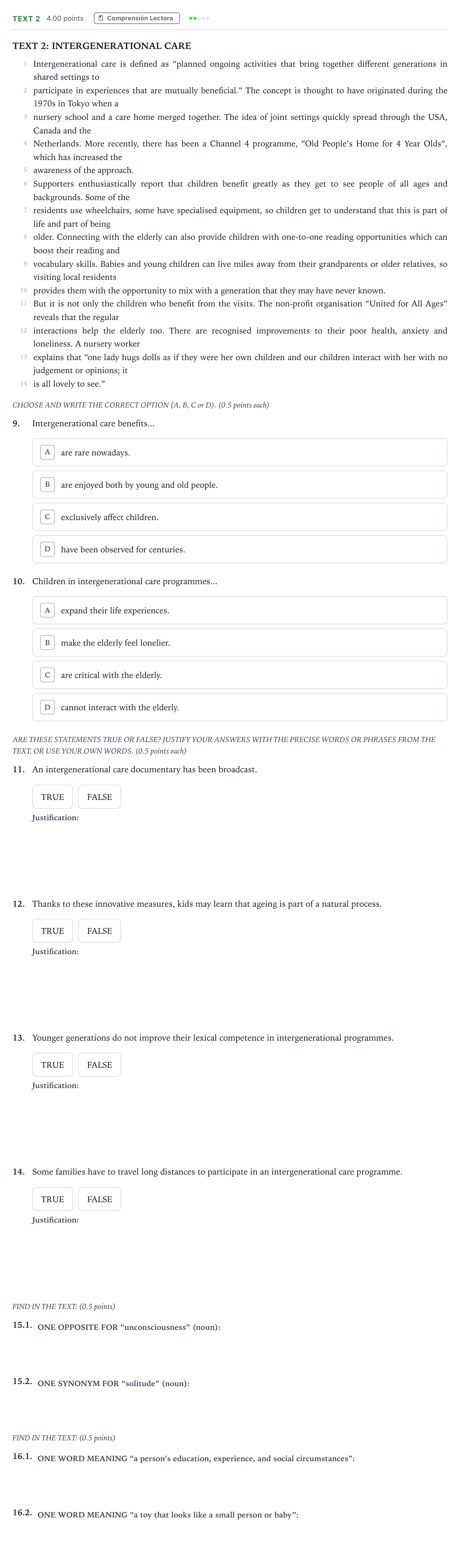
TEXT 2: INTERGENERATIONAL CARE
1 Intergenerational care is defined as “planned ongoing activities that bring together different generations in shared settings to
2 participate in experiences that are mutually beneficial.” The concept is thought to have originated during the 1970s in Tokyo when a
3 nursery school and a care home merged together. The idea of joint settings quickly spread through the USA, Canada and the
4 Netherlands. More recently, there has been a Channel 4 programme, “Old People’s Home for 4 Year Olds”, which has increased the
5 awareness of the approach.
6 Supporters enthusiastically report that children benefit greatly as they get to see people of all ages and backgrounds. Some of the
7 residents use wheelchairs, some have specialised equipment, so children get to understand that this is part of life and part of being
8 older. Connecting with the elderly can also provide children with one-to-one reading opportunities which can boost their reading and
9 vocabulary skills. Babies and young children can live miles away from their grandparents or older relatives, so visiting local residents
10 provides them with the opportunity to mix with a generation that they may have never known.
11 But it is not only the children who benefit from the visits. The non-profit organisation “United for All Ages” reveals that the regular
12 interactions help the elderly too. There are recognised improvements to their poor health, anxiety and loneliness. A nursery worker
13 explains that “one lady hugs dolls as if they were her own children and our children interact with her with no judgement or opinions; it
14 is all lovely to see.”
CHOOSE AND WRITE THE CORRECT OPTION (A, B, C or D). (0.5 points each)
9.
Intergenerational care benefits...
A
are rare nowadays.
B
are enjoyed both by young and old people.
C
exclusively affect children.
D
have been observed for centuries.
10.
Children in intergenerational care programmes...
A
expand their life experiences.
B
make the elderly feel lonelier.
C
are critical with the elderly.
D
cannot interact with the elderly.
ARE THESE STATEMENTS TRUE OR FALSE? JUSTIFY YOUR ANSWERS WITH THE PRECISE WORDS OR PHRASES FROM THE TEXT, OR USE YOUR OWN WORDS. (0.5 points each)
11.
An intergenerational care documentary has been broadcast.
TRUE
FALSE
12.
Thanks to these innovative measures, kids may learn that ageing is part of a natural process.
TRUE
FALSE
13.
Younger generations do not improve their lexical competence in intergenerational programmes.
TRUE
FALSE
14.
Some families have to travel long distances to participate in an intergenerational care programme.
TRUE
FALSE
FIND IN THE TEXT: (0.5 points)
15.1.
15.2.
FIND IN THE TEXT: (0.5 points)
16.1.
16.2.
Solución
Según los criterios oficiales de corrección
9. Intergenerational care benefits...
Solución: (b) are enjoyed both by young and old people.
10. Children in intergenerational care programmes...
Solución: (a) expand their life experiences.
11. An intergenerational care documentary has been broadcast.
Solución: TRUE: "More recently there has been a Channel 4 programme, 'Old People's Home for 4 Year Olds', (...the approach.)" (lines 4-5)
12. Thanks to these innovative measures, kids may learn that ageing is part of a natural process.
Solución: TRUE: "(Some of the residents use wheelchairs, some have specialised equipment, so) children get to understand that this is part of life and part of being older." (lines 7-8)
13. Younger generations do not improve their lexical competence in intergenerational programmes.
Solución: FALSE: "Connecting with the elderly can also provide children with one-to-one reading opportunities which can boost their reading and vocabulary skills." (lines 8-9)
14. Some families have to travel long distances to participate in an intergenerational care programme.
Solución: FALSE: "(Babies...) visiting local residents provides them with the opportunity to mix with a generation that they may have never known." (lines 9-10)
15.1. ONE OPPOSITE FOR “unconsciousness” (noun).
Solución: awareness
15.2. ONE SYNONYM FOR “solitude” (noun).
Solución: loneliness
16.1. ONE WORD MEANING “a person’s education, experience, and social circumstances”.
Solución: background / backgrounds
16.2. ONE WORD MEANING “a toy that looks like a small person or baby”.
Solución: doll / dolls
La explicación paso a paso, hecha con IA, es Premium. Premium
Resuélvelo aquí mismo: corrección automática, pistas y solución paso a paso.
‹ Ejercicio Text 1 · Ordinaria Titular (Admisión) 2021 · Bloque A - Text 1 · Examen E 2020 ›
Más ejercicios de Comprensión Lectora
- Bloque A - Text 1 · Ordinaria Suplente 2021
- Bloque A - Text 2 · Ordinaria Suplente 2021
- Bloque A - Texto 1 · Ordinaria Titular (Acceso) 2021
- Bloque A - Texto 2 · Ordinaria Titular (Acceso) 2021
- Ejercicio Text 1 · Ordinaria Titular (Admisión) 2021
- Bloque A - Text 1 · Examen E 2020
- Bloque A - Text 2 · Examen E 2020
- Bloque A - Text 1 · Examen F 2020
- Bloque A - Text 2 · Examen F 2020
- Ejercicio Text 1: Cult Films · Examen G 2020