Exercici 1 · Física I URV 2025
Tema: Oscil·lacions: harmòniques, esmorteïdes i forçades · Del examen Exam Physics (1st partial) - January 2025 (2025)
Enunciado
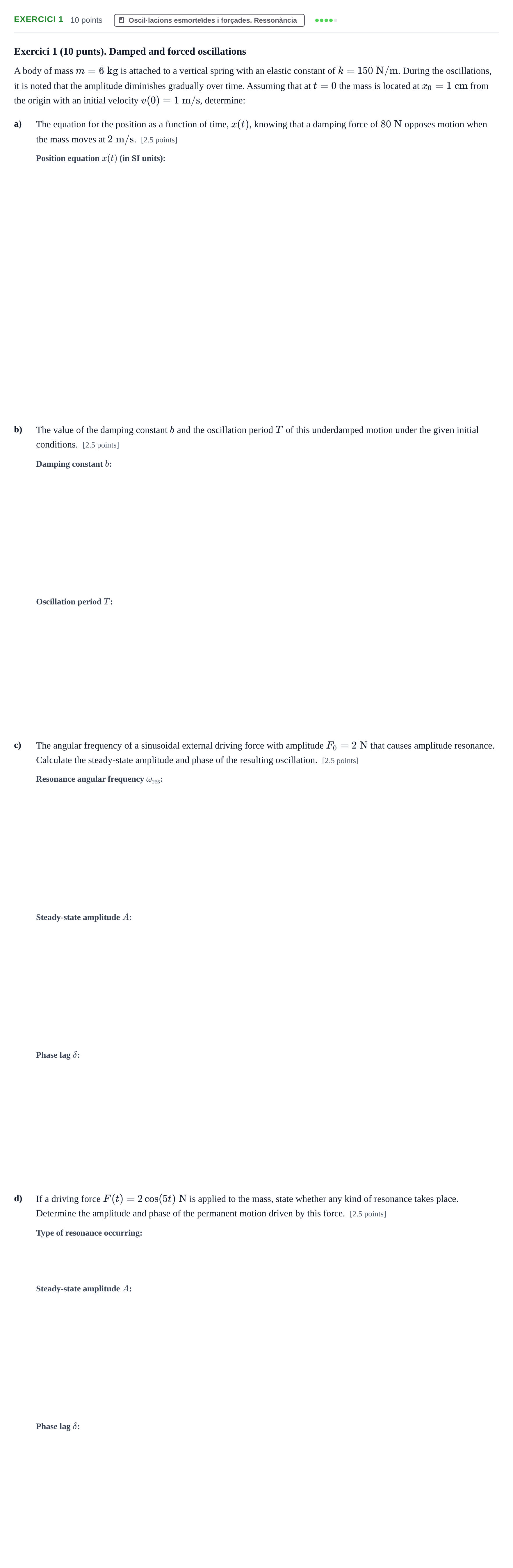
Exercici 1 (10 punts). Damped and forced oscillations
A body of mass is attached to a vertical spring with an elastic constant of . During the oscillations, it is noted that the amplitude diminishes gradually over time. Assuming that at the mass is located at from the origin with an initial velocity , determine:
a)
The equation for the position as a function of time, , knowing that a damping force of opposes motion when the mass moves at . [2.5 points]
b)
The value of the damping constant and the oscillation period of this underdamped motion under the given initial conditions. [2.5 points]
c)
The angular frequency of a sinusoidal external driving force with amplitude that causes amplitude resonance. Calculate the steady-state amplitude and phase of the resulting oscillation. [2.5 points]
d)
If a driving force is applied to the mass, state whether any kind of resonance takes place. Determine the amplitude and phase of the permanent motion driven by this force. [2.5 points]
Solución
Según los criterios oficiales de corrección
a. The equation for the position as a function of time, x(t)
Solución:
b. The value of the damping constant b
Solución: kg/s
b. The oscillation period T of this underdamped motion
Solución: s
c. The angular frequency of a sinusoidal external driving force with amplitude F0 = 2 N that causes amplitude resonance
Solución: rad/s
c. Calculate the steady-state amplitude of the resulting oscillation
Solución: m / cm
c. Calculate the phase of the resulting oscillation
Solución: rad
d. State whether any kind of resonance takes place
Solución: velocity resonance
d. Determine the amplitude of the permanent motion driven by this force
Solución: m / cm
d. Determine the phase of the permanent motion driven by this force
Solución: rad / rad
La explicación paso a paso, hecha con IA, es Premium. Premium
Resuélvelo aquí mismo: corrección automática, pistas y solución paso a paso.
Más ejercicios de Oscil·lacions: harmòniques, esmorteïdes i forçades
- Ejercicio Exercise 2 · 2024
- Ejercicio Exercise 2 · 2024
- Ejercicio Problem · 2023
- Ejercicio 1 - Problema (Prova 07/04/10) · 2021
- Ejercicio 4 - Problema (Oscil·lador) · 2021
- Ejercicio 5 - Problema (Oscil·lador esmorteït) · 2021
- Ejercicio 6 - P3. Oscil·lador harmònic simple · 2021
- Ejercicio 7 - P4. Oscil·lador esmorteït i forçat · 2021
- Ejercicio 8 - Problema (Prova 17/04/13) · 2021
- Ejercicio 9 - Problema P-D (Recuperació 2019-2020) · 2021