Aufgabe 1 · Abitur NRW Geschichte GK · Haupttermin · bilingual Englisch 2023
Thema: Friedliche Revolution 1989 und Wiedervereinigung · Aus der Prüfung GK · Haupttermin · bilingual Englisch (2023)
Aufgabenstellung
Aufgabenstellung:
1.
Analyse the text. (26 Punkte)
2.
Put the source into the historical setting of its time (14 Punkte) and present the “challenge and an opportunity of historic proportions” (ll. 54 f.) that Callaghan mentions in his speech (14 Punkte). (28 Punkte)
3.
Assess the views expressed by the author. (26 Punkte)
Materialgrundlage:
• Lord James Callaghan of Cardiff: Germany: Unification Prospect, Speech in the House of Lords on 17 th January 1990. (Rechtschreibung und Hervorhebungen wie im Original)
Hinweise zum Autor: Leonard James Callaghan, Baron Callaghan of Cardiff (1912 – 2005): a British Labour politician and Prime Minister of the United Kingdom (1976 – 1979). He was a member of Parliament (MP) from 1945 to 1987, subsequently being elevated to the House of Lords as a life peer.
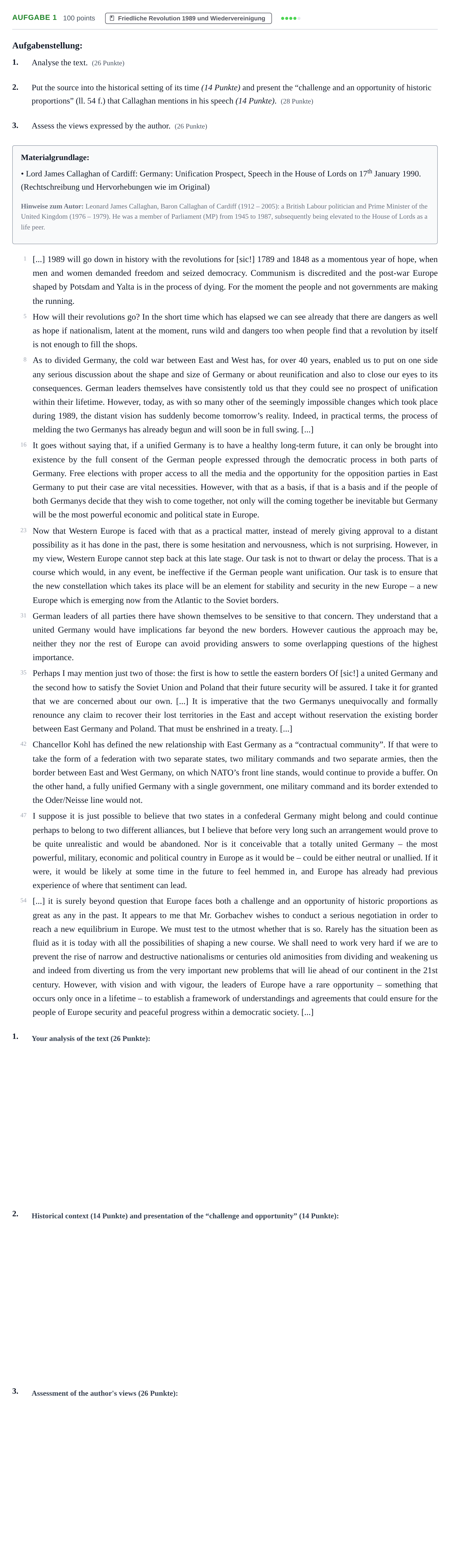
1 [...] 1989 will go down in history with the revolutions for [sic!] 1789 and 1848 as a momentous year of hope, when men and women demanded freedom and seized democracy. Communism is discredited and the post-war Europe shaped by Potsdam and Yalta is in the process of dying. For the moment the people and not governments are making the running.
5 How will their revolutions go? In the short time which has elapsed we can see already that there are dangers as well as hope if nationalism, latent at the moment, runs wild and dangers too when people find that a revolution by itself is not enough to fill the shops.
8 As to divided Germany, the cold war between East and West has, for over 40 years, enabled us to put on one side any serious discussion about the shape and size of Germany or about reunification and also to close our eyes to its consequences. German leaders themselves have consistently told us that they could see no prospect of unification within their lifetime. However, today, as with so many other of the seemingly impossible changes which took place during 1989, the distant vision has suddenly become tomorrow’s reality. Indeed, in practical terms, the process of melding the two Germanys has already begun and will soon be in full swing. [...]
16 It goes without saying that, if a unified Germany is to have a healthy long-term future, it can only be brought into existence by the full consent of the German people expressed through the democratic process in both parts of Germany. Free elections with proper access to all the media and the opportunity for the opposition parties in East Germany to put their case are vital necessities. However, with that as a basis, if that is a basis and if the people of both Germanys decide that they wish to come together, not only will the coming together be inevitable but Germany will be the most powerful economic and political state in Europe.
23 Now that Western Europe is faced with that as a practical matter, instead of merely giving approval to a distant possibility as it has done in the past, there is some hesitation and nervousness, which is not surprising. However, in my view, Western Europe cannot step back at this late stage. Our task is not to thwart or delay the process. That is a course which would, in any event, be ineffective if the German people want unification. Our task is to ensure that the new constellation which takes its place will be an element for stability and security in the new Europe – a new Europe which is emerging now from the Atlantic to the Soviet borders.
31 German leaders of all parties there have shown themselves to be sensitive to that concern. They understand that a united Germany would have implications far beyond the new borders. However cautious the approach may be, neither they nor the rest of Europe can avoid providing answers to some overlapping questions of the highest importance.
35 Perhaps I may mention just two of those: the first is how to settle the eastern borders Of [sic!] a united Germany and the second how to satisfy the Soviet Union and Poland that their future security will be assured. I take it for granted that we are concerned about our own. [...] It is imperative that the two Germanys unequivocally and formally renounce any claim to recover their lost territories in the East and accept without reservation the existing border between East Germany and Poland. That must be enshrined in a treaty. [...]
42 Chancellor Kohl has defined the new relationship with East Germany as a “contractual community”. If that were to take the form of a federation with two separate states, two military commands and two separate armies, then the border between East and West Germany, on which NATO’s front line stands, would continue to provide a buffer. On the other hand, a fully unified Germany with a single government, one military command and its border extended to the Oder/Neisse line would not.
47 I suppose it is just possible to believe that two states in a confederal Germany might belong and could continue perhaps to belong to two different alliances, but I believe that before very long such an arrangement would prove to be quite unrealistic and would be abandoned. Nor is it conceivable that a totally united Germany – the most powerful, military, economic and political country in Europe as it would be – could be either neutral or unallied. If it were, it would be likely at some time in the future to feel hemmed in, and Europe has already had previous experience of where that sentiment can lead.
54 [...] it is surely beyond question that Europe faces both a challenge and an opportunity of historic proportions as great as any in the past. It appears to me that Mr. Gorbachev wishes to conduct a serious negotiation in order to reach a new equilibrium in Europe. We must test to the utmost whether that is so. Rarely has the situation been as fluid as it is today with all the possibilities of shaping a new course. We shall need to work very hard if we are to prevent the rise of narrow and destructive nationalisms or centuries old animosities from dividing and weakening us and indeed from diverting us from the very important new problems that will lie ahead of our continent in the 21st century. However, with vision and with vigour, the leaders of Europe have a rare opportunity – something that occurs only once in a lifetime – to establish a framework of understandings and agreements that could ensure for the people of Europe security and peaceful progress within a democratic society. [...]
1.
2.
3.
Lösung
Nach den offiziellen Korrekturhinweisen
1. Analyse the text. (26 Punkte)
Lösung: Analysis covering formal categorization, historical-situational embedding, intention, and systematic reconstruction of content and argumentation.
2. Put the source into the historical setting of its time (14 Punkte) and present the “challenge and an opportunity of historic proportions” (ll. 54 f.) that Callaghan mentions in his speech (14 Punkte). (28 Punkte)
Lösung: Contextualization of the German reunification process and analysis of challenges and opportunities as formulated by Callaghan.
3. Assess the views expressed by the author. (26 Punkte)
Lösung: Critical assessment and historical judgement of Callaghan's views and his realistic yet optimistic stance in contrast to the official British government position.
Die ausführliche Erklärung Schritt für Schritt (mit KI) gibt es mit Premium. Premium
Löse sie direkt hier: automatische Korrektur, Hinweise und Lösung Schritt für Schritt.
‹ Aufgabe 1 · GK · Haupttermin 2023 · Aufgabe 3 (GE GK NT 3) · GK · Nachtermin 2023 ›
Mehr Aufgaben zu Friedliche Revolution 1989 und Wiedervereinigung
- Aufgabe 1 · GK · Haupttermin 2023
- Aufgabe 3 (GE GK NT 3) · GK · Nachtermin 2023
- Aufgabe 3 · GK · Nachtermin · bilingual Englisch 2023
- Aufgabe 3 · LK · Haupttermin 2023
- Aufgabe GE LK NT 3 · LK · Nachtermin 2023
- Aufgabe 2 · GK · Haupttermin 2022
- Aufgabe 2 · GK · Haupttermin · bilingual Englisch 2022
- Aufgabe 2 · GK · Haupttermin · bilingual Französisch 2022
- Aufgabe 4 · GK · Nachtermin 2022
- Aufgabe NT 4 · GK · Nachtermin · bilingual Englisch 2022