Aufgabe 3 · Abitur NRW Geschichte GK · Nachtermin · bilingual Englisch 2023
Thema: Friedliche Revolution 1989 und Wiedervereinigung · Aus der Prüfung GK · Nachtermin · bilingual Englisch (2023)
Aufgabenstellung
Abiturprüfung 2023 – Geschichte bilingual-englisch, Grundkurs
Aufgabenstellung:
1.
Analyse the source.
(26 Punkte)
2.
Using the text as your starting point, explain the historical references made to the Cold War and to German Unification (14 Punkte), and characterize how the self and the other are portrayed in this excerpt from Pompeo’s speech (14 Punkte).
(28 Punkte)
3.
Take a stance on what the author claims in the text.
(26 Punkte)
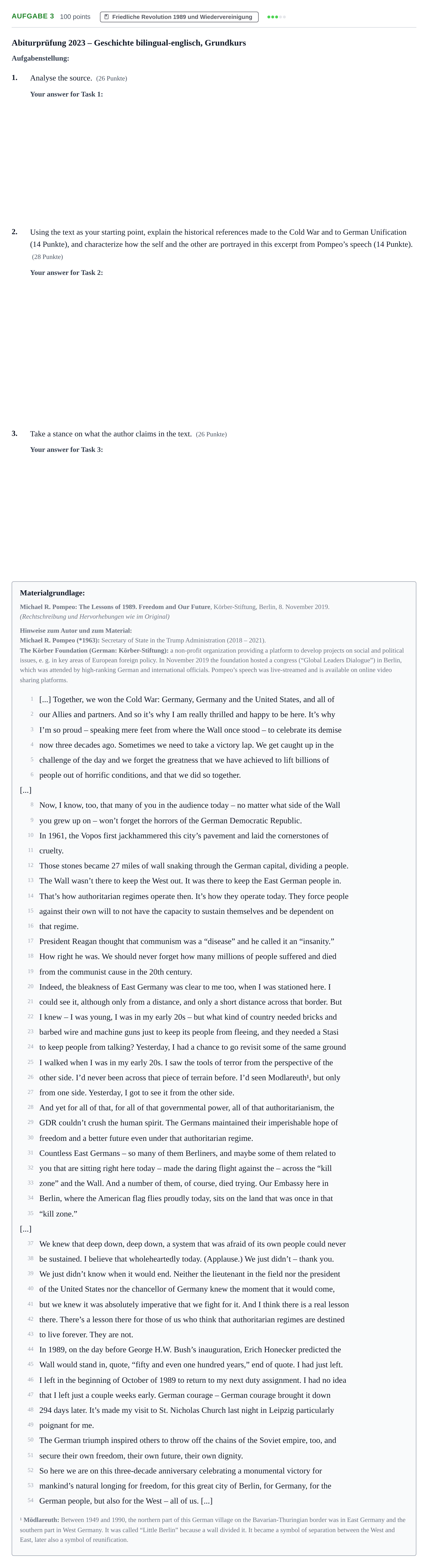
Materialgrundlage:
Michael R. Pompeo: The Lessons of 1989. Freedom and Our Future, Körber-Stiftung, Berlin, 8. November 2019.
(Rechtschreibung und Hervorhebungen wie im Original)
Hinweise zum Autor und zum Material:
Michael R. Pompeo (*1963): Secretary of State in the Trump Administration (2018 – 2021).
The Körber Foundation (German: Körber-Stiftung): a non-profit organization providing a platform to develop projects on social and political issues, e. g. in key areas of European foreign policy. In November 2019 the foundation hosted a congress (“Global Leaders Dialogue”) in Berlin, which was attended by high-ranking German and international officials. Pompeo’s speech was live-streamed and is available on online video sharing platforms.
1 [...] Together, we won the Cold War: Germany, Germany and the United States, and all of
2 our Allies and partners. And so it’s why I am really thrilled and happy to be here. It’s why
3 I’m so proud – speaking mere feet from where the Wall once stood – to celebrate its demise
4 now three decades ago. Sometimes we need to take a victory lap. We get caught up in the
5 challenge of the day and we forget the greatness that we have achieved to lift billions of
6 people out of horrific conditions, and that we did so together.
[...]
8 Now, I know, too, that many of you in the audience today – no matter what side of the Wall
9 you grew up on – won’t forget the horrors of the German Democratic Republic.
10 In 1961, the Vopos first jackhammered this city’s pavement and laid the cornerstones of
11 cruelty.
12 Those stones became 27 miles of wall snaking through the German capital, dividing a people.
13 The Wall wasn’t there to keep the West out. It was there to keep the East German people in.
14 That’s how authoritarian regimes operate then. It’s how they operate today. They force people
15 against their own will to not have the capacity to sustain themselves and be dependent on
16 that regime.
17 President Reagan thought that communism was a “disease” and he called it an “insanity.”
18 How right he was. We should never forget how many millions of people suffered and died
19 from the communist cause in the 20th century.
20 Indeed, the bleakness of East Germany was clear to me too, when I was stationed here. I
21 could see it, although only from a distance, and only a short distance across that border. But
22 I knew – I was young, I was in my early 20s – but what kind of country needed bricks and
23 barbed wire and machine guns just to keep its people from fleeing, and they needed a Stasi
24 to keep people from talking? Yesterday, I had a chance to go revisit some of the same ground
25 I walked when I was in my early 20s. I saw the tools of terror from the perspective of the
26 other side. I’d never been across that piece of terrain before. I’d seen Modlareuth¹, but only
27 from one side. Yesterday, I got to see it from the other side.
28 And yet for all of that, for all of that governmental power, all of that authoritarianism, the
29 GDR couldn’t crush the human spirit. The Germans maintained their imperishable hope of
30 freedom and a better future even under that authoritarian regime.
31 Countless East Germans – so many of them Berliners, and maybe some of them related to
32 you that are sitting right here today – made the daring flight against the – across the “kill
33 zone” and the Wall. And a number of them, of course, died trying. Our Embassy here in
34 Berlin, where the American flag flies proudly today, sits on the land that was once in that
35 “kill zone.”
[...]
37 We knew that deep down, deep down, a system that was afraid of its own people could never
38 be sustained. I believe that wholeheartedly today. (Applause.) We just didn’t – thank you.
39 We just didn’t know when it would end. Neither the lieutenant in the field nor the president
40 of the United States nor the chancellor of Germany knew the moment that it would come,
41 but we knew it was absolutely imperative that we fight for it. And I think there is a real lesson
42 there. There’s a lesson there for those of us who think that authoritarian regimes are destined
43 to live forever. They are not.
44 In 1989, on the day before George H.W. Bush’s inauguration, Erich Honecker predicted the
45 Wall would stand in, quote, “fifty and even one hundred years,” end of quote. I had just left.
46 I left in the beginning of October of 1989 to return to my next duty assignment. I had no idea
47 that I left just a couple weeks early. German courage – German courage brought it down
48 294 days later. It’s made my visit to St. Nicholas Church last night in Leipzig particularly
49 poignant for me.
50 The German triumph inspired others to throw off the chains of the Soviet empire, too, and
51 secure their own freedom, their own future, their own dignity.
52 So here we are on this three-decade anniversary celebrating a monumental victory for
53 mankind’s natural longing for freedom, for this great city of Berlin, for Germany, for the
54 German people, but also for the West – all of us. [...]
¹ Mödlareuth: Between 1949 and 1990, the northern part of this German village on the Bavarian-Thuringian border was in East Germany and the southern part in West Germany. It was called “Little Berlin” because a wall divided it. It became a symbol of separation between the West and East, later also a symbol of reunification.
Lösung
Nach den offiziellen Korrekturhinweisen
1. Analyse the source. (26 Punkte)
Lösung: Comprehensive textual analysis of the speech extract (formal introduction, thematic focus, author's intention, and main line of thought).
2. Using the text as your starting point, explain the historical references made to the Cold War and to German Unification (14 Punkte), and characterize how the self and the other are portrayed in this excerpt from Pompeo’s speech (14 Punkte). (28 Punkte)
Lösung: Historical contextualisation of Cold War and Unification aspects, followed by an analysis of the contrasting images of self (the West) and other (the East/GDR).
3. Take a stance on what the author claims in the text. (26 Punkte)
Lösung: Critical assessment and balanced discussion of Pompeo's arguments, culminating in a sound historical judgement.
Die ausführliche Erklärung Schritt für Schritt (mit KI) gibt es mit Premium. Premium
Löse sie direkt hier: automatische Korrektur, Hinweise und Lösung Schritt für Schritt.
‹ Aufgabe 3 (GE GK NT 3) · GK · Nachtermin 2023 · Aufgabe 3 · LK · Haupttermin 2023 ›
Mehr Aufgaben zu Friedliche Revolution 1989 und Wiedervereinigung
- Aufgabe 1 · GK · Haupttermin 2023
- Aufgabe 1 · GK · Haupttermin · bilingual Englisch 2023
- Aufgabe 3 (GE GK NT 3) · GK · Nachtermin 2023
- Aufgabe 3 · LK · Haupttermin 2023
- Aufgabe GE LK NT 3 · LK · Nachtermin 2023
- Aufgabe 2 · GK · Haupttermin 2022
- Aufgabe 2 · GK · Haupttermin · bilingual Englisch 2022
- Aufgabe 2 · GK · Haupttermin · bilingual Französisch 2022
- Aufgabe 4 · GK · Nachtermin 2022
- Aufgabe NT 4 · GK · Nachtermin · bilingual Englisch 2022