Aufgabe NT 4 · Abitur NRW Geschichte GK · Nachtermin · bilingual Englisch 2022
Thema: Friedliche Revolution 1989 und Wiedervereinigung · Aus der Prüfung GK · Nachtermin · bilingual Englisch (2022)
Aufgabenstellung
Abiturprüfung 2022 – Geschichte bilingual-englisch, Grundkurs
Aufgabenstellung:
1. Analyse the text. [26 Punkte]
2. Put the source into the historical context of the upheavals of 1989/90 (14 Punkte) and characterize how the author sees the “German revival” (title) (14 Punkte). [28 Punkte]
3. Take a critical stand on the views the author puts forward. [26 Punkte]
Materialgrundlage:
Charles Krauthammer: The German revival. In: The New Republic, Vol 202, Nr. 13, 26 March, 1990, S. 18 – 21.
Hinweise zum Autor/Material:
Charles Krauthammer (1950 – 2018): a renowned and award-winning American journalist and avid political commentator.
The New Republic: a weekly US magazine focusing on politics, contemporary culture, and the arts, founded in 1914.
Zugelassene Hilfsmittel: Ein- und zweisprachiges Wörterbuch
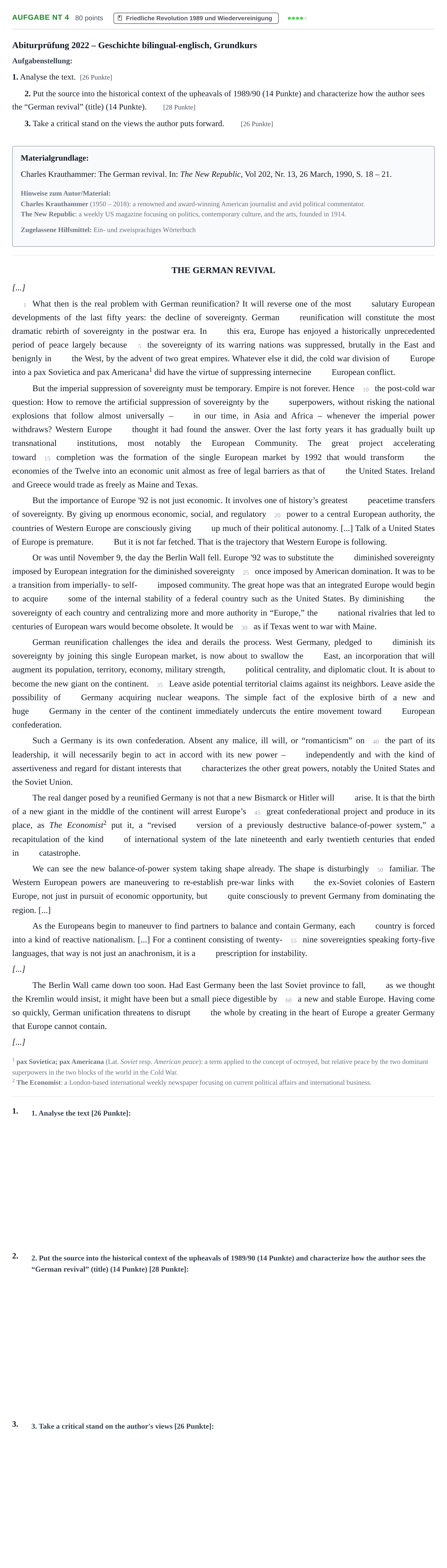
THE GERMAN REVIVAL
[...]
1 What then is the real problem with German reunification? It will reverse one of the most salutary European developments of the last fifty years: the decline of sovereignty. German reunification will constitute the most dramatic rebirth of sovereignty in the postwar era. In this era, Europe has enjoyed a historically unprecedented period of peace largely because 5 the sovereignty of its warring nations was suppressed, brutally in the East and benignly in the West, by the advent of two great empires. Whatever else it did, the cold war division of Europe into a pax Sovietica and pax Americana 1 did have the virtue of suppressing internecine European conflict.
But the imperial suppression of sovereignty must be temporary. Empire is not forever. Hence 10 the post-cold war question: How to remove the artificial suppression of sovereignty by the superpowers, without risking the national explosions that follow almost universally – in our time, in Asia and Africa – whenever the imperial power withdraws? Western Europe thought it had found the answer. Over the last forty years it has gradually built up transnational institutions, most notably the European Community. The great project accelerating toward 15 completion was the formation of the single European market by 1992 that would transform the economies of the Twelve into an economic unit almost as free of legal barriers as that of the United States. Ireland and Greece would trade as freely as Maine and Texas.
But the importance of Europe '92 is not just economic. It involves one of history’s greatest peacetime transfers of sovereignty. By giving up enormous economic, social, and regulatory 20 power to a central European authority, the countries of Western Europe are consciously giving up much of their political autonomy. [...] Talk of a United States of Europe is premature. But it is not far fetched. That is the trajectory that Western Europe is following.
Or was until November 9, the day the Berlin Wall fell. Europe '92 was to substitute the diminished sovereignty imposed by European integration for the diminished sovereignty 25 once imposed by American domination. It was to be a transition from imperially- to self- imposed community. The great hope was that an integrated Europe would begin to acquire some of the internal stability of a federal country such as the United States. By diminishing the sovereignty of each country and centralizing more and more authority in “Europe,” the national rivalries that led to centuries of European wars would become obsolete. It would be 30 as if Texas went to war with Maine.
German reunification challenges the idea and derails the process. West Germany, pledged to diminish its sovereignty by joining this single European market, is now about to swallow the East, an incorporation that will augment its population, territory, economy, military strength, political centrality, and diplomatic clout. It is about to become the new giant on the continent. 35 Leave aside potential territorial claims against its neighbors. Leave aside the possibility of Germany acquiring nuclear weapons. The simple fact of the explosive birth of a new and huge Germany in the center of the continent immediately undercuts the entire movement toward European confederation.
Such a Germany is its own confederation. Absent any malice, ill will, or “romanticism” on 40 the part of its leadership, it will necessarily begin to act in accord with its new power – independently and with the kind of assertiveness and regard for distant interests that characterizes the other great powers, notably the United States and the Soviet Union.
The real danger posed by a reunified Germany is not that a new Bismarck or Hitler will arise. It is that the birth of a new giant in the middle of the continent will arrest Europe’s 45 great confederational project and produce in its place, as The Economist 2 put it, a “revised version of a previously destructive balance-of-power system,” a recapitulation of the kind of international system of the late nineteenth and early twentieth centuries that ended in catastrophe.
We can see the new balance-of-power system taking shape already. The shape is disturbingly 50 familiar. The Western European powers are maneuvering to re-establish pre-war links with the ex-Soviet colonies of Eastern Europe, not just in pursuit of economic opportunity, but quite consciously to prevent Germany from dominating the region. [...]
As the Europeans begin to maneuver to find partners to balance and contain Germany, each country is forced into a kind of reactive nationalism. [...] For a continent consisting of twenty- 55 nine sovereignties speaking forty-five languages, that way is not just an anachronism, it is a prescription for instability.
[...]
The Berlin Wall came down too soon. Had East Germany been the last Soviet province to fall, as we thought the Kremlin would insist, it might have been but a small piece digestible by 60 a new and stable Europe. Having come so quickly, German unification threatens to disrupt the whole by creating in the heart of Europe a greater Germany that Europe cannot contain.
[...]
1 pax Sovietica; pax Americana (Lat. Soviet resp. American peace): a term applied to the concept of octroyed, but relative peace by the two dominant superpowers in the two blocks of the world in the Cold War.
2 The Economist: a London-based international weekly newspaper focusing on current political affairs and international business.
1.
2.
3.
Lösung
Nach den offiziellen Korrekturhinweisen
1. Analyse the text. (26 Punkte)
Lösung: Comprehensive textual analysis identifying formal elements (author, source type, date, addressees, topic, intention) and tracing Krauthammer's line of reasoning.
2. Put the source into the historical context of the upheavals of 1989/90 (14 Punkte) and characterize how the author sees the “German revival” (title) (14 Punkte). (28 Punkte)
Lösung: Historical contextualization of the peaceful revolution and reunification process 1989/90 alongside characterization of Krauthammer's perspective and rhetoric.
3. Assess the author's views critically. (26 Punkte)
Lösung: Differentiated historical judgement evaluating Krauthammer's warnings against the actual course of German and European integration.
Die ausführliche Erklärung Schritt für Schritt (mit KI) gibt es mit Premium. Premium
Löse sie direkt hier: automatische Korrektur, Hinweise und Lösung Schritt für Schritt.
‹ Aufgabe 4 · GK · Nachtermin 2022 · Aufgabe 4 · GK · Haupttermin 2021 ›
Mehr Aufgaben zu Friedliche Revolution 1989 und Wiedervereinigung
- Aufgabe GE LK NT 3 · LK · Nachtermin 2023
- Aufgabe 2 · GK · Haupttermin 2022
- Aufgabe 2 · GK · Haupttermin · bilingual Englisch 2022
- Aufgabe 2 · GK · Haupttermin · bilingual Französisch 2022
- Aufgabe 4 · GK · Nachtermin 2022
- Aufgabe 4 · GK · Haupttermin 2021
- Aufgabe GE BIL E GK HT 4 · GK · Haupttermin · bilingual Englisch 2021
- Aufgabe 3 · LK · Haupttermin 2021
- Aufgabe 4 (GE LK NT 4) · LK · Nachtermin 2021