Bloque A - Text 2 · Inglés PAU Andalucía Extraordinaria Titular (Admisión) 2023
Tema: Comprensión Lectora · Del examen Extraordinaria Titular (Admisión) (2023)
Enunciado
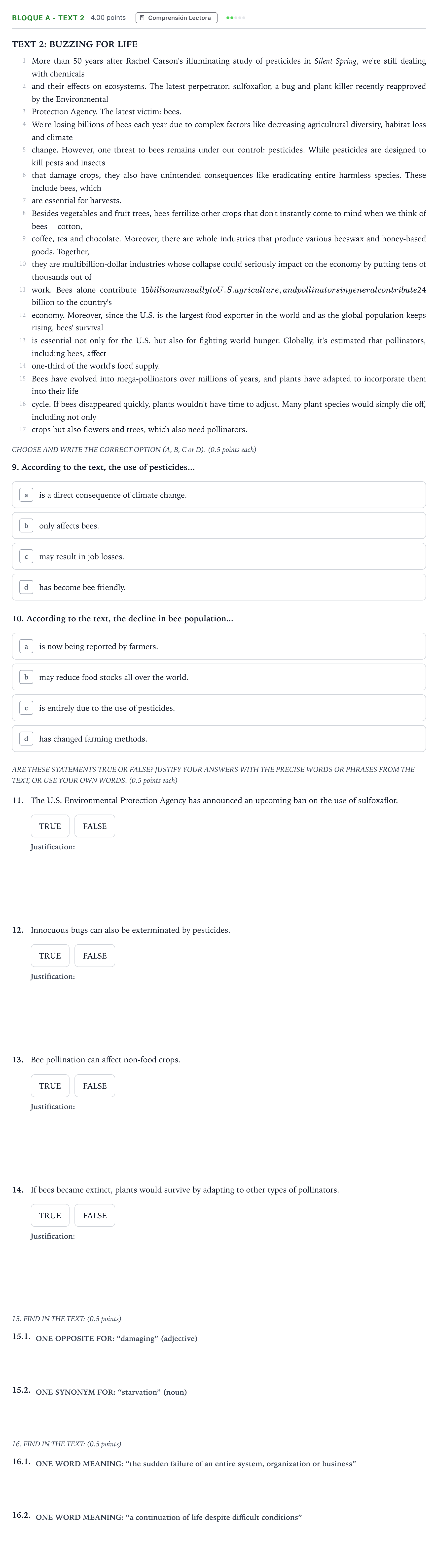
TEXT 2: BUZZING FOR LIFE
1 More than 50 years after Rachel Carson's illuminating study of pesticides in Silent Spring, we're still dealing with chemicals
2 and their effects on ecosystems. The latest perpetrator: sulfoxaflor, a bug and plant killer recently reapproved by the Environmental
3 Protection Agency. The latest victim: bees.
4 We're losing billions of bees each year due to complex factors like decreasing agricultural diversity, habitat loss and climate
5 change. However, one threat to bees remains under our control: pesticides. While pesticides are designed to kill pests and insects
6 that damage crops, they also have unintended consequences like eradicating entire harmless species. These include bees, which
7 are essential for harvests.
8 Besides vegetables and fruit trees, bees fertilize other crops that don't instantly come to mind when we think of bees —cotton,
9 coffee, tea and chocolate. Moreover, there are whole industries that produce various beeswax and honey-based goods. Together,
10 they are multibillion-dollar industries whose collapse could seriously impact on the economy by putting tens of thousands out of
11 work. Bees alone contribute 24 billion to the country's
12 economy. Moreover, since the U.S. is the largest food exporter in the world and as the global population keeps rising, bees' survival
13 is essential not only for the U.S. but also for fighting world hunger. Globally, it's estimated that pollinators, including bees, affect
14 one-third of the world's food supply.
15 Bees have evolved into mega-pollinators over millions of years, and plants have adapted to incorporate them into their life
16 cycle. If bees disappeared quickly, plants wouldn't have time to adjust. Many plant species would simply die off, including not only
17 crops but also flowers and trees, which also need pollinators.
CHOOSE AND WRITE THE CORRECT OPTION (A, B, C or D). (0.5 points each)
9. According to the text, the use of pesticides...
10. According to the text, the decline in bee population...
ARE THESE STATEMENTS TRUE OR FALSE? JUSTIFY YOUR ANSWERS WITH THE PRECISE WORDS OR PHRASES FROM THE TEXT, OR USE YOUR OWN WORDS. (0.5 points each)
11.
The U.S. Environmental Protection Agency has announced an upcoming ban on the use of sulfoxaflor.
TRUE
FALSE
12.
Innocuous bugs can also be exterminated by pesticides.
TRUE
FALSE
13.
Bee pollination can affect non-food crops.
TRUE
FALSE
14.
If bees became extinct, plants would survive by adapting to other types of pollinators.
TRUE
FALSE
15. FIND IN THE TEXT: (0.5 points)
15.1.
15.2.
16. FIND IN THE TEXT: (0.5 points)
16.1.
16.2.
Solución
Según los criterios oficiales de corrección
9. According to the text, the use of pesticides...
Solución: (c) may result in job losses.
10. According to the text, the decline in bee population...
Solución: (b) may reduce food stocks all over the world.
11. The U.S. Environmental Protection Agency has announced an upcoming ban on the use of sulfoxaflor.
Solución: FALSE
11. Justification:
Solución: "The latest perpetrator: sulfoxaflor, a bug and plant killer recently reapproved by the Environmental Protection Agency." (lines 2-3)
12. Innocuous bugs can also be exterminated by pesticides.
Solución: TRUE
12. Justification:
Solución: "(While pesticides are designed to kill pests and insects that damage crops,) they also have unintended consequences like eradicating entire harmless species." (line 6)
13. Bee pollination can affect non-food crops.
Solución: TRUE
13. Justification:
Solución: "(Besides vegetables and fruit trees,) bees fertilize other crops that don't instantly come to mind when we think of bees —cotton (, coffee, tea and chocolate)." (line 8)
14. If bees became extinct, plants would survive by adapting to other types of pollinators.
Solución: FALSE
14. Justification:
Solución: "If bees disappeared quickly, plants wouldn't have time to adjust. // Many plant species would simply die off (, including not only crops but also flowers and trees, which also need pollinators)." (line 16)
15.1. ONE OPPOSITE FOR: “damaging” (adjective)
Solución: harmless
15.2. ONE SYNONYM FOR: “starvation” (noun)
Solución: hunger
16.1. ONE WORD MEANING: “the sudden failure of an entire system, organization or business”
Solución: collapse
16.2. ONE WORD MEANING: “a continuation of life despite difficult conditions”
Solución: survival
La explicación paso a paso, hecha con IA, es Premium. Premium
Resuélvelo aquí mismo: corrección automática, pistas y solución paso a paso.
‹ Bloque A - Text 1 · Extraordinaria Titular (Admisión) 2023 · Bloque A - Texto 1 · Ordinaria Reserva 2023 ›
Más ejercicios de Comprensión Lectora
- Ejercicio Texto 1 · Extraordinaria Suplente 2023
- Ejercicio Texto 2 · Extraordinaria Suplente 2023
- Ejercicio Text 1 · Extraordinaria Titular (Acceso) 2023
- Ejercicio Text 2 · Extraordinaria Titular (Acceso) 2023
- Bloque A - Text 1 · Extraordinaria Titular (Admisión) 2023
- Bloque A - Texto 1 · Ordinaria Reserva 2023
- Bloque A - Texto 2 · Ordinaria Reserva 2023
- Bloque A - Text 1 · Ordinaria Suplente 2023
- Bloque A - Text 2 · Ordinaria Suplente 2023
- Ejercicio Texto 1: War Letters · Ordinaria Titular (Acceso) 2023