Aufgabe HT 2 · Abitur NRW Sozialwissenschaften GK · Haupttermin · bilingual Englisch 2022
Thema: Europäische Integration: Geschichte, Institutionen und Modelle · Aus der Prüfung GK · Haupttermin · bilingual Englisch (2022)
Aufgabenstellung
Vivien Schmidt
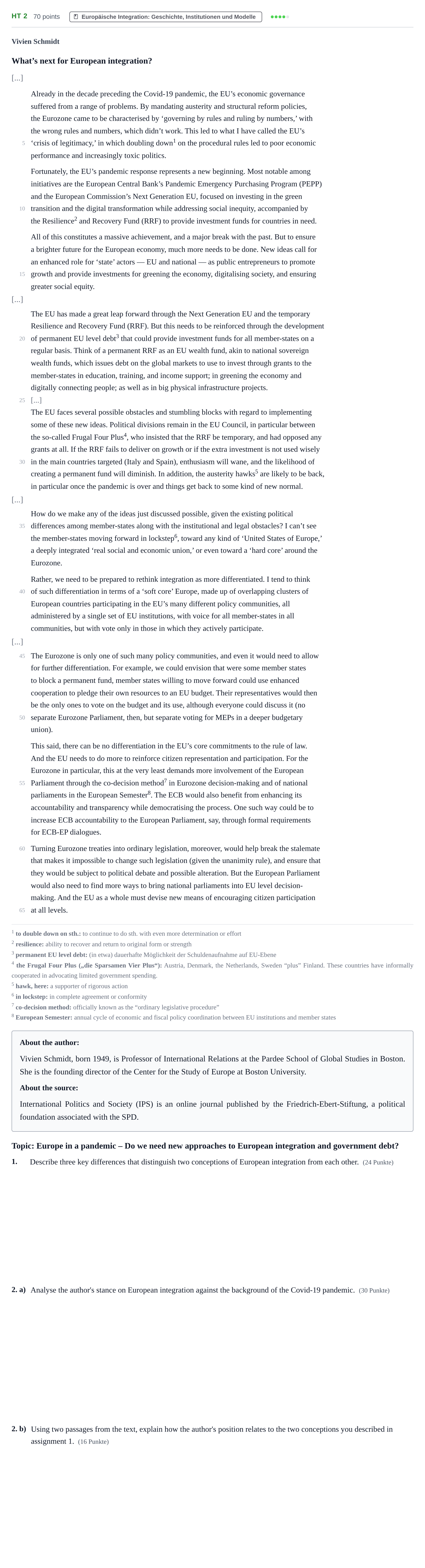
What’s next for European integration?
[...]
Already in the decade preceding the Covid-19 pandemic, the EU’s economic governance
suffered from a range of problems. By mandating austerity and structural reform policies,
the Eurozone came to be characterised by ‘governing by rules and ruling by numbers,’ with
the wrong rules and numbers, which didn’t work. This led to what I have called the EU’s
5 ‘crisis of legitimacy,’ in which doubling down 1 on the procedural rules led to poor economic
performance and increasingly toxic politics.
Fortunately, the EU’s pandemic response represents a new beginning. Most notable among
initiatives are the European Central Bank’s Pandemic Emergency Purchasing Program (PEPP)
and the European Commission’s Next Generation EU, focused on investing in the green
10 transition and the digital transformation while addressing social inequity, accompanied by
the Resilience 2 and Recovery Fund (RRF) to provide investment funds for countries in need.
All of this constitutes a massive achievement, and a major break with the past. But to ensure
a brighter future for the European economy, much more needs to be done. New ideas call for
an enhanced role for ‘state’ actors — EU and national — as public entrepreneurs to promote
15 growth and provide investments for greening the economy, digitalising society, and ensuring
greater social equity.
[...]
The EU has made a great leap forward through the Next Generation EU and the temporary
Resilience and Recovery Fund (RRF). But this needs to be reinforced through the development
20 of permanent EU level debt 3 that could provide investment funds for all member-states on a
regular basis. Think of a permanent RRF as an EU wealth fund, akin to national sovereign
wealth funds, which issues debt on the global markets to use to invest through grants to the
member-states in education, training, and income support; in greening the economy and
digitally connecting people; as well as in big physical infrastructure projects.
25 [...]
The EU faces several possible obstacles and stumbling blocks with regard to implementing
some of these new ideas. Political divisions remain in the EU Council, in particular between
the so-called Frugal Four Plus 4, who insisted that the RRF be temporary, and had opposed any
grants at all. If the RRF fails to deliver on growth or if the extra investment is not used wisely
30 in the main countries targeted (Italy and Spain), enthusiasm will wane, and the likelihood of
creating a permanent fund will diminish. In addition, the austerity hawks 5 are likely to be back,
in particular once the pandemic is over and things get back to some kind of new normal.
[...]
How do we make any of the ideas just discussed possible, given the existing political
35 differences among member-states along with the institutional and legal obstacles? I can’t see
the member-states moving forward in lockstep 6, toward any kind of ‘United States of Europe,’
a deeply integrated ‘real social and economic union,’ or even toward a ‘hard core’ around the
Eurozone.
Rather, we need to be prepared to rethink integration as more differentiated. I tend to think
40 of such differentiation in terms of a ‘soft core’ Europe, made up of overlapping clusters of
European countries participating in the EU’s many different policy communities, all
administered by a single set of EU institutions, with voice for all member-states in all
communities, but with vote only in those in which they actively participate.
[...]
45 The Eurozone is only one of such many policy communities, and even it would need to allow
for further differentiation. For example, we could envision that were some member states
to block a permanent fund, member states willing to move forward could use enhanced
cooperation to pledge their own resources to an EU budget. Their representatives would then
be the only ones to vote on the budget and its use, although everyone could discuss it (no
50 separate Eurozone Parliament, then, but separate voting for MEPs in a deeper budgetary
union).
This said, there can be no differentiation in the EU’s core commitments to the rule of law.
And the EU needs to do more to reinforce citizen representation and participation. For the
Eurozone in particular, this at the very least demands more involvement of the European
55 Parliament through the co-decision method 7 in Eurozone decision-making and of national
parliaments in the European Semester 8. The ECB would also benefit from enhancing its
accountability and transparency while democratising the process. One such way could be to
increase ECB accountability to the European Parliament, say, through formal requirements
for ECB-EP dialogues.
60 Turning Eurozone treaties into ordinary legislation, moreover, would help break the stalemate
that makes it impossible to change such legislation (given the unanimity rule), and ensure that
they would be subject to political debate and possible alteration. But the European Parliament
would also need to find more ways to bring national parliaments into EU level decision-
making. And the EU as a whole must devise new means of encouraging citizen participation
65 at all levels.
1 to double down on sth.: to continue to do sth. with even more determination or effort
2 resilience: ability to recover and return to original form or strength
3 permanent EU level debt: (in etwa) dauerhafte Möglichkeit der Schuldenaufnahme auf EU-Ebene
4 the Frugal Four Plus („die Sparsamen Vier Plus“): Austria, Denmark, the Netherlands, Sweden “plus” Finland. These countries have informally cooperated in advocating limited government spending.
5 hawk, here: a supporter of rigorous action
6 in lockstep: in complete agreement or conformity
7 co-decision method: officially known as the “ordinary legislative procedure”
8 European Semester: annual cycle of economic and fiscal policy coordination between EU institutions and member states
About the author:
Vivien Schmidt, born 1949, is Professor of International Relations at the Pardee School of Global Studies in Boston. She is the founding director of the Center for the Study of Europe at Boston University.
About the source:
International Politics and Society (IPS) is an online journal published by the Friedrich-Ebert-Stiftung, a political foundation associated with the SPD.
Topic: Europe in a pandemic – Do we need new approaches to European integration and government debt?
1.
Describe three key differences that distinguish two conceptions of European integration from each other. (24 Punkte)
2. a)
Analyse the author's stance on European integration against the background of the Covid-19 pandemic. (30 Punkte)
2. b)
Using two passages from the text, explain how the author's position relates to the two conceptions you described in assignment 1. (16 Punkte)
Lösung
Nach den offiziellen Korrekturhinweisen
1. Describe three key differences that distinguish two conceptions of European integration from each other.
Lösung: Individuelle Ausführung der Prüflinge entsprechend den Modellen der europäischen Integration (z. B. Föderalismus vs. Intergouvernementalismus).
2. a) Analyse the author's stance on European integration against the background of the Covid-19 pandemic.
Lösung: Strukturierte Analyse von Textart, Position, Begründungsgang, Argumentationsweise und Intention der Autorin.
2. b) Using two passages from the text, explain how the author's position relates to the two conceptions you described in assignment 1.
Lösung: Erklärung anhand zweier Textstellen zur Verknüpfung der Position der Autorin mit den gewählten Integrationsmodellen.
Die ausführliche Erklärung Schritt für Schritt (mit KI) gibt es mit Premium. Premium
Löse sie direkt hier: automatische Korrektur, Hinweise und Lösung Schritt für Schritt.
‹ Aufgabe HT 2 · GK · Haupttermin 2022 · Aufgabe HT 2 · LK · Haupttermin 2022 ›
Mehr Aufgaben zu Europäische Integration: Geschichte, Institutionen und Modelle
- Aufgabe HT 2 · GK · Haupttermin · Wirtschaft 2023
- Aufgabe 2 · LK · Nachtermin 2023
- Aufgabe NT 2 - 1 · LK · Nachtermin · Wirtschaft 2023
- Aufgabe NT 2 · LK · Nachtermin · Wirtschaft 2023
- Aufgabe HT 2 · GK · Haupttermin 2022
- Aufgabe HT 2 · LK · Haupttermin 2022
- Aufgabe 2 · LK · Haupttermin · Wirtschaft 2022
- Aufgabe 2 (SW LK NT 2) · LK · Nachtermin 2022
- Aufgabe 2 · LK · Nachtermin · Wirtschaft 2022
- Aufgabe 2 · GK · Haupttermin 2021