Aufgabe 1 · Abitur NRW Geschichte GK · Nachtermin · bilingual Englisch 2021
Thema: Imperialismus und Erster Weltkrieg · Aus der Prüfung GK · Nachtermin · bilingual Englisch (2021)
Aufgabenstellung
Abiturprüfung 2021 – Geschichte bilingual-englisch, Grundkurs
Aufgabenstellung:
1.
Analyse the source. (26 Punkte)
2.
Put the source into the broader context of imperialism (12 Punkte) and determine how the author views British rule (16 Punkte). (28 Punkte)
3.
Take a critical stand on what the author states. (26 Punkte)
Materialgrundlage:
Earl of Rosebery: Questions of Empire: A Rectorial Address Delivered before the Students of the University of Glasgow, November 16th, 1900, New York 1901, S. 9 – 35. (Rechtschreibung und Hervorhebungen wie im Original)
Hinweise zum Autor: Archibald Philip Primrose, 5 th Earl of Rosebery (1847 – 1929): prominent British Liberal politician who served a short term as Prime Minister of Great Britain (1894 – 1895). He gave the speech when he took up his post as rector of the University of Glasgow (1899 – 1902).
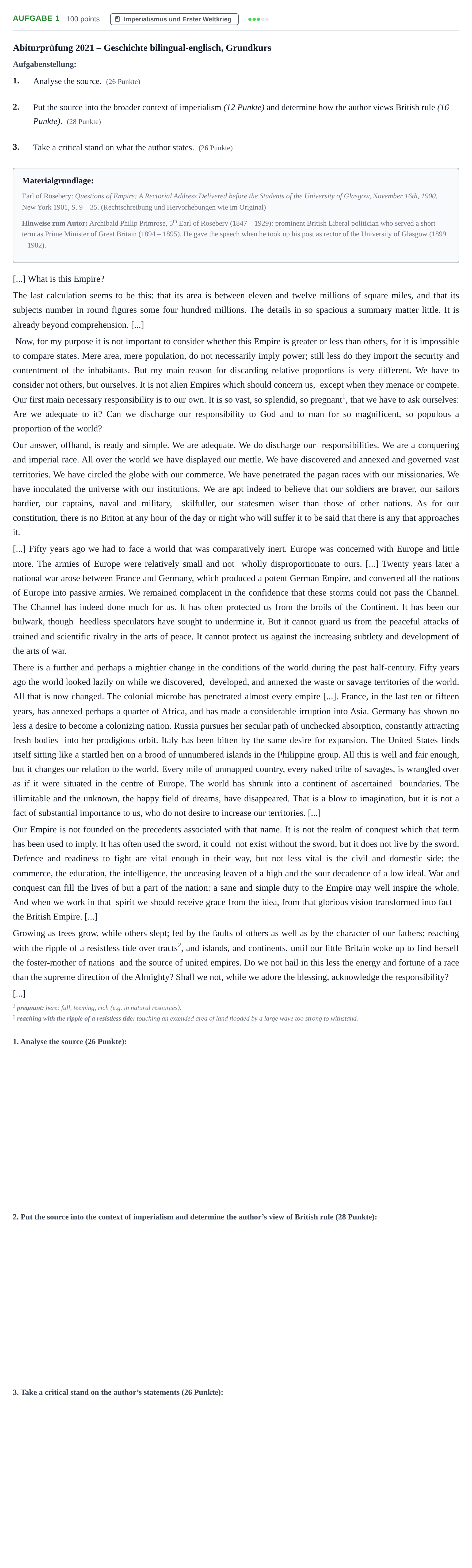
[...] What is this Empire?
The last calculation seems to be this: that its area is between eleven and twelve millions of square miles, and that its subjects number in round figures some four hundred millions. The details in so spacious a summary matter little. It is already beyond comprehension. [...]
5 Now, for my purpose it is not important to consider whether this Empire is greater or less than others, for it is impossible to compare states. Mere area, mere population, do not necessarily imply power; still less do they import the security and contentment of the inhabitants. But my main reason for discarding relative proportions is very different. We have to consider not others, but ourselves. It is not alien Empires which should concern us, 10 except when they menace or compete. Our first main necessary responsibility is to our own. It is so vast, so splendid, so pregnant 1, that we have to ask ourselves: Are we adequate to it? Can we discharge our responsibility to God and to man for so magnificent, so populous a proportion of the world?
Our answer, offhand, is ready and simple. We are adequate. We do discharge our 15 responsibilities. We are a conquering and imperial race. All over the world we have displayed our mettle. We have discovered and annexed and governed vast territories. We have circled the globe with our commerce. We have penetrated the pagan races with our missionaries. We have inoculated the universe with our institutions. We are apt indeed to believe that our soldiers are braver, our sailors hardier, our captains, naval and military, 20 skilfuller, our statesmen wiser than those of other nations. As for our constitution, there is no Briton at any hour of the day or night who will suffer it to be said that there is any that approaches it.
[...] Fifty years ago we had to face a world that was comparatively inert. Europe was concerned with Europe and little more. The armies of Europe were relatively small and not 25 wholly disproportionate to ours. [...] Twenty years later a national war arose between France and Germany, which produced a potent German Empire, and converted all the nations of Europe into passive armies. We remained complacent in the confidence that these storms could not pass the Channel. The Channel has indeed done much for us. It has often protected us from the broils of the Continent. It has been our bulwark, though 30 heedless speculators have sought to undermine it. But it cannot guard us from the peaceful attacks of trained and scientific rivalry in the arts of peace. It cannot protect us against the increasing subtlety and development of the arts of war.
There is a further and perhaps a mightier change in the conditions of the world during the past half-century. Fifty years ago the world looked lazily on while we discovered, 35 developed, and annexed the waste or savage territories of the world. All that is now changed. The colonial microbe has penetrated almost every empire [...]. France, in the last ten or fifteen years, has annexed perhaps a quarter of Africa, and has made a considerable irruption into Asia. Germany has shown no less a desire to become a colonizing nation. Russia pursues her secular path of unchecked absorption, constantly attracting fresh bodies 40 into her prodigious orbit. Italy has been bitten by the same desire for expansion. The United States finds itself sitting like a startled hen on a brood of unnumbered islands in the Philippine group. All this is well and fair enough, but it changes our relation to the world. Every mile of unmapped country, every naked tribe of savages, is wrangled over as if it were situated in the centre of Europe. The world has shrunk into a continent of ascertained 45 boundaries. The illimitable and the unknown, the happy field of dreams, have disappeared. That is a blow to imagination, but it is not a fact of substantial importance to us, who do not desire to increase our territories. [...]
Our Empire is not founded on the precedents associated with that name. It is not the realm of conquest which that term has been used to imply. It has often used the sword, it could 50 not exist without the sword, but it does not live by the sword. Defence and readiness to fight are vital enough in their way, but not less vital is the civil and domestic side: the commerce, the education, the intelligence, the unceasing leaven of a high and the sour decadence of a low ideal. War and conquest can fill the lives of but a part of the nation: a sane and simple duty to the Empire may well inspire the whole. And when we work in that 55 spirit we should receive grace from the idea, from that glorious vision transformed into fact – the British Empire. [...]
Growing as trees grow, while others slept; fed by the faults of others as well as by the character of our fathers; reaching with the ripple of a resistless tide over tracts 2, and islands, and continents, until our little Britain woke up to find herself the foster-mother of nations 60 and the source of united empires. Do we not hail in this less the energy and fortune of a race than the supreme direction of the Almighty? Shall we not, while we adore the blessing, acknowledge the responsibility?
[...]
1 pregnant: here: full, teeming, rich (e.g. in natural resources).
2 reaching with the ripple of a resistless tide: touching an extended area of land flooded by a large wave too strong to withstand.
Lösung
Nach den offiziellen Korrekturhinweisen
1. Analyse the source.
Lösung: Individuelle Schülerleistung gemäß den Vorgaben der Abiturprüfung.
2. Put the source into the broader context of imperialism (12 Punkte) and determine how the author views British rule (16 Punkte).
Lösung: Individuelle Schülerleistung gemäß den Vorgaben der Abiturprüfung.
3. Take a critical stand on what the author states.
Lösung: Individuelle Schülerleistung gemäß den Vorgaben der Abiturprüfung.
Die ausführliche Erklärung Schritt für Schritt (mit KI) gibt es mit Premium. Premium
Löse sie direkt hier: automatische Korrektur, Hinweise und Lösung Schritt für Schritt.
‹ Aufgabe 3 · GK · Nachtermin 2021 · Aufgabe 3 · GK · Nachtermin · bilingual Englisch 2021 ›