Part 2: Reading comprehension · Inglés Selectividad Cataluña Juny Serie 5 2024
Tema: Reading comprehension · Del examen Juny Serie 5 (2024)
Enunciado
Part 2: Reading comprehension
WHAT YOUR JEANS CAN (AND DO) HIDE
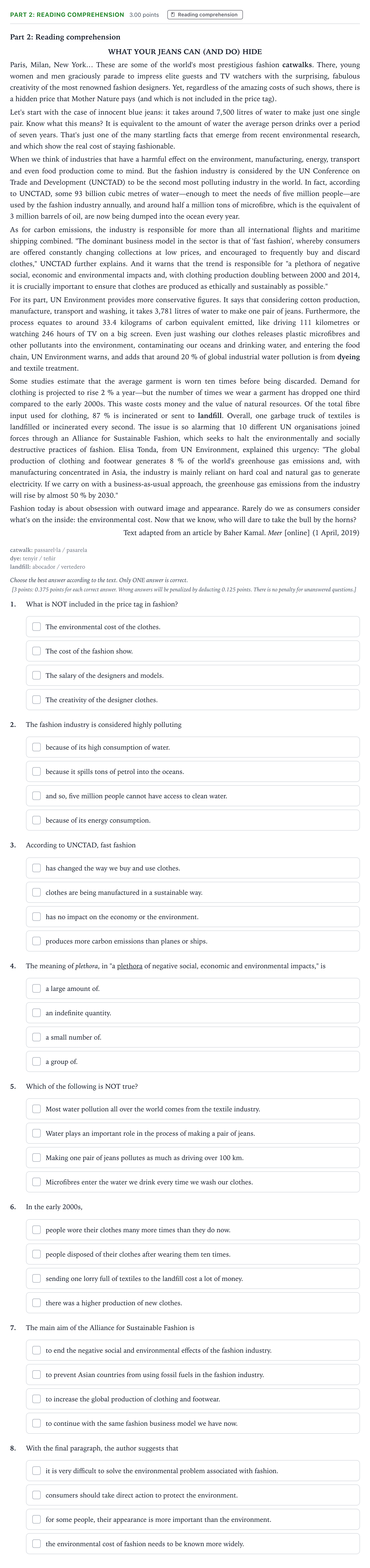
Paris, Milan, New York… These are some of the world's most prestigious fashion catwalks. There, young women and men graciously parade to impress elite guests and TV watchers with the surprising, fabulous creativity of the most renowned fashion designers. Yet, regardless of the amazing costs of such shows, there is a hidden price that Mother Nature pays (and which is not included in the price tag).
Let's start with the case of innocent blue jeans: it takes around 7,500 litres of water to make just one single pair. Know what this means? It is equivalent to the amount of water the average person drinks over a period of seven years. That's just one of the many startling facts that emerge from recent environmental research, and which show the real cost of staying fashionable.
When we think of industries that have a harmful effect on the environment, manufacturing, energy, transport and even food production come to mind. But the fashion industry is considered by the UN Conference on Trade and Development (UNCTAD) to be the second most polluting industry in the world. In fact, according to UNCTAD, some 93 billion cubic metres of water—enough to meet the needs of five million people—are used by the fashion industry annually, and around half a million tons of microfibre, which is the equivalent of 3 million barrels of oil, are now being dumped into the ocean every year.
As for carbon emissions, the industry is responsible for more than all international flights and maritime shipping combined. "The dominant business model in the sector is that of 'fast fashion', whereby consumers are offered constantly changing collections at low prices, and encouraged to frequently buy and discard clothes," UNCTAD further explains. And it warns that the trend is responsible for "a plethora of negative social, economic and environmental impacts and, with clothing production doubling between 2000 and 2014, it is crucially important to ensure that clothes are produced as ethically and sustainably as possible."
For its part, UN Environment provides more conservative figures. It says that considering cotton production, manufacture, transport and washing, it takes 3,781 litres of water to make one pair of jeans. Furthermore, the process equates to around 33.4 kilograms of carbon equivalent emitted, like driving 111 kilometres or watching 246 hours of TV on a big screen. Even just washing our clothes releases plastic microfibres and other pollutants into the environment, contaminating our oceans and drinking water, and entering the food chain, UN Environment warns, and adds that around 20 % of global industrial water pollution is from dyeing and textile treatment.
Some studies estimate that the average garment is worn ten times before being discarded. Demand for clothing is projected to rise 2 % a year—but the number of times we wear a garment has dropped one third compared to the early 2000s. This waste costs money and the value of natural resources. Of the total fibre input used for clothing, 87 % is incinerated or sent to landfill. Overall, one garbage truck of textiles is landfilled or incinerated every second. The issue is so alarming that 10 different UN organisations joined forces through an Alliance for Sustainable Fashion, which seeks to halt the environmentally and socially destructive practices of fashion. Elisa Tonda, from UN Environment, explained this urgency: "The global production of clothing and footwear generates 8 % of the world's greenhouse gas emissions and, with manufacturing concentrated in Asia, the industry is mainly reliant on hard coal and natural gas to generate electricity. If we carry on with a business-as-usual approach, the greenhouse gas emissions from the industry will rise by almost 50 % by 2030."
Fashion today is about obsession with outward image and appearance. Rarely do we as consumers consider what's on the inside: the environmental cost. Now that we know, who will dare to take the bull by the horns?
Text adapted from an article by Baher Kamal. Meer [online] (1 April, 2019)
catwalk: passarel·la / pasarela
dye: tenyir / teñir
landfill: abocador / vertedero
Choose the best answer according to the text. Only ONE answer is correct. [3 points: 0.375 points for each correct answer. Wrong answers will be penalized by deducting 0.125 points. There is no penalty for unanswered questions.]
.
Solución
Según los criterios oficiales de corrección
1. What is NOT included in the price tag in fashion?
Solución: The environmental cost of the clothes.
2. The fashion industry is considered highly polluting
Solución: because of its high consumption of water.
3. According to UNCTAD, fast fashion
Solución: has changed the way we buy and use clothes.
4. The meaning of plethora, in 'a plethora of negative social, economic and environmental impacts,' is
Solución: a large amount of.
5. Which of the following is NOT true?
Solución: Most water pollution all over the world comes from the textile industry.
6. In the early 2000s,
Solución: people wore their clothes many more times than they do now.
7. The main aim of the Alliance for Sustainable Fashion is
Solución: to end the negative social and environmental effects of the fashion industry.
8. With the final paragraph, the author suggests that
Solución: it is very difficult to solve the environmental problem associated with fashion.
La explicación paso a paso, hecha con IA, es Premium. Premium
Resuélvelo aquí mismo: corrección automática, pistas y solución paso a paso.
‹ Part 2: Reading comprehension · Juny Serie 1 2024 · Part 2: Reading comprehension · Setembre Serie 3 2024 ›
Más ejercicios de Reading comprehension
- Part 2: Reading comprehension · Setembre Serie 2 2026
- Part 2: Reading comprehension · Juny Serie 1 2025
- Part 2: Reading comprehension · Juny Serie 4 2025
- Part 2: Reading comprehension · Setembre Serie 3 2025
- Part 2: Reading comprehension · Juny Serie 1 2024
- Part 2: Reading comprehension · Setembre Serie 3 2024
- Part 2: Reading comprehension · Juny Serie 1 2023
- Part 2 · Juny Serie 5 2023
- Part 2: Reading comprehension · Setembre Serie 2 2023
- Part 2: Reading comprehension · Juliol Serie 2 2022
Exámenes oficiales en PDF y soluciones: examenselectivitat.cat