Part 2: Reading comprehension · Inglés Selectividad Cataluña Setembre Serie 2 2026
Tema: Reading comprehension · Del examen Setembre Serie 2 (2026)
Enunciado
Part 2: Reading comprehension
YOU MIGHT BE A LATE BLOOMER
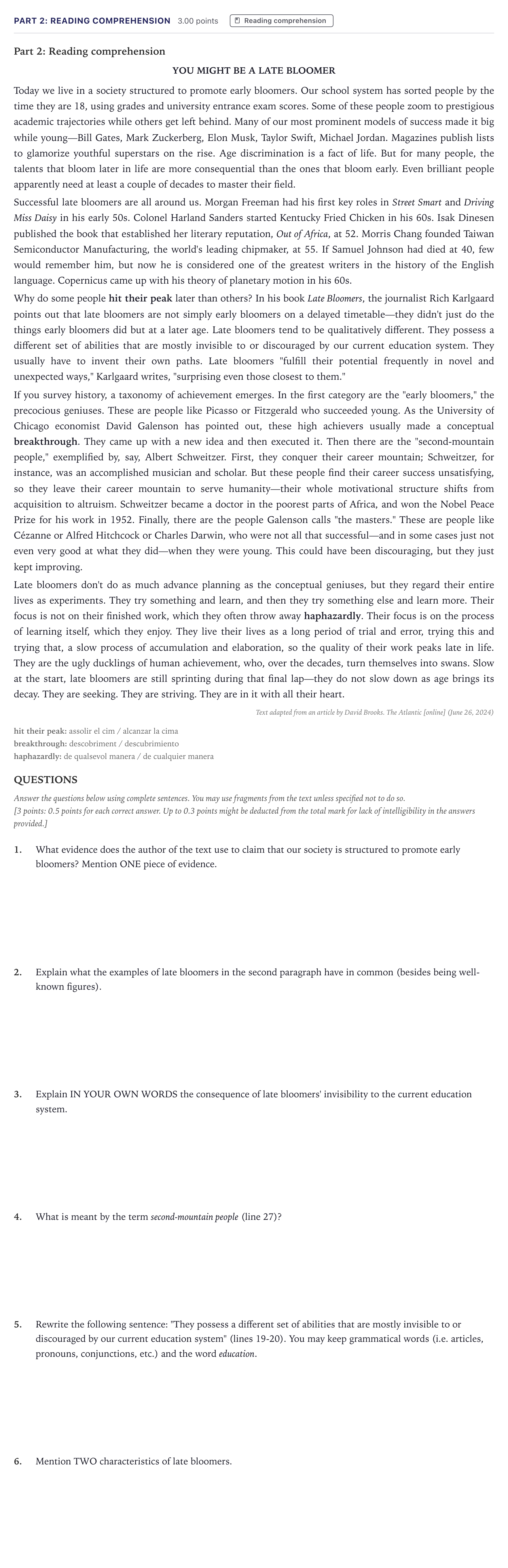
Today we live in a society structured to promote early bloomers. Our school system has sorted people by the time they are 18, using grades and university entrance exam scores. Some of these people zoom to prestigious academic trajectories while others get left behind. Many of our most prominent models of success made it big while young—Bill Gates, Mark Zuckerberg, Elon Musk, Taylor Swift, Michael Jordan. Magazines publish lists to glamorize youthful superstars on the rise. Age discrimination is a fact of life. But for many people, the talents that bloom later in life are more consequential than the ones that bloom early. Even brilliant people apparently need at least a couple of decades to master their field.
Successful late bloomers are all around us. Morgan Freeman had his first key roles in Street Smart and Driving Miss Daisy in his early 50s. Colonel Harland Sanders started Kentucky Fried Chicken in his 60s. Isak Dinesen published the book that established her literary reputation, Out of Africa, at 52. Morris Chang founded Taiwan Semiconductor Manufacturing, the world's leading chipmaker, at 55. If Samuel Johnson had died at 40, few would remember him, but now he is considered one of the greatest writers in the history of the English language. Copernicus came up with his theory of planetary motion in his 60s.
Why do some people hit their peak later than others? In his book Late Bloomers, the journalist Rich Karlgaard points out that late bloomers are not simply early bloomers on a delayed timetable—they didn't just do the things early bloomers did but at a later age. Late bloomers tend to be qualitatively different. They possess a different set of abilities that are mostly invisible to or discouraged by our current education system. They usually have to invent their own paths. Late bloomers "fulfill their potential frequently in novel and unexpected ways," Karlgaard writes, "surprising even those closest to them."
If you survey history, a taxonomy of achievement emerges. In the first category are the "early bloomers," the precocious geniuses. These are people like Picasso or Fitzgerald who succeeded young. As the University of Chicago economist David Galenson has pointed out, these high achievers usually made a conceptual breakthrough. They came up with a new idea and then executed it. Then there are the "second-mountain people," exemplified by, say, Albert Schweitzer. First, they conquer their career mountain; Schweitzer, for instance, was an accomplished musician and scholar. But these people find their career success unsatisfying, so they leave their career mountain to serve humanity—their whole motivational structure shifts from acquisition to altruism. Schweitzer became a doctor in the poorest parts of Africa, and won the Nobel Peace Prize for his work in 1952. Finally, there are the people Galenson calls "the masters." These are people like Cézanne or Alfred Hitchcock or Charles Darwin, who were not all that successful—and in some cases just not even very good at what they did—when they were young. This could have been discouraging, but they just kept improving.
Late bloomers don't do as much advance planning as the conceptual geniuses, but they regard their entire lives as experiments. They try something and learn, and then they try something else and learn more. Their focus is not on their finished work, which they often throw away haphazardly. Their focus is on the process of learning itself, which they enjoy. They live their lives as a long period of trial and error, trying this and trying that, a slow process of accumulation and elaboration, so the quality of their work peaks late in life. They are the ugly ducklings of human achievement, who, over the decades, turn themselves into swans. Slow at the start, late bloomers are still sprinting during that final lap—they do not slow down as age brings its decay. They are seeking. They are striving. They are in it with all their heart.
Text adapted from an article by David Brooks. The Atlantic [online] (June 26, 2024)
hit their peak: assolir el cim / alcanzar la cima
breakthrough: descobriment / descubrimiento
haphazardly: de qualsevol manera / de cualquier manera
QUESTIONS
Answer the questions below using complete sentences. You may use fragments from the text unless specified not to do so.
[3 points: 0.5 points for each correct answer. Up to 0.3 points might be deducted from the total mark for lack of intelligibility in the answers provided.]
1.
What evidence does the author of the text use to claim that our society is structured to promote early bloomers? Mention ONE piece of evidence.
2.
Explain what the examples of late bloomers in the second paragraph have in common (besides being well-known figures).
3.
Explain IN YOUR OWN WORDS the consequence of late bloomers' invisibility to the current education system.
4.
What is meant by the term second-mountain people (line 27)?
5.
Rewrite the following sentence: "They possess a different set of abilities that are mostly invisible to or discouraged by our current education system" (lines 19-20). You may keep grammatical words (i.e. articles, pronouns, conjunctions, etc.) and the word education.
6.
Mention TWO characteristics of late bloomers.
Solución
Según los criterios oficiales de corrección
1. What evidence does the author of the text use to claim that our society is structured to promote early bloomers? Mention ONE piece of evidence.
Solución: Our school system sorts people by the time they are 18. / Many models of success became successful when they were young. / Magazines publish lists of young superstars.
2. Explain what the examples of late bloomers in the second paragraph have in common (besides being well-known figures).
Solución: They are all people who became successful late in life.
3. Explain IN YOUR OWN WORDS the consequence of late bloomers' invisibility to the current education system.
Solución: Late bloomers accomplish success/live their lives/succeed in life/make progress (...) in ways that are different from the usual ones.
4. What is meant by the term second-mountain people (line 27)?
Solución: Second-mountain people conquer their career mountain first/succeed early in life but find their success unsatisfying and they leave their careers to serve humanity.
5. Rewrite the following sentence: "They possess a different set of abilities that are mostly invisible to or discouraged by our current education system" (lines 19-20). You may keep grammatical words (i.e. articles, pronouns, conjunctions, etc.) and the word education.
Solución: They have distinct characteristics that are not considered/seen/taken into account/encouraged by the present-day education authorities/laws.
6. Mention TWO characteristics of late bloomers.
Solución: Late bloomers do not plan ahead. / They regard their lives as experiments. / They focus on the process of learning. / They enjoy the process of learning. / They live their lives as a long period of trial and error. / They are slow at the start but fast as they age.
La explicación paso a paso, hecha con IA, es Premium. Premium
Resuélvelo aquí mismo: corrección automática, pistas y solución paso a paso.
‹ Part 2 · Juny Serie 5 2026 · Part 2: Reading comprehension · Juny Serie 1 2025 ›
Más ejercicios de Reading comprehension
- Part 2: Reading comprehension · Juny Serie 1 2026
- Part 2 · Juny Serie 5 2026
- Part 2: Reading comprehension · Juny Serie 1 2025
- Part 2: Reading comprehension · Juny Serie 4 2025
- Part 2: Reading comprehension · Setembre Serie 3 2025
- Part 2: Reading comprehension · Juny Serie 1 2024
- Part 2: Reading comprehension · Juny Serie 5 2024
- Part 2: Reading comprehension · Setembre Serie 3 2024
- Part 2: Reading comprehension · Juny Serie 1 2023
- Part 2 · Juny Serie 5 2023
Exámenes oficiales en PDF y soluciones: examenselectivitat.cat