Part 2: Reading comprehension · Inglés Selectividad Cataluña Juny Serie 4 2025
Tema: Reading comprehension · Del examen Juny Serie 4 (2025)
Enunciado
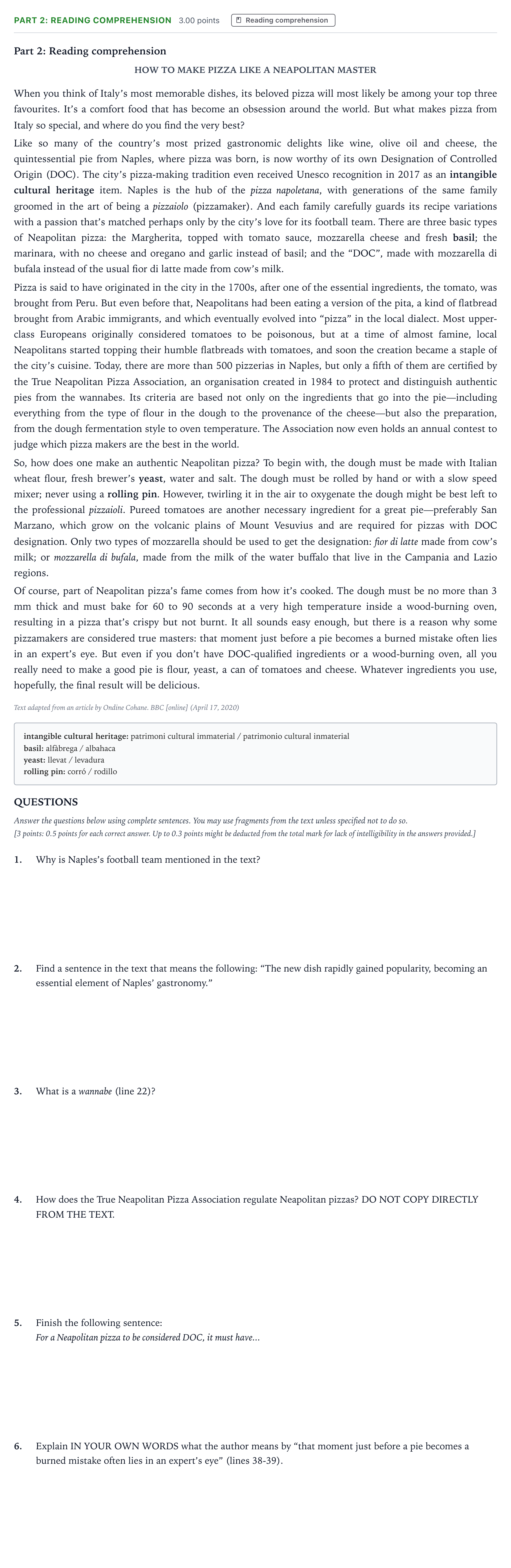
Part 2: Reading comprehension
HOW TO MAKE PIZZA LIKE A NEAPOLITAN MASTER
When you think of Italy’s most memorable dishes, its beloved pizza will most likely be among your top three favourites. It’s a comfort food that has become an obsession around the world. But what makes pizza from Italy so special, and where do you find the very best?
5 Like so many of the country’s most prized gastronomic delights like wine, olive oil and cheese, the quintessential pie from Naples, where pizza was born, is now worthy of its own Designation of Controlled Origin (DOC). The city’s pizza-making tradition even received Unesco recognition in 2017 as an intangible cultural heritage item. Naples is the hub of the pizza napoletana, with generations of the same family groomed in the art of being a pizzaiolo (pizzamaker). And each family carefully guards its recipe variations with a passion that’s 10 matched perhaps only by the city’s love for its football team. There are three basic types of Neapolitan pizza: the Margherita, topped with tomato sauce, mozzarella cheese and fresh basil; the marinara, with no cheese and oregano and garlic instead of basil; and the “DOC”, made with mozzarella di bufala instead of the usual fior di latte made from cow’s milk.
Pizza is said to have originated in the city in the 1700s, after one of the essential ingredients, 15 the tomato, was brought from Peru. But even before that, Neapolitans had been eating a version of the pita, a kind of flatbread brought from Arabic immigrants, and which eventually evolved into “pizza” in the local dialect. Most upper-class Europeans originally considered tomatoes to be poisonous, but at a time of almost famine, local Neapolitans started topping their humble flatbreads with tomatoes, and soon the creation became a staple of the city’s cuisine. Today, there 20 are more than 500 pizzerias in Naples, but only a fifth of them are certified by the True Neapolitan Pizza Association, an organisation created in 1984 to protect and distinguish authentic pies from the wannabes. Its criteria are based not only on the ingredients that go into the pie—including everything from the type of flour in the dough to the provenance of the cheese—but also the preparation, from the dough fermentation style to oven temperature. The Association now even 25 holds an annual contest to judge which pizza makers are the best in the world.
So, how does one make an authentic Neapolitan pizza? To begin with, the dough must be made with Italian wheat flour, fresh brewer’s yeast, water and salt. The dough must be rolled by hand or with a slow speed mixer; never using a rolling pin. However, twirling it in the air to oxygenate the dough might be best left to the professional pizzaioli. Pureed tomatoes are 30 another necessary ingredient for a great pie—preferably San Marzano, which grow on the volcanic plains of Mount Vesuvius and are required for pizzas with DOC designation. Only two types of mozzarella should be used to get the designation: fior di latte made from cow’s milk; or mozzarella di bufala, made from the milk of the water buffalo that live in the Campania and Lazio regions.
35 Of course, part of Neapolitan pizza’s fame comes from how it’s cooked. The dough must be no more than 3 mm thick and must bake for 60 to 90 seconds at a very high temperature inside a wood-burning oven, resulting in a pizza that’s crispy but not burnt. It all sounds easy enough, but there is a reason why some pizzamakers are considered true masters: that moment just before a pie becomes a burned mistake often lies in an expert’s eye. But even if you don’t 40 have DOC-qualified ingredients or a wood-burning oven, all you really need to make a good pie is flour, yeast, a can of tomatoes and cheese. Whatever ingredients you use, hopefully, the final result will be delicious.
Text adapted from an article by Ondine Cohane. BBC [online] (April 17, 2020)
intangible cultural heritage: patrimoni cultural immaterial / patrimonio cultural inmaterial
basil: alfàbrega / albahaca
yeast: llevat / levadura
rolling pin: corró / rodillo
QUESTIONS
Answer the questions below using complete sentences. You may use fragments from the text unless specified not to do so.
[3 points: 0.5 points for each correct answer. Up to 0.3 points might be deducted from the total mark for lack of intelligibility in the answers provided.]
1.
Why is Naples’s football team mentioned in the text?
2.
Find a sentence in the text that means the following: “The new dish rapidly gained popularity, becoming an essential element of Naples’ gastronomy.”
3.
What is a wannabe (line 22)?
4.
How does the True Neapolitan Pizza Association regulate Neapolitan pizzas? DO NOT COPY DIRECTLY FROM THE TEXT.
5.
Finish the following sentence:
For a Neapolitan pizza to be considered DOC, it must have...
6.
Explain IN YOUR OWN WORDS what the author means by “that moment just before a pie becomes a burned mistake often lies in an expert’s eye” (lines 38-39).
Solución
Según los criterios oficiales de corrección
1. Why is Naples’s football team mentioned in the text?
Solución: Naples’s football team is mentioned in order to compare the passion families from Naples have to guard pizza recipes with the love Naples’s citizens have for their football team.
2. Find a sentence in the text that means the following: “The new dish rapidly gained popularity, becoming an essential element of Naples’ gastronomy.”
Solución: Soon the creation became a staple of the city’s cuisine.
3. What is a wannabe (line 22)?
Solución: Something that is not considered authentic/original / An imitation / a bad copy
4. How does the True Neapolitan Pizza Association regulate Neapolitan pizzas? DO NOT COPY DIRECTLY FROM THE TEXT.
Solución: The Association controls/ They control the ingredients that are put on the pizzas and how they must be cooked (among others).
5. Finish the following sentence: For a Neapolitan pizza to be considered DOC, it must have...
Solución: San Marzano tomatoes (which grow on the volcanic plains of Mount Vesuvius) and either fior di latte (made from cow’s milk) or mozzarella di bufala (made from the milk of the water buffalo that live in the Campania and Lazio regions).
6. Explain IN YOUR OWN WORDS what the author means by “that moment just before a pie becomes a burned mistake often lies in an expert’s eye” (lines 38-39).
Solución: Only an experienced cook / pizzaiolo knows when a pizza is cooked to perfection / the cooking point of a pizza / when a pizza must be taken out of the oven to avoid it being burnt (among others).
La explicación paso a paso, hecha con IA, es Premium. Premium
Resuélvelo aquí mismo: corrección automática, pistas y solución paso a paso.
‹ Part 2: Reading comprehension · Juny Serie 1 2025 · Part 2: Reading comprehension · Setembre Serie 3 2025 ›
Más ejercicios de Reading comprehension
- Part 2: Reading comprehension · Juny Serie 1 2026
- Part 2 · Juny Serie 5 2026
- Part 2: Reading comprehension · Setembre Serie 2 2026
- Part 2: Reading comprehension · Juny Serie 1 2025
- Part 2: Reading comprehension · Setembre Serie 3 2025
- Part 2: Reading comprehension · Juny Serie 1 2024
- Part 2: Reading comprehension · Juny Serie 5 2024
- Part 2: Reading comprehension · Setembre Serie 3 2024
- Part 2: Reading comprehension · Juny Serie 1 2023
- Part 2 · Juny Serie 5 2023
Exámenes oficiales en PDF y soluciones: examenselectivitat.cat