Part 2: Reading comprehension · Inglés Selectividad Cataluña Setembre Serie 3 2024
Tema: Reading comprehension · Del examen Setembre Serie 3 (2024)
Enunciado
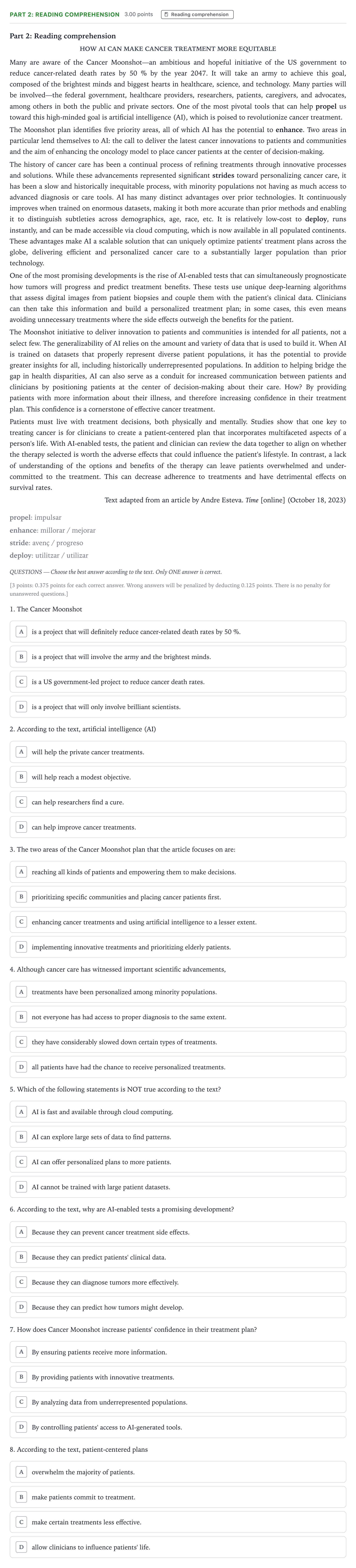
Part 2: Reading comprehension
HOW AI CAN MAKE CANCER TREATMENT MORE EQUITABLE
Many are aware of the Cancer Moonshot—an ambitious and hopeful initiative of the US government to reduce cancer-related death rates by 50 % by the year 2047. It will take an army to achieve this goal, composed of the brightest minds and biggest hearts in healthcare, science, and technology. Many parties will be involved—the federal government, healthcare providers, researchers, patients, caregivers, and advocates, among others in both the public and private sectors. One of the most pivotal tools that can help propel us toward this high-minded goal is artificial intelligence (AI), which is poised to revolutionize cancer treatment.
The Moonshot plan identifies five priority areas, all of which AI has the potential to enhance. Two areas in particular lend themselves to AI: the call to deliver the latest cancer innovations to patients and communities and the aim of enhancing the oncology model to place cancer patients at the center of decision-making.
The history of cancer care has been a continual process of refining treatments through innovative processes and solutions. While these advancements represented significant strides toward personalizing cancer care, it has been a slow and historically inequitable process, with minority populations not having as much access to advanced diagnosis or care tools. AI has many distinct advantages over prior technologies. It continuously improves when trained on enormous datasets, making it both more accurate than prior methods and enabling it to distinguish subtleties across demographics, age, race, etc. It is relatively low-cost to deploy, runs instantly, and can be made accessible via cloud computing, which is now available in all populated continents. These advantages make AI a scalable solution that can uniquely optimize patients' treatment plans across the globe, delivering efficient and personalized cancer care to a substantially larger population than prior technology.
One of the most promising developments is the rise of AI-enabled tests that can simultaneously prognosticate how tumors will progress and predict treatment benefits. These tests use unique deep-learning algorithms that assess digital images from patient biopsies and couple them with the patient's clinical data. Clinicians can then take this information and build a personalized treatment plan; in some cases, this even means avoiding unnecessary treatments where the side effects outweigh the benefits for the patient.
The Moonshot initiative to deliver innovation to patients and communities is intended for all patients, not a select few. The generalizability of AI relies on the amount and variety of data that is used to build it. When AI is trained on datasets that properly represent diverse patient populations, it has the potential to provide greater insights for all, including historically underrepresented populations. In addition to helping bridge the gap in health disparities, AI can also serve as a conduit for increased communication between patients and clinicians by positioning patients at the center of decision-making about their care. How? By providing patients with more information about their illness, and therefore increasing confidence in their treatment plan. This confidence is a cornerstone of effective cancer treatment.
Patients must live with treatment decisions, both physically and mentally. Studies show that one key to treating cancer is for clinicians to create a patient-centered plan that incorporates multifaceted aspects of a person's life. With AI-enabled tests, the patient and clinician can review the data together to align on whether the therapy selected is worth the adverse effects that could influence the patient's lifestyle. In contrast, a lack of understanding of the options and benefits of the therapy can leave patients overwhelmed and under-committed to the treatment. This can decrease adherence to treatments and have detrimental effects on survival rates.
Text adapted from an article by Andre Esteva. Time [online] (October 18, 2023)
propel: impulsar
enhance: millorar / mejorar
stride: avenç / progreso
deploy: utilitzar / utilizar
QUESTIONS — Choose the best answer according to the text. Only ONE answer is correct.
[3 points: 0.375 points for each correct answer. Wrong answers will be penalized by deducting 0.125 points. There is no penalty for unanswered questions.]
.
Solución
Según los criterios oficiales de corrección
1. The Cancer Moonshot
Solución: is a US government-led project to reduce cancer death rates.
2. According to the text, artificial intelligence (AI)
Solución: can help improve cancer treatments.
3. The two areas of the Cancer Moonshot plan that the article focuses on are:
Solución: reaching all kinds of patients and empowering them to make decisions.
4. Although cancer care has witnessed important scientific advancements,
Solución: not everyone has had access to proper diagnosis to the same extent.
5. Which of the following statements is NOT true according to the text?
Solución: AI cannot be trained with large patient datasets.
6. According to the text, why are AI-enabled tests a promising development?
Solución: Because they can predict how tumors might develop.
7. How does Cancer Moonshot increase patients' confidence in their treatment plan?
Solución: By ensuring patients receive more information.
8. According to the text, patient-centered plans
Solución: make patients commit to treatment.
La explicación paso a paso, hecha con IA, es Premium. Premium
Resuélvelo aquí mismo: corrección automática, pistas y solución paso a paso.
‹ Part 2: Reading comprehension · Juny Serie 5 2024 · Part 2: Reading comprehension · Juny Serie 1 2023 ›
Más ejercicios de Reading comprehension
- Part 2: Reading comprehension · Juny Serie 1 2025
- Part 2: Reading comprehension · Juny Serie 4 2025
- Part 2: Reading comprehension · Setembre Serie 3 2025
- Part 2: Reading comprehension · Juny Serie 1 2024
- Part 2: Reading comprehension · Juny Serie 5 2024
- Part 2: Reading comprehension · Juny Serie 1 2023
- Part 2 · Juny Serie 5 2023
- Part 2: Reading comprehension · Setembre Serie 2 2023
- Part 2: Reading comprehension · Juliol Serie 2 2022
- Part 2: Reading comprehension · Juny Serie 2 2022
Exámenes oficiales en PDF y soluciones: examenselectivitat.cat