Part 2: Reading comprehension · Inglés Selectividad Cataluña Juliol Serie 2 2022
Tema: Reading comprehension · Del examen Juliol Serie 2 (2022)
Enunciado
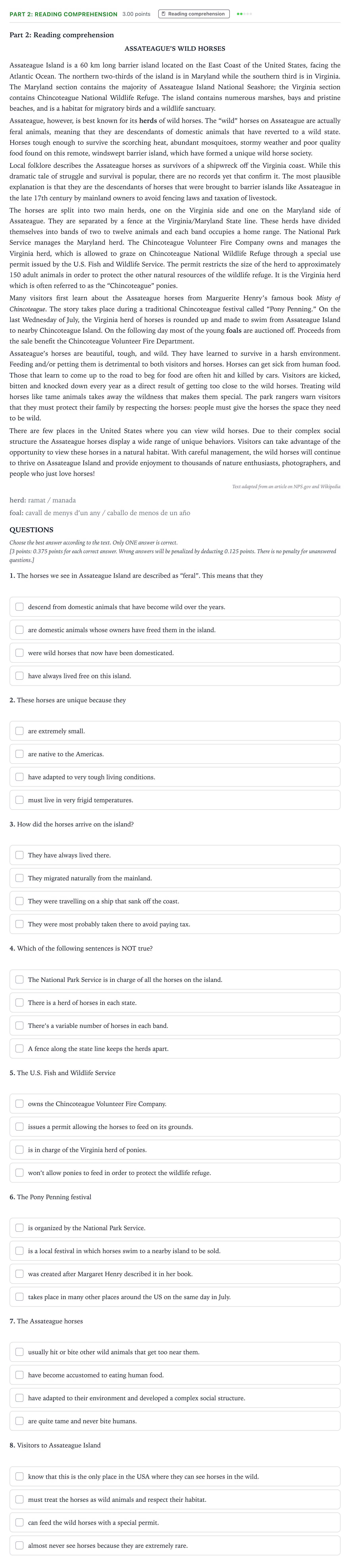
Part 2: Reading comprehension
ASSATEAGUE’S WILD HORSES
Assateague Island is a 60 km long barrier island located on the East Coast of the United States, facing the Atlantic Ocean. The northern two-thirds of the island is in Maryland while the southern third is in Virginia. The Maryland section contains the majority of Assateague Island National Seashore; the Virginia section contains Chincoteague National Wildlife Refuge. The island contains numerous marshes, bays and pristine beaches, and is a habitat for migratory birds and a wildlife sanctuary.
Assateague, however, is best known for its herds of wild horses. The “wild” horses on Assateague are actually feral animals, meaning that they are descendants of domestic animals that have reverted to a wild state. Horses tough enough to survive the scorching heat, abundant mosquitoes, stormy weather and poor quality food found on this remote, windswept barrier island, which have formed a unique wild horse society.
Local folklore describes the Assateague horses as survivors of a shipwreck off the Virginia coast. While this dramatic tale of struggle and survival is popular, there are no records yet that confirm it. The most plausible explanation is that they are the descendants of horses that were brought to barrier islands like Assateague in the late 17th century by mainland owners to avoid fencing laws and taxation of livestock.
The horses are split into two main herds, one on the Virginia side and one on the Maryland side of Assateague. They are separated by a fence at the Virginia/Maryland State line. These herds have divided themselves into bands of two to twelve animals and each band occupies a home range. The National Park Service manages the Maryland herd. The Chincoteague Volunteer Fire Company owns and manages the Virginia herd, which is allowed to graze on Chincoteague National Wildlife Refuge through a special use permit issued by the U.S. Fish and Wildlife Service. The permit restricts the size of the herd to approximately 150 adult animals in order to protect the other natural resources of the wildlife refuge. It is the Virginia herd which is often referred to as the “Chincoteague” ponies.
Many visitors first learn about the Assateague horses from Marguerite Henry’s famous book Misty of Chincoteague. The story takes place during a traditional Chincoteague festival called “Pony Penning.” On the last Wednesday of July, the Virginia herd of horses is rounded up and made to swim from Assateague Island to nearby Chincoteague Island. On the following day most of the young foals are auctioned off. Proceeds from the sale benefit the Chincoteague Volunteer Fire Department.
Assateague’s horses are beautiful, tough, and wild. They have learned to survive in a harsh environment. Feeding and/or petting them is detrimental to both visitors and horses. Horses can get sick from human food. Those that learn to come up to the road to beg for food are often hit and killed by cars. Visitors are kicked, bitten and knocked down every year as a direct result of getting too close to the wild horses. Treating wild horses like tame animals takes away the wildness that makes them special. The park rangers warn visitors that they must protect their family by respecting the horses: people must give the horses the space they need to be wild.
There are few places in the United States where you can view wild horses. Due to their complex social structure the Assateague horses display a wide range of unique behaviors. Visitors can take advantage of the opportunity to view these horses in a natural habitat. With careful management, the wild horses will continue to thrive on Assateague Island and provide enjoyment to thousands of nature enthusiasts, photographers, and people who just love horses!
Text adapted from an article on NPS.gov and Wikipedia
herd: ramat / manada
foal: cavall de menys d’un any / caballo de menos de un año
QUESTIONS
Choose the best answer according to the text. Only ONE answer is correct.
[3 points: 0.375 points for each correct answer. Wrong answers will be penalized by deducting 0.125 points. There is no penalty for unanswered questions.]
.
Solución
Solución de AprenAI (no es la oficial)
1. The horses we see in Assateague Island are described as “feral”. This means that they
Solución: descend from domestic animals that have become wild over the years.
2. These horses are unique because they
Solución: have adapted to very tough living conditions.
3. How did the horses arrive on the island?
Solución: They were most probably taken there to avoid paying tax.
4. Which of the following sentences is NOT true?
Solución: The National Park Service is in charge of all the horses on the island.
Las soluciones de los 4 apartados que faltan y la explicación paso a paso son Premium. Premium
Resuélvelo aquí mismo: corrección automática, pistas y solución paso a paso.
‹ Part 2: Reading comprehension · Setembre Serie 2 2023 · Part 2: Reading comprehension · Juny Serie 2 2022 ›
Más ejercicios de Reading comprehension
- Part 2: Reading comprehension · Juny Serie 5 2024
- Part 2: Reading comprehension · Setembre Serie 3 2024
- Part 2: Reading comprehension · Juny Serie 1 2023
- Part 2 · Juny Serie 5 2023
- Part 2: Reading comprehension · Setembre Serie 2 2023
- Part 2: Reading comprehension · Juny Serie 2 2022
- Part 2: Reading comprehension · Juny Serie 5 2022
- Part 2: Reading comprehension · Setembre Serie 3 2022
- Part 2: Reading comprehension · Juny Serie 2 2021
- Part 2: Reading comprehension · Juny Serie 5 2021
Exámenes oficiales en PDF y soluciones: examenselectivitat.cat