Part 2 · Inglés Selectividad Cataluña Juny Serie 5 2023
Tema: Reading comprehension · Del examen Juny Serie 5 (2023)
Enunciado
Part 2: Reading comprehension
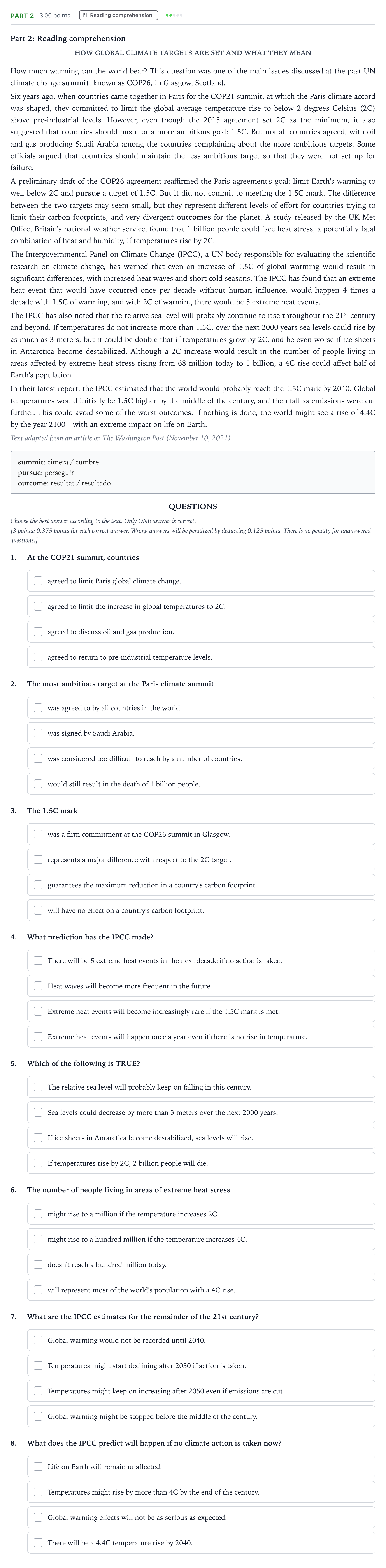
HOW GLOBAL CLIMATE TARGETS ARE SET AND WHAT THEY MEAN
How much warming can the world bear? This question was one of the main issues discussed at the past UN climate change summit, known as COP26, in Glasgow, Scotland.
Six years ago, when countries came together in Paris for the COP21 summit, at which the Paris climate accord was shaped, they committed to limit the global average temperature rise to below 2 degrees Celsius (2C) above pre-industrial levels. However, even though the 2015 agreement set 2C as the minimum, it also suggested that countries should push for a more ambitious goal: 1.5C. But not all countries agreed, with oil and gas producing Saudi Arabia among the countries complaining about the more ambitious targets. Some officials argued that countries should maintain the less ambitious target so that they were not set up for failure.
A preliminary draft of the COP26 agreement reaffirmed the Paris agreement's goal: limit Earth's warming to well below 2C and pursue a target of 1.5C. But it did not commit to meeting the 1.5C mark. The difference between the two targets may seem small, but they represent different levels of effort for countries trying to limit their carbon footprints, and very divergent outcomes for the planet. A study released by the UK Met Office, Britain's national weather service, found that 1 billion people could face heat stress, a potentially fatal combination of heat and humidity, if temperatures rise by 2C.
The Intergovernmental Panel on Climate Change (IPCC), a UN body responsible for evaluating the scientific research on climate change, has warned that even an increase of 1.5C of global warming would result in significant differences, with increased heat waves and short cold seasons. The IPCC has found that an extreme heat event that would have occurred once per decade without human influence, would happen 4 times a decade with 1.5C of warming, and with 2C of warming there would be 5 extreme heat events.
The IPCC has also noted that the relative sea level will probably continue to rise throughout the 21 st century and beyond. If temperatures do not increase more than 1.5C, over the next 2000 years sea levels could rise by as much as 3 meters, but it could be double that if temperatures grow by 2C, and be even worse if ice sheets in Antarctica become destabilized. Although a 2C increase would result in the number of people living in areas affected by extreme heat stress rising from 68 million today to 1 billion, a 4C rise could affect half of Earth's population.
In their latest report, the IPCC estimated that the world would probably reach the 1.5C mark by 2040. Global temperatures would initially be 1.5C higher by the middle of the century, and then fall as emissions were cut further. This could avoid some of the worst outcomes. If nothing is done, the world might see a rise of 4.4C by the year 2100—with an extreme impact on life on Earth.
Text adapted from an article on The Washington Post (November 10, 2021)
summit: cimera / cumbre
pursue: perseguir
outcome: resultat / resultado
QUESTIONS
Choose the best answer according to the text. Only ONE answer is correct.
[3 points: 0.375 points for each correct answer. Wrong answers will be penalized by deducting 0.125 points. There is no penalty for unanswered questions.]
.
Solución
Según los criterios oficiales de corrección
1. At the COP21 summit, countries
Solución: agreed to limit the increase in global temperatures to 2C.
2. The most ambitious target at the Paris climate summit...
Solución: was considered too difficult to reach by a number of countries.
3. The 1.5C mark...
Solución: represents a major difference with respect to the 2C target.
4. What prediction has the IPCC made?
Solución: Heat waves will become more frequent in the future.
5. Which of the following is TRUE?
Solución: If ice sheets in Antarctica become destabilized, sea levels will rise.
6. The number of people living in areas of extreme heat stress...
Solución: doesn't reach a hundred million today.
7. What are the IPCC estimates for the remainder of the 21st century?
Solución: Temperatures might start declining after 2050 if action is taken.
8. What does the IPCC predict will happen if no climate action is taken now?
Solución: Temperatures might rise by more than 4C by the end of the century.
La explicación paso a paso, hecha con IA, es Premium. Premium
Resuélvelo aquí mismo: corrección automática, pistas y solución paso a paso.
‹ Part 2: Reading comprehension · Juny Serie 1 2023 · Part 2: Reading comprehension · Setembre Serie 2 2023 ›
Más ejercicios de Reading comprehension
- Part 2: Reading comprehension · Setembre Serie 3 2025
- Part 2: Reading comprehension · Juny Serie 1 2024
- Part 2: Reading comprehension · Juny Serie 5 2024
- Part 2: Reading comprehension · Setembre Serie 3 2024
- Part 2: Reading comprehension · Juny Serie 1 2023
- Part 2: Reading comprehension · Setembre Serie 2 2023
- Part 2: Reading comprehension · Juliol Serie 2 2022
- Part 2: Reading comprehension · Juny Serie 2 2022
- Part 2: Reading comprehension · Juny Serie 5 2022
- Part 2: Reading comprehension · Setembre Serie 3 2022
Exámenes oficiales en PDF y soluciones: examenselectivitat.cat