Part 2: Reading comprehension · Inglés Selectividad Cataluña Setembre Serie 2 2023
Tema: Reading comprehension · Del examen Setembre Serie 2 (2023)
Enunciado
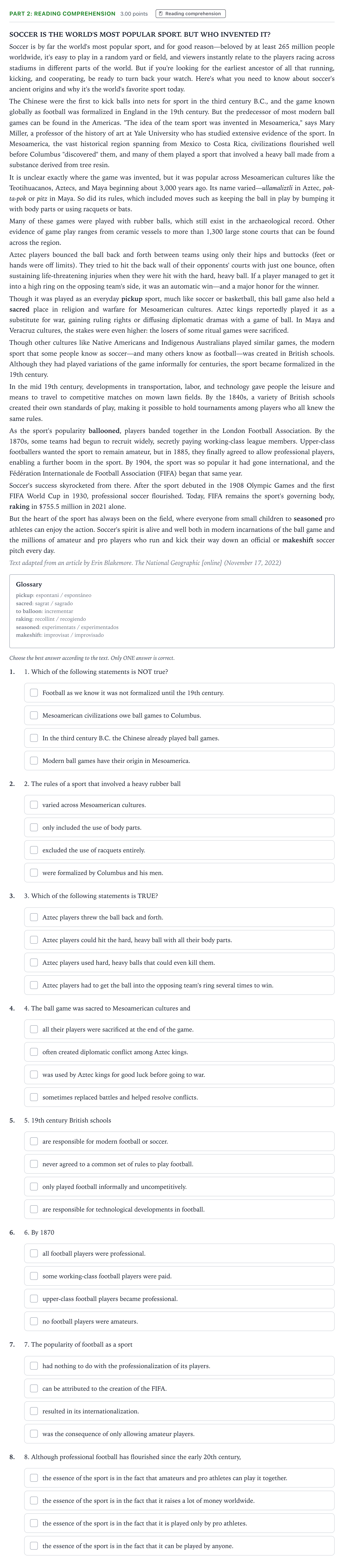
SOCCER IS THE WORLD'S MOST POPULAR SPORT. BUT WHO INVENTED IT?
Soccer is by far the world's most popular sport, and for good reason—beloved by at least 265 million people worldwide, it's easy to play in a random yard or field, and viewers instantly relate to the players racing across stadiums in different parts of the world. But if you're looking for the earliest ancestor of all that running, kicking, and cooperating, be ready to turn back your watch. Here's what you need to know about soccer's ancient origins and why it's the world's favorite sport today.
The Chinese were the first to kick balls into nets for sport in the third century B.C., and the game known globally as football was formalized in England in the 19th century. But the predecessor of most modern ball games can be found in the Americas. "The idea of the team sport was invented in Mesoamerica," says Mary Miller, a professor of the history of art at Yale University who has studied extensive evidence of the sport. In Mesoamerica, the vast historical region spanning from Mexico to Costa Rica, civilizations flourished well before Columbus "discovered" them, and many of them played a sport that involved a heavy ball made from a substance derived from tree resin.
It is unclear exactly where the game was invented, but it was popular across Mesoamerican cultures like the Teotihuacanos, Aztecs, and Maya beginning about 3,000 years ago. Its name varied— ullamaliztli in Aztec, pok-ta-pok or pitz in Maya. So did its rules, which included moves such as keeping the ball in play by bumping it with body parts or using racquets or bats.
Many of these games were played with rubber balls, which still exist in the archaeological record. Other evidence of game play ranges from ceramic vessels to more than 1,300 large stone courts that can be found across the region.
Aztec players bounced the ball back and forth between teams using only their hips and buttocks (feet or hands were off limits). They tried to hit the back wall of their opponents' courts with just one bounce, often sustaining life-threatening injuries when they were hit with the hard, heavy ball. If a player managed to get it into a high ring on the opposing team's side, it was an automatic win—and a major honor for the winner.
Though it was played as an everyday pickup sport, much like soccer or basketball, this ball game also held a sacred place in religion and warfare for Mesoamerican cultures. Aztec kings reportedly played it as a substitute for war, gaining ruling rights or diffusing diplomatic dramas with a game of ball. In Maya and Veracruz cultures, the stakes were even higher: the losers of some ritual games were sacrificed.
Though other cultures like Native Americans and Indigenous Australians played similar games, the modern sport that some people know as soccer—and many others know as football—was created in British schools. Although they had played variations of the game informally for centuries, the sport became formalized in the 19th century.
In the mid 19th century, developments in transportation, labor, and technology gave people the leisure and means to travel to competitive matches on mown lawn fields. By the 1840s, a variety of British schools created their own standards of play, making it possible to hold tournaments among players who all knew the same rules.
As the sport's popularity ballooned, players banded together in the London Football Association. By the 1870s, some teams had begun to recruit widely, secretly paying working-class league members. Upper-class footballers wanted the sport to remain amateur, but in 1885, they finally agreed to allow professional players, enabling a further boom in the sport. By 1904, the sport was so popular it had gone international, and the Fédération Internationale de Football Association (FIFA) began that same year.
Soccer's success skyrocketed from there. After the sport debuted in the 1908 Olympic Games and the first FIFA World Cup in 1930, professional soccer flourished. Today, FIFA remains the sport's governing body, raking in $755.5 million in 2021 alone.
But the heart of the sport has always been on the field, where everyone from small children to seasoned pro athletes can enjoy the action. Soccer's spirit is alive and well both in modern incarnations of the ball game and the millions of amateur and pro players who run and kick their way down an official or makeshift soccer pitch every day.
Text adapted from an article by Erin Blakemore. The National Geographic [online] (November 17, 2022)
Glossary
pickup: espontani / espontáneo
sacred: sagrat / sagrado
to balloon: incrementar
raking: recollint / recogiendo
seasoned: experimentats / experimentados
makeshift: improvisat / improvisado
Choose the best answer according to the text. Only ONE answer is correct.
.
Solución
Según los criterios oficiales de corrección
1. Which of the following statements is NOT true?
Solución: Mesoamerican civilizations owe ball games to Columbus.
2. The rules of a sport that involved a heavy rubber ball
Solución: varied across Mesoamerican cultures.
3. Which of the following statements is TRUE?
Solución: Aztec players used hard, heavy balls that could even kill them.
4. The ball game was sacred to Mesoamerican cultures and
Solución: sometimes replaced battles and helped resolve conflicts.
5. 19th century British schools
Solución: are responsible for modern football or soccer.
6. By 1870
Solución: some working-class football players were paid.
7. The popularity of football as a sport
Solución: resulted in its internationalization.
8. Although professional football has flourished since the early 20th century,
Solución: the essence of the sport is in the fact that it can be played by anyone.
La explicación paso a paso, hecha con IA, es Premium. Premium
Resuélvelo aquí mismo: corrección automática, pistas y solución paso a paso.
‹ Part 2 · Juny Serie 5 2023 · Part 2: Reading comprehension · Juliol Serie 2 2022 ›
Más ejercicios de Reading comprehension
- Part 2: Reading comprehension · Juny Serie 1 2024
- Part 2: Reading comprehension · Juny Serie 5 2024
- Part 2: Reading comprehension · Setembre Serie 3 2024
- Part 2: Reading comprehension · Juny Serie 1 2023
- Part 2 · Juny Serie 5 2023
- Part 2: Reading comprehension · Juliol Serie 2 2022
- Part 2: Reading comprehension · Juny Serie 2 2022
- Part 2: Reading comprehension · Juny Serie 5 2022
- Part 2: Reading comprehension · Setembre Serie 3 2022
- Part 2: Reading comprehension · Juny Serie 2 2021
Exámenes oficiales en PDF y soluciones: examenselectivitat.cat