Part 2: Reading comprehension · Inglés Selectividad Cataluña Juny Serie 1 2025
Tema: Reading comprehension · Del examen Juny Serie 1 (2025)
Enunciado
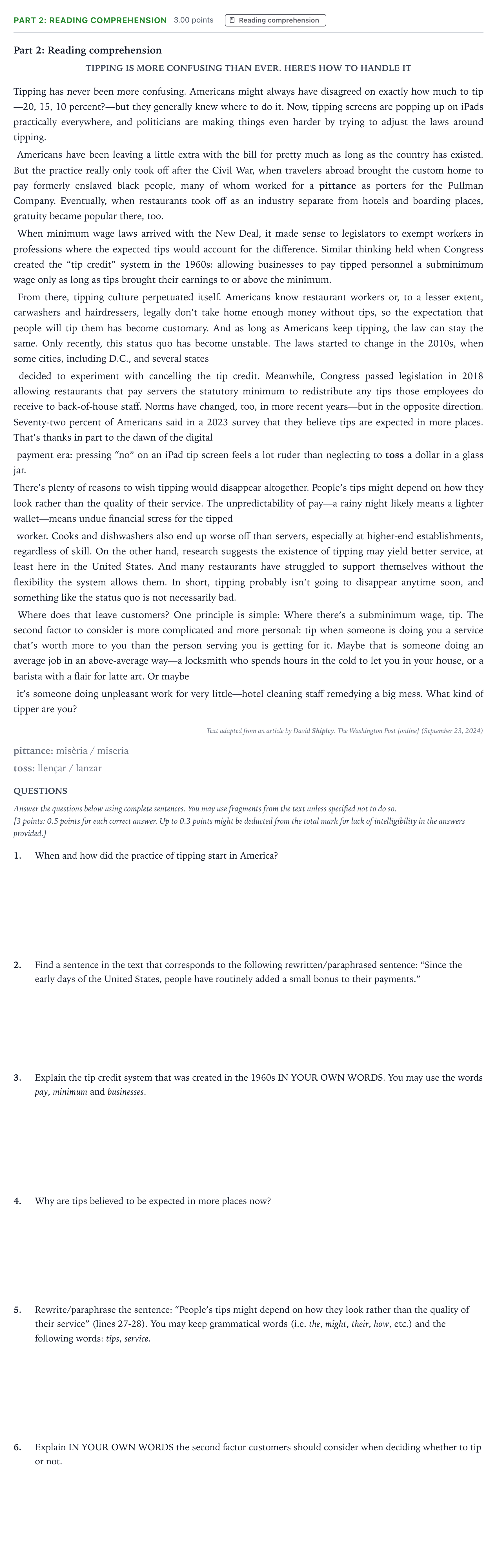
Part 2: Reading comprehension
TIPPING IS MORE CONFUSING THAN EVER. HERE'S HOW TO HANDLE IT
Tipping has never been more confusing. Americans might always have disagreed on exactly how much to tip—20, 15, 10 percent?—but they generally knew where to do it. Now, tipping screens are popping up on iPads practically everywhere, and politicians are making things even harder by trying to adjust the laws around tipping.
5 Americans have been leaving a little extra with the bill for pretty much as long as the country has existed. But the practice really only took off after the Civil War, when travelers abroad brought the custom home to pay formerly enslaved black people, many of whom worked for a pittance as porters for the Pullman Company. Eventually, when restaurants took off as an industry separate from hotels and boarding places, gratuity became popular there, too.
10 When minimum wage laws arrived with the New Deal, it made sense to legislators to exempt workers in professions where the expected tips would account for the difference. Similar thinking held when Congress created the “tip credit” system in the 1960s: allowing businesses to pay tipped personnel a subminimum wage only as long as tips brought their earnings to or above the minimum.
15 From there, tipping culture perpetuated itself. Americans know restaurant workers or, to a lesser extent, carwashers and hairdressers, legally don’t take home enough money without tips, so the expectation that people will tip them has become customary. And as long as Americans keep tipping, the law can stay the same. Only recently, this status quo has become unstable. The laws started to change in the 2010s, when some cities, including D.C., and several states
20 decided to experiment with cancelling the tip credit. Meanwhile, Congress passed legislation in 2018 allowing restaurants that pay servers the statutory minimum to redistribute any tips those employees do receive to back-of-house staff. Norms have changed, too, in more recent years—but in the opposite direction. Seventy-two percent of Americans said in a 2023 survey that they believe tips are expected in more places. That’s thanks in part to the dawn of the digital
25 payment era: pressing “no” on an iPad tip screen feels a lot ruder than neglecting to toss a dollar in a glass jar.
There’s plenty of reasons to wish tipping would disappear altogether. People’s tips might depend on how they look rather than the quality of their service. The unpredictability of pay—a rainy night likely means a lighter wallet—means undue financial stress for the tipped
30 worker. Cooks and dishwashers also end up worse off than servers, especially at higher-end establishments, regardless of skill. On the other hand, research suggests the existence of tipping may yield better service, at least here in the United States. And many restaurants have struggled to support themselves without the flexibility the system allows them. In short, tipping probably isn’t going to disappear anytime soon, and something like the status quo is not necessarily bad.
35 Where does that leave customers? One principle is simple: Where there’s a subminimum wage, tip. The second factor to consider is more complicated and more personal: tip when someone is doing you a service that’s worth more to you than the person serving you is getting for it. Maybe that is someone doing an average job in an above-average way—a locksmith who spends hours in the cold to let you in your house, or a barista with a flair for latte art. Or maybe
40 it’s someone doing unpleasant work for very little—hotel cleaning staff remedying a big mess. What kind of tipper are you?
Text adapted from an article by David Shipley. The Washington Post [online] (September 23, 2024)
pittance: misèria / miseria
toss: llençar / lanzar
QUESTIONS
Answer the questions below using complete sentences. You may use fragments from the text unless specified not to do so.
[3 points: 0.5 points for each correct answer. Up to 0.3 points might be deducted from the total mark for lack of intelligibility in the answers provided.]
1.
When and how did the practice of tipping start in America?
2.
Find a sentence in the text that corresponds to the following rewritten/paraphrased sentence: “Since the early days of the United States, people have routinely added a small bonus to their payments.”
3.
Explain the tip credit system that was created in the 1960s IN YOUR OWN WORDS. You may use the words pay, minimum and businesses.
4.
Why are tips believed to be expected in more places now?
5.
Rewrite/paraphrase the sentence: “People’s tips might depend on how they look rather than the quality of their service” (lines 27-28). You may keep grammatical words (i.e. the, might, their, how, etc.) and the following words: tips, service.
6.
Explain IN YOUR OWN WORDS the second factor customers should consider when deciding whether to tip or not.
Solución
Según los criterios oficiales de corrección
1. When and how did the practice of tipping start in America?
Solución: The practice of tipping started in America after the Civil War and it was brought by travellers who used to pay formerly enslaved black people, many of whom worked for a pittance as porters for the Pullman Company.
2. Find a sentence in the text that corresponds to the following rewritten/paraphrased sentence: “Since the early days of the United States, people have routinely added a small bonus to their payments.”
Solución: Americans have been leaving a little extra with the bill for pretty much as long as the country has existed (lines 5-6).
3. Explain the tip credit system that was created in the 1960s IN YOUR OWN WORDS. You may use the words pay, minimum and businesses.
Solución: The tip credit system permitted businesses to pay their staff less than required if tipping increased their salaries to the minimum or more.
4. Why are tips believed to be expected in more places now?
Solución: Tips are believed to be expected in more places because we are in the digital era and pressing “no” on a screen feels ruder than not leaving any dollars in a jar/neglecting to toss a dollar in a glass jar.
5. Rewrite/paraphrase the sentence: “People’s tips might depend on how they look rather than the quality of their service” (lines 27-28). You may keep grammatical words (i.e. the, might, their, how, etc.) and the following words: tips, service.
Solución: The tips workers get/receive might be determined by/might be related to their appearance rather than/and not by/to how well they treat you/how good the service was. (among others)
6. Explain IN YOUR OWN WORDS the second factor customers should consider when deciding whether to tip or not.
Solución: The second factor we should consider when tipping is whether the service you receive/are provided with/get is better/of higher quality/more valuable than the money the person doing it is receiving.
La explicación paso a paso, hecha con IA, es Premium. Premium
Resuélvelo aquí mismo: corrección automática, pistas y solución paso a paso.
‹ Part 2: Reading comprehension · Setembre Serie 2 2026 · Part 2: Reading comprehension · Juny Serie 4 2025 ›
Más ejercicios de Reading comprehension
- Part 2: Reading comprehension · Juny Serie 1 2026
- Part 2 · Juny Serie 5 2026
- Part 2: Reading comprehension · Setembre Serie 2 2026
- Part 2: Reading comprehension · Juny Serie 4 2025
- Part 2: Reading comprehension · Setembre Serie 3 2025
- Part 2: Reading comprehension · Juny Serie 1 2024
- Part 2: Reading comprehension · Juny Serie 5 2024
- Part 2: Reading comprehension · Setembre Serie 3 2024
- Part 2: Reading comprehension · Juny Serie 1 2023
- Part 2 · Juny Serie 5 2023
Exámenes oficiales en PDF y soluciones: examenselectivitat.cat