Part 2: Reading comprehension · Inglés Selectividad Cataluña Juny Serie 2 2021
Tema: Reading comprehension · Del examen Juny Serie 2 (2021)
Enunciado
Part 2: Reading comprehension
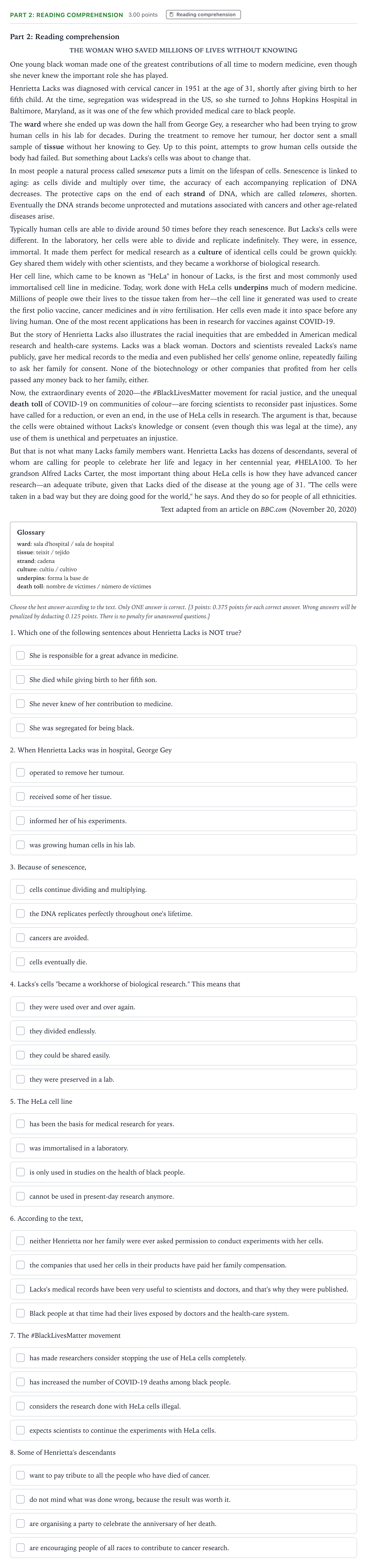
THE WOMAN WHO SAVED MILLIONS OF LIVES WITHOUT KNOWING
One young black woman made one of the greatest contributions of all time to modern medicine, even though she never knew the important role she has played.
Henrietta Lacks was diagnosed with cervical cancer in 1951 at the age of 31, shortly after giving birth to her fifth child. At the time, segregation was widespread in the US, so she turned to Johns Hopkins Hospital in Baltimore, Maryland, as it was one of the few which provided medical care to black people.
The ward where she ended up was down the hall from George Gey, a researcher who had been trying to grow human cells in his lab for decades. During the treatment to remove her tumour, her doctor sent a small sample of tissue without her knowing to Gey. Up to this point, attempts to grow human cells outside the body had failed. But something about Lacks's cells was about to change that.
In most people a natural process called senescence puts a limit on the lifespan of cells. Senescence is linked to aging: as cells divide and multiply over time, the accuracy of each accompanying replication of DNA decreases. The protective caps on the end of each strand of DNA, which are called telomeres, shorten. Eventually the DNA strands become unprotected and mutations associated with cancers and other age-related diseases arise.
Typically human cells are able to divide around 50 times before they reach senescence. But Lacks's cells were different. In the laboratory, her cells were able to divide and replicate indefinitely. They were, in essence, immortal. It made them perfect for medical research as a culture of identical cells could be grown quickly. Gey shared them widely with other scientists, and they became a workhorse of biological research.
Her cell line, which came to be known as "HeLa" in honour of Lacks, is the first and most commonly used immortalised cell line in medicine. Today, work done with HeLa cells underpins much of modern medicine. Millions of people owe their lives to the tissue taken from her—the cell line it generated was used to create the first polio vaccine, cancer medicines and in vitro fertilisation. Her cells even made it into space before any living human. One of the most recent applications has been in research for vaccines against COVID-19.
But the story of Henrietta Lacks also illustrates the racial inequities that are embedded in American medical research and health-care systems. Lacks was a black woman. Doctors and scientists revealed Lacks's name publicly, gave her medical records to the media and even published her cells' genome online, repeatedly failing to ask her family for consent. None of the biotechnology or other companies that profited from her cells passed any money back to her family, either.
Now, the extraordinary events of 2020—the #BlackLivesMatter movement for racial justice, and the unequal death toll of COVID-19 on communities of colour—are forcing scientists to reconsider past injustices. Some have called for a reduction, or even an end, in the use of HeLa cells in research. The argument is that, because the cells were obtained without Lacks's knowledge or consent (even though this was legal at the time), any use of them is unethical and perpetuates an injustice.
But that is not what many Lacks family members want. Henrietta Lacks has dozens of descendants, several of whom are calling for people to celebrate her life and legacy in her centennial year, #HELA100. To her grandson Alfred Lacks Carter, the most important thing about HeLa cells is how they have advanced cancer research—an adequate tribute, given that Lacks died of the disease at the young age of 31. "The cells were taken in a bad way but they are doing good for the world," he says. And they do so for people of all ethnicities.
Text adapted from an article on BBC.com (November 20, 2020)
Glossary
ward: sala d'hospital / sala de hospital
tissue: teixit / tejido
strand: cadena
culture: cultiu / cultivo
underpins: forma la base de
death toll: nombre de víctimes / número de víctimes
Choose the best answer according to the text. Only ONE answer is correct. [3 points: 0.375 points for each correct answer. Wrong answers will be penalized by deducting 0.125 points. There is no penalty for unanswered questions.]
.
Solución
Según los criterios oficiales de corrección
1. Which one of the following sentences about Henrietta Lacks is NOT true?
Solución: She died while giving birth to her fifth son.
2. When Henrietta Lacks was in hospital, George Gey
Solución: received some of her tissue.
3. Because of senescence,
Solución: cells eventually die.
4. Lacks's cells "became a workhorse of biological research". This means that
Solución: they were used over and over again.
5. The HeLa cell line
Solución: has been the basis for medical research for years.
6. According to the text,
Solución: neither Henrietta nor her family were ever asked permission to conduct experiments with her cells.
7. The #BlackLivesMatter movement
Solución: has made researchers consider stopping the use of HeLa cells completely.
8. Some of Henrietta's descendants
Solución: do not mind what was done wrong, because the result was worth it.
La explicación paso a paso, hecha con IA, es Premium. Premium
Resuélvelo aquí mismo: corrección automática, pistas y solución paso a paso.
‹ Part 2: Reading comprehension · Setembre Serie 3 2022 · Part 2: Reading comprehension · Juny Serie 5 2021 ›
Más ejercicios de Reading comprehension
- Part 2: Reading comprehension · Setembre Serie 2 2023
- Part 2: Reading comprehension · Juliol Serie 2 2022
- Part 2: Reading comprehension · Juny Serie 2 2022
- Part 2: Reading comprehension · Juny Serie 5 2022
- Part 2: Reading comprehension · Setembre Serie 3 2022
- Part 2: Reading comprehension · Juny Serie 5 2021
- Part 2: Reading comprehension · Setembre Serie 1 2021
Exámenes oficiales en PDF y soluciones: examenselectivitat.cat