Part 2: Reading comprehension · Inglés Selectividad Cataluña Juny Serie 5 2021
Tema: Reading comprehension · Del examen Juny Serie 5 (2021)
Enunciado
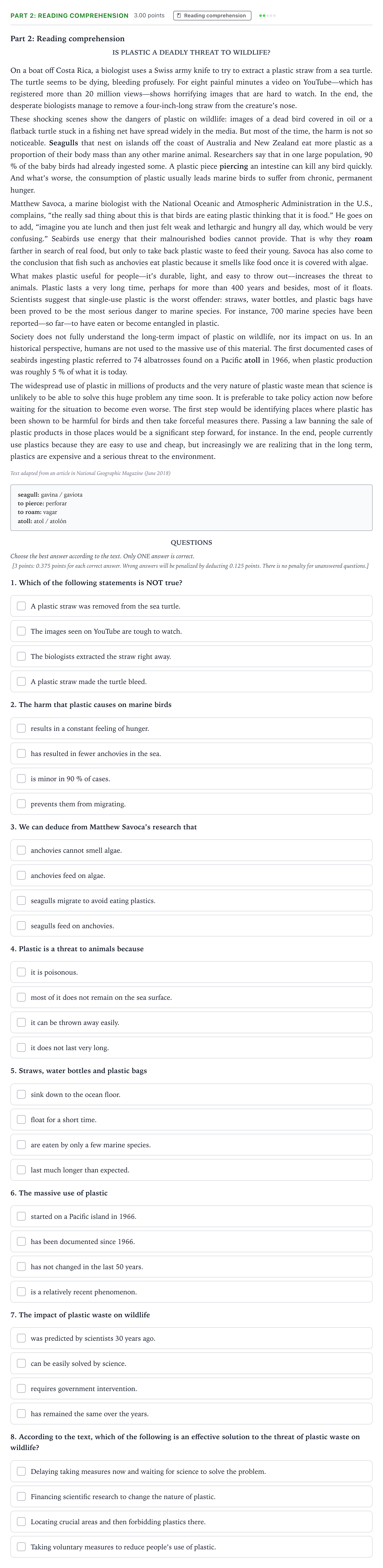
Part 2: Reading comprehension
IS PLASTIC A DEADLY THREAT TO WILDLIFE?
On a boat off Costa Rica, a biologist uses a Swiss army knife to try to extract a plastic straw from a sea turtle. The turtle seems to be dying, bleeding profusely. For eight painful minutes a video on YouTube—which has registered more than 20 million views—shows horrifying images that are hard to watch. In the end, the desperate biologists manage to remove a four-inch-long straw from the creature’s nose.
These shocking scenes show the dangers of plastic on wildlife: images of a dead bird covered in oil or a flatback turtle stuck in a fishing net have spread widely in the media. But most of the time, the harm is not so noticeable. Seagulls that nest on islands off the coast of Australia and New Zealand eat more plastic as a proportion of their body mass than any other marine animal. Researchers say that in one large population, 90 % of the baby birds had already ingested some. A plastic piece piercing an intestine can kill any bird quickly. And what’s worse, the consumption of plastic usually leads marine birds to suffer from chronic, permanent hunger.
Matthew Savoca, a marine biologist with the National Oceanic and Atmospheric Administration in the U.S., complains, “the really sad thing about this is that birds are eating plastic thinking that it is food.” He goes on to add, “imagine you ate lunch and then just felt weak and lethargic and hungry all day, which would be very confusing.” Seabirds use energy that their malnourished bodies cannot provide. That is why they roam farther in search of real food, but only to take back plastic waste to feed their young. Savoca has also come to the conclusion that fish such as anchovies eat plastic because it smells like food once it is covered with algae.
What makes plastic useful for people—it’s durable, light, and easy to throw out—increases the threat to animals. Plastic lasts a very long time, perhaps for more than 400 years and besides, most of it floats. Scientists suggest that single-use plastic is the worst offender: straws, water bottles, and plastic bags have been proved to be the most serious danger to marine species. For instance, 700 marine species have been reported—so far—to have eaten or become entangled in plastic.
Society does not fully understand the long-term impact of plastic on wildlife, nor its impact on us. In an historical perspective, humans are not used to the massive use of this material. The first documented cases of seabirds ingesting plastic referred to 74 albatrosses found on a Pacific atoll in 1966, when plastic production was roughly 5 % of what it is today.
The widespread use of plastic in millions of products and the very nature of plastic waste mean that science is unlikely to be able to solve this huge problem any time soon. It is preferable to take policy action now before waiting for the situation to become even worse. The first step would be identifying places where plastic has been shown to be harmful for birds and then take forceful measures there. Passing a law banning the sale of plastic products in those places would be a significant step forward, for instance. In the end, people currently use plastics because they are easy to use and cheap, but increasingly we are realizing that in the long term, plastics are expensive and a serious threat to the environment.
Text adapted from an article in National Geographic Magazine (June 2018)
seagull: gavina / gaviota
to pierce: perforar
to roam: vagar
atoll: atol / atolón
QUESTIONS
Choose the best answer according to the text. Only ONE answer is correct.
[3 points: 0.375 points for each correct answer. Wrong answers will be penalized by deducting 0.125 points. There is no penalty for unanswered questions.]
.
Solución
Según los criterios oficiales de corrección
1. Which of the following statements is NOT true?
Solución: The biologists extracted the straw right away.
2. The harm that plastic causes on marine birds
Solución: results in a constant feeling of hunger.
3. We can deduce from Matthew Savoca’s research that
Solución: anchovies feed on algae.
4. Plastic is a threat to animals because
Solución: it can be thrown away easily.
5. Straws, water bottles and plastic bags
Solución: last much longer than expected.
6. The massive use of plastic
Solución: is a relatively recent phenomenon.
7. The impact of plastic waste on wildlife
Solución: requires government intervention.
8. According to the text, which of the following is an effective solution to the threat of plastic waste on wildlife?
Solución: Locating crucial areas and then forbidding plastics there.
La explicación paso a paso, hecha con IA, es Premium. Premium
Resuélvelo aquí mismo: corrección automática, pistas y solución paso a paso.
‹ Part 2: Reading comprehension · Juny Serie 2 2021 · Part 2: Reading comprehension · Setembre Serie 1 2021 ›
Más ejercicios de Reading comprehension
- Part 2: Reading comprehension · Juliol Serie 2 2022
- Part 2: Reading comprehension · Juny Serie 2 2022
- Part 2: Reading comprehension · Juny Serie 5 2022
- Part 2: Reading comprehension · Setembre Serie 3 2022
- Part 2: Reading comprehension · Juny Serie 2 2021
- Part 2: Reading comprehension · Setembre Serie 1 2021
Exámenes oficiales en PDF y soluciones: examenselectivitat.cat