Part 2: Reading comprehension · Inglés Selectividad Cataluña Juny Serie 5 2022
Tema: Reading comprehension · Del examen Juny Serie 5 (2022)
Enunciado
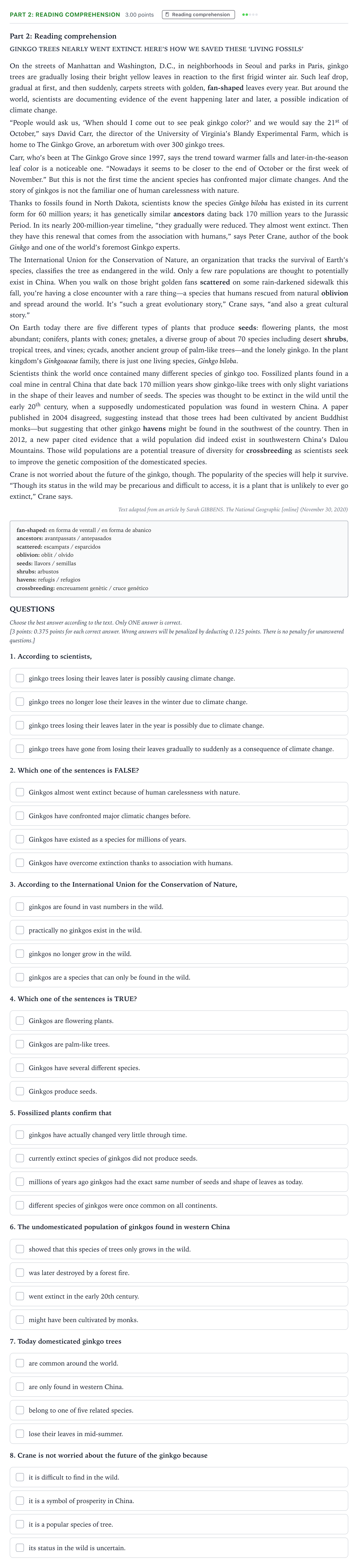
Part 2: Reading comprehension
GINKGO TREES NEARLY WENT EXTINCT. HERE’S HOW WE SAVED THESE ‘LIVING FOSSILS’
On the streets of Manhattan and Washington, D.C., in neighborhoods in Seoul and parks in Paris, ginkgo trees are gradually losing their bright yellow leaves in reaction to the first frigid winter air. Such leaf drop, gradual at first, and then suddenly, carpets streets with golden, fan-shaped leaves every year. But around the world, scientists are documenting evidence of the event happening later and later, a possible indication of climate change.
“People would ask us, ‘When should I come out to see peak ginkgo color?’ and we would say the 21 st of October,” says David Carr, the director of the University of Virginia’s Blandy Experimental Farm, which is home to The Ginkgo Grove, an arboretum with over 300 ginkgo trees.
Carr, who’s been at The Ginkgo Grove since 1997, says the trend toward warmer falls and later-in-the-season leaf color is a noticeable one. “Nowadays it seems to be closer to the end of October or the first week of November.” But this is not the first time the ancient species has confronted major climate changes. And the story of ginkgos is not the familiar one of human carelessness with nature.
Thanks to fossils found in North Dakota, scientists know the species Ginkgo biloba has existed in its current form for 60 million years; it has genetically similar ancestors dating back 170 million years to the Jurassic Period. In its nearly 200-million-year timeline, “they gradually were reduced. They almost went extinct. Then they have this renewal that comes from the association with humans,” says Peter Crane, author of the book Ginkgo and one of the world’s foremost Ginkgo experts.
The International Union for the Conservation of Nature, an organization that tracks the survival of Earth’s species, classifies the tree as endangered in the wild. Only a few rare populations are thought to potentially exist in China. When you walk on those bright golden fans scattered on some rain-darkened sidewalk this fall, you’re having a close encounter with a rare thing—a species that humans rescued from natural oblivion and spread around the world. It’s “such a great evolutionary story,” Crane says, “and also a great cultural story.”
On Earth today there are five different types of plants that produce seeds: flowering plants, the most abundant; conifers, plants with cones; gnetales, a diverse group of about 70 species including desert shrubs, tropical trees, and vines; cycads, another ancient group of palm-like trees—and the lonely ginkgo. In the plant kingdom’s Ginkgoaceae family, there is just one living species, Ginkgo biloba.
Scientists think the world once contained many different species of ginkgo too. Fossilized plants found in a coal mine in central China that date back 170 million years show ginkgo-like trees with only slight variations in the shape of their leaves and number of seeds. The species was thought to be extinct in the wild until the early 20 th century, when a supposedly undomesticated population was found in western China. A paper published in 2004 disagreed, suggesting instead that those trees had been cultivated by ancient Buddhist monks—but suggesting that other ginkgo havens might be found in the southwest of the country. Then in 2012, a new paper cited evidence that a wild population did indeed exist in southwestern China’s Dalou Mountains. Those wild populations are a potential treasure of diversity for crossbreeding as scientists seek to improve the genetic composition of the domesticated species.
Crane is not worried about the future of the ginkgo, though. The popularity of the species will help it survive. “Though its status in the wild may be precarious and difficult to access, it is a plant that is unlikely to ever go extinct,” Crane says.
Text adapted from an article by Sarah GIBBENS. The National Geographic [online] (November 30, 2020)
fan-shaped: en forma de ventall / en forma de abanico
ancestors: avantpassats / antepasados
scattered: escampats / esparcidos
oblivion: oblit / olvido
seeds: llavors / semillas
shrubs: arbustos
havens: refugis / refugios
crossbreeding: encreuament genètic / cruce genético
QUESTIONS
Choose the best answer according to the text. Only ONE answer is correct.
[3 points: 0.375 points for each correct answer. Wrong answers will be penalized by deducting 0.125 points. There is no penalty for unanswered questions.]
.
Solución
Según los criterios oficiales de corrección
1. According to scientists,
Solución: ginkgo trees losing their leaves later in the year is possibly due to climate change.
2. Which one of the sentences is FALSE?
Solución: Ginkgos almost went extinct because of human carelessness with nature.
3. According to the International Union for the Conservation of Nature,
Solución: practically no ginkgos exist in the wild.
4. Which one of the sentences is TRUE?
Solución: Ginkgos produce seeds.
5. Fossilized plants confirm that
Solución: ginkgos have actually changed very little through time.
6. The undomesticated population of ginkgos found in western China
Solución: might have been cultivated by monks.
7. Today domesticated ginkgo trees
Solución: are common around the world.
8. Crane is not worried about the future of the ginkgo because
Solución: it is a popular species of tree.
La explicación paso a paso, hecha con IA, es Premium. Premium
Resuélvelo aquí mismo: corrección automática, pistas y solución paso a paso.
‹ Part 2: Reading comprehension · Juny Serie 2 2022 · Part 2: Reading comprehension · Setembre Serie 3 2022 ›
Más ejercicios de Reading comprehension
- Part 2: Reading comprehension · Juny Serie 1 2023
- Part 2 · Juny Serie 5 2023
- Part 2: Reading comprehension · Setembre Serie 2 2023
- Part 2: Reading comprehension · Juliol Serie 2 2022
- Part 2: Reading comprehension · Juny Serie 2 2022
- Part 2: Reading comprehension · Setembre Serie 3 2022
- Part 2: Reading comprehension · Juny Serie 2 2021
- Part 2: Reading comprehension · Juny Serie 5 2021
- Part 2: Reading comprehension · Setembre Serie 1 2021
Exámenes oficiales en PDF y soluciones: examenselectivitat.cat