Aufgabe NT 2 - Aufgabe 4 · Abitur NRW Englisch GK · Nachtermin · Weiterbildungskolleg 2022
Thema: Sprachmittlung Deutsch → Englisch (Mediation) · Aus der Prüfung GK · Nachtermin · Weiterbildungskolleg (2022)
Aufgabenstellung
Klausurteil B: Sprachmittlung isoliert
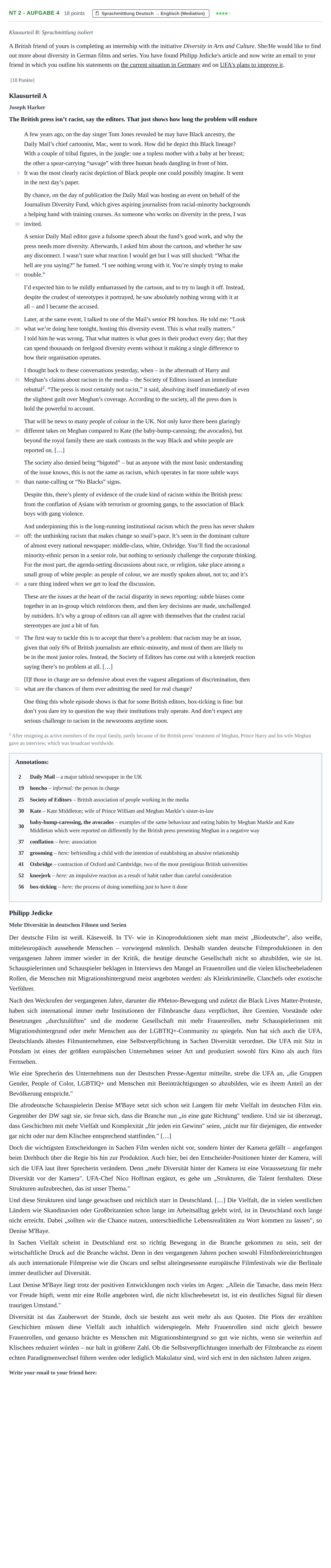
A British friend of yours is completing an internship with the initiative Diversity in Arts and Culture. She/He would like to find out more about diversity in German films and series. You have found Philipp Jedicke's article and now write an email to your friend in which you outline his statements on the current situation in Germany and on UFA's plans to improve it.
[18 Punkte]
Klausurteil A
Joseph Harker
The British press isn’t racist, say the editors. That just shows how long the problem will endure
A few years ago, on the day singer Tom Jones revealed he may have Black ancestry, the
Daily Mail’s chief cartoonist, Mac, went to work. How did he depict this Black lineage?
With a couple of tribal figures, in the jungle: one a topless mother with a baby at her breast;
the other a spear-carrying “savage” with three human heads dangling in front of him.
5 It was the most clearly racist depiction of Black people one could possibly imagine. It went
in the next day’s paper.
By chance, on the day of publication the Daily Mail was hosting an event on behalf of the
Journalism Diversity Fund, which gives aspiring journalists from racial-minority backgrounds
a helping hand with training courses. As someone who works on diversity in the press, I was
10 invited.
A senior Daily Mail editor gave a fulsome speech about the fund’s good work, and why the
press needs more diversity. Afterwards, I asked him about the cartoon, and whether he saw
any disconnect. I wasn’t sure what reaction I would get but I was still shocked: “What the
hell are you saying?” he fumed. “I see nothing wrong with it. You’re simply trying to make
15 trouble.”
I’d expected him to be mildly embarrassed by the cartoon, and to try to laugh it off. Instead,
despite the crudest of stereotypes it portrayed, he saw absolutely nothing wrong with it at
all – and I became the accused.
Later, at the same event, I talked to one of the Mail’s senior PR honchos. He told me: “Look
20 what we’re doing here tonight, hosting this diversity event. This is what really matters.”
I told him he was wrong. That what matters is what goes in their product every day; that they
can spend thousands on feelgood diversity events without it making a single difference to
how their organisation operates.
I thought back to these conversations yesterday, when – in the aftermath of Harry and
25 Meghan’s claims about racism in the media – the Society of Editors issued an immediate
rebuttal 2. “The press is most certainly not racist,” it said, absolving itself immediately of even
the slightest guilt over Meghan’s coverage. According to the society, all the press does is
hold the powerful to account.
That will be news to many people of colour in the UK. Not only have there been glaringly
30 different takes on Meghan compared to Kate (the baby-bump-caressing; the avocados), but
beyond the royal family there are stark contrasts in the way Black and white people are
reported on. […]
The society also denied being “bigoted” – but as anyone with the most basic understanding
of the issue knows, this is not the same as racism, which operates in far more subtle ways
35 than name-calling or “No Blacks” signs.
Despite this, there’s plenty of evidence of the crude kind of racism within the British press:
from the conflation of Asians with terrorism or grooming gangs, to the association of Black
boys with gang violence.
And underpinning this is the long-running institutional racism which the press has never shaken
40 off: the unthinking racism that makes change so snail’s-pace. It’s seen in the dominant culture
of almost every national newspaper: middle-class, white, Oxbridge. You’ll find the occasional
minority-ethnic person in a senior role, but nothing to seriously challenge the corporate thinking.
For the most part, the agenda-setting discussions about race, or religion, take place among a
small group of white people: as people of colour, we are mostly spoken about, not to; and it’s
45 a rare thing indeed when we get to lead the discussion.
These are the issues at the heart of the racial disparity in news reporting: subtle biases come
together in an in-group which reinforces them, and then key decisions are made, unchallenged
by outsiders. It’s why a group of editors can all agree with themselves that the crudest racial
stereotypes are just a bit of fun.
50 The first way to tackle this is to accept that there’s a problem: that racism may be an issue,
given that only 6% of British journalists are ethnic-minority, and most of them are likely to
be in the most junior roles. Instead, the Society of Editors has come out with a kneejerk reaction
saying there’s no problem at all. […]
[I]f those in charge are so defensive about even the vaguest allegations of discrimination, then
55 what are the chances of them ever admitting the need for real change?
One thing this whole episode shows is that for some British editors, box-ticking is fine: but
don’t you dare try to question the way their institutions truly operate. And don’t expect any
serious challenge to racism in the newsrooms anytime soon.
2 After resigning as active members of the royal family, partly because of the British press’ treatment of Meghan, Prince Harry and his wife Meghan gave an interview, which was broadcast worldwide.
Annotations:
2 · Daily Mail – a major tabloid newspaper in the UK
19 · honcho – informal: the person in charge
25 · Society of Editors – British association of people working in the media
30 · Kate – Kate Middleton; wife of Prince William and Meghan Markle’s sister-in-law
30 · baby-bump-caressing, the avocados – examples of the same behaviour and eating habits by Meghan Markle and Kate Middleton which were reported on differently by the British press presenting Meghan in a negative way
37 · conflation – here: association
37 · grooming – here: befriending a child with the intention of establishing an abusive relationship
41 · Oxbridge – contraction of Oxford and Cambridge, two of the most prestigious British universities
52 · kneejerk – here: an impulsive reaction as a result of habit rather than careful consideration
56 · box-ticking – here: the process of doing something just to have it done
Philipp Jedicke
Mehr Diversität in deutschen Filmen und Serien
Der deutsche Film ist weiß. Käseweiß. In TV- wie in Kinoproduktionen sieht man meist „Biodeutsche", also weiße, mitteleuropäisch aussehende Menschen – vorwiegend männlich. Deshalb standen deutsche Filmproduktionen in den vergangenen Jahren immer wieder in der Kritik, die heutige deutsche Gesellschaft nicht so abzubilden, wie sie ist. Schauspielerinnen und Schauspieler beklagen in Interviews den Mangel an Frauenrollen und die vielen klischeebeladenen Rollen, die Menschen mit Migrationshintergrund meist angeboten werden: als Kleinkriminelle, Clanchefs oder exotische Verführer.
Nach den Weckrufen der vergangenen Jahre, darunter die #Metoo-Bewegung und zuletzt die Black Lives Matter-Proteste, haben sich international immer mehr Institutionen der Filmbranche dazu verpflichtet, ihre Gremien, Vorstände oder Besetzungen „durchzulüften" und die moderne Gesellschaft mit mehr Frauenrollen, mehr Schauspielerinnen mit Migrationshintergrund oder mehr Menschen aus der LGBTIQ+-Community zu spiegeln. Nun hat sich auch die UFA, Deutschlands ältestes Filmunternehmen, eine Selbstverpflichtung in Sachen Diversität verordnet. Die UFA mit Sitz in Potsdam ist eines der größten europäischen Unternehmen seiner Art und produziert sowohl fürs Kino als auch fürs Fernsehen.
Wie eine Sprecherin des Unternehmens nun der Deutschen Presse-Agentur mitteilte, strebe die UFA an, „die Gruppen Gender, People of Color, LGBTIQ+ und Menschen mit Beeinträchtigungen so abzubilden, wie es ihrem Anteil an der Bevölkerung entspricht."
Die afrodeutsche Schauspielerin Denise M'Baye setzt sich schon seit Langem für mehr Vielfalt im deutschen Film ein. Gegenüber der DW sagt sie, sie freue sich, dass die Branche nun „in eine gute Richtung" tendiere. Und sie ist überzeugt, dass Geschichten mit mehr Vielfalt und Komplexität „für jeden ein Gewinn" seien, „nicht nur für diejenigen, die entweder gar nicht oder nur dem Klischee entsprechend stattfinden." […]
Doch die wichtigsten Entscheidungen in Sachen Film werden nicht vor, sondern hinter der Kamera gefällt – angefangen beim Drehbuch über die Regie bis hin zur Produktion. Auch hier, bei den Entscheider-Positionen hinter der Kamera, will sich die UFA laut ihrer Sprecherin verändern. Denn „mehr Diversität hinter der Kamera ist eine Voraussetzung für mehr Diversität vor der Kamera". UFA-Chef Nico Hoffman ergänzt, es gehe um „Strukturen, die Talent fernhalten. Diese Strukturen aufzubrechen, das ist unser Thema."
Und diese Strukturen sind lange gewachsen und reichlich starr in Deutschland. […] Die Vielfalt, die in vielen westlichen Ländern wie Skandinavien oder Großbritannien schon lange im Arbeitsalltag gelebt wird, ist in Deutschland noch lange nicht erreicht. Dabei „sollten wir die Chance nutzen, unterschiedliche Lebensrealitäten zu Wort kommen zu lassen", so Denise M'Baye.
In Sachen Vielfalt scheint in Deutschland erst so richtig Bewegung in die Branche gekommen zu sein, seit der wirtschaftliche Druck auf die Branche wächst. Denn in den vergangenen Jahren pochen sowohl Filmfördereinrichtungen als auch internationale Filmpreise wie die Oscars und selbst alteingesessene europäische Filmfestivals wie die Berlinale immer deutlicher auf Diversität.
Laut Denise M'Baye liegt trotz der positiven Entwicklungen noch vieles im Argen: „Allein die Tatsache, dass mein Herz vor Freude hüpft, wenn mir eine Rolle angeboten wird, die nicht klischeebesetzt ist, ist ein deutliches Signal für diesen traurigen Umstand."
Diversität ist das Zauberwort der Stunde, doch sie besteht aus weit mehr als aus Quoten. Die Plots der erzählten Geschichten müssen diese Vielfalt auch inhaltlich widerspiegeln. Mehr Frauenrollen sind nicht gleich bessere Frauenrollen, und genauso brächte es Menschen mit Migrationshintergrund so gut wie nichts, wenn sie weiterhin auf Klischees reduziert würden – nur halt in größerer Zahl. Ob die Selbstverpflichtungen innerhalb der Filmbranche zu einem echten Paradigmenwechsel führen werden oder lediglich Makulatur sind, wird sich erst in den nächsten Jahren zeigen.
Lösung
Nach den offiziellen Korrekturhinweisen
Write your email to your friend here:
Lösung: Dear [Friend's Name], I hope you're settling in well at Diversity in Arts and Culture! I just came across an interesting article by Philipp Jedicke discussing diversity in German films and television, which might be helpful for your internship. According to the article, German film productions are still predominantly white and male, failing to accurately reflect the reality of modern society. Actresses report a lack of roles for women, while actors with migrant backgrounds often find themselves cast in stereotypical roles, such as petty criminals or clan leaders. Germany has lagged behind countries like the UK or Scandinavia in terms of diversity, partly due to rigid and deeply entrenched structures. It is only recently, spurred on by movements like #MeToo and Black Lives Matter, as well as economic pressure from funding bodies and international festivals demanding diversity, that real change has started to occur. To improve this, UFA—Germany's oldest and one of its largest film production companies—has made a voluntary commitment to mirror German society by representing women, People of Color, LGBTIQ+ individuals, and people with disabilities in accordance with their share of the population. Crucially, UFA plans to implement these changes not only on screen but also behind the camera (directors, screenwriters, producers), recognizing that breaking open traditional power structures behind the scenes is essential for achieving genuine, non-stereotypical diversity in stories. I hope this gives you some useful context! Let me know if you need any more details. Best wishes, [Your Name]
Write an email in which you outline Jedicke's statements on the current situation in Germany and on UFA's plans to improve it.
Lösung:
Die ausführliche Erklärung Schritt für Schritt (mit KI) gibt es mit Premium. Premium
Löse sie direkt hier: automatische Korrektur, Hinweise und Lösung Schritt für Schritt.
‹ Aufgabe NT 1 - Aufgabe 4 · GK · Nachtermin · Weiterbildungskolleg 2022 · Aufgabe NT 3 - Aufgabe 4 · GK · Nachtermin · Weiterbildungskolleg 2022 ›
Mehr Aufgaben zu Sprachmittlung Deutsch → Englisch (Mediation)
- Aufgabe HT 3 - Aufgabe 4 · GK · Haupttermin · Weiterbildungskolleg 2022
- Aufgabe 4 (NT 1) · GK · Nachtermin 2022
- Aufgabe 4 (NT 2) · GK · Nachtermin 2022
- Aufgabe 4 (NT 3) · GK · Nachtermin 2022
- Aufgabe NT 1 - Aufgabe 4 · GK · Nachtermin · Weiterbildungskolleg 2022
- Aufgabe NT 3 - Aufgabe 4 · GK · Nachtermin · Weiterbildungskolleg 2022
- Aufgabe HT 1 - Task 4 · LK · Haupttermin 2022
- Aufgabe HT 2 - Task 4 · LK · Haupttermin 2022
- Aufgabe HT 3 - Task 4 · LK · Haupttermin 2022
- Aufgabe HT 1 - Aufgabe 4 · LK · Haupttermin · Weiterbildungskolleg 2022