Aufgabe NT 1 - Aufgabe 4 · Abitur NRW Englisch GK · Nachtermin · Weiterbildungskolleg 2022
Thema: Sprachmittlung Deutsch → Englisch (Mediation) · Aus der Prüfung GK · Nachtermin · Weiterbildungskolleg (2022)
Aufgabenstellung
Klausurteil A
Uzodinma Iweala
Speak No Evil
The novel centres on the narrator Niru and his family, who have Nigerian roots and live in Washington, D. C..
The airplane rumbles to a full stop, shaking the luggage in the bins overhead and the seat
backs in front. I watch my father relax his grip on the armrest, cross himself and mutter a
silent prayer of thanks before he opens his eyes to cast sideways glances at the passengers
already standing in the aisle. See our people, my father says, but I press my forehead against
5 the window and look out at the carcasses of scrapped airplanes rusting in the tall grass by
the tarmac. [...]
My father becomes an entirely different man when we come to Nigeria. OJ came up with a
term for the condition during a trip we took the summer after his first year in medical school.
He said Daddy had a bad case of Nigeriatoma, an acute swelling of ego and pride that affects
10 diaspora Nigerian men, rendering them unable to accept the idea that a true home might exist
outside of their birth country. Symptoms may vary but are exceptionally pronounced upon
return to native soil and include hyperactivity, elevated mood, grandiose thinking and increased
aggression. The differential includes bipolar disorder and indeed those afflicted have much in
common with patients observed in the thrall of a manic episode. The duration of symptoms
15 may vary, but poor electricity, bad roads and exposure to extreme heat have proven effective
as treatment. My mother laughed at that, my father too, but only because OJ said it. [...]
I’ve always felt weird about coming to Nigeria. Everything is always so overwhelming and
aggressive from the moment we step out of the airport and into a country that my father loves
so deeply he had to run away from it. But I’ve never had a choice. No one has ever asked me.
20 Each summer my father’s momentum dragged us all home. His excitement sent my mother
to the big-box stores to buy clothes, shoes and handbags to distribute to the aunties and uncles
in the village. In the weeks leading up to each trip, he grew restless and wondered why OJ
and I didn’t share his level of enthusiasm. OJ was smart enough to keep his mouth shut and
nod when my father said, come on boys, show some excitement, we’re going home. I never
25 learned. But this is home, I said once as we sat at the kitchen table. No it’s not, my father
snapped, this place is not your home not now, not ever. He speared a piece of beef with his
fork and then let the utensil clatter against the plate. I stared across the table into my
father’s eyes searching for some recognition that here in Washington, we had our own
house full of our things, pictures of us as a family, books collected over the years, my toys,
30 random trinkets. Here my parents drove their own cars and always knew where they were
going. We had our church, and they had jobs they went to every single day. On some days
the word Nigeria never even leaves your mouth, I wanted to shout. My father’s face gave
nothing. He said, Nigeria is home.
But no matter how many times we came “home”, everything was so uncomfortable for me.
35 My father never seemed to notice that his shirt stuck to his back with sweat, or if he noticed
he didn’t care. I hated the fact that everyone walked around in a cloud of body odor so thick
it almost formed a visible aura around them. I hated the discomfort sitting in traffic, discomfort
sitting in the darkness when the power went out – it was always going out – the constant
vibration of the generators and their exhaust fumes. [...]
40 I wanted to ask how I should really feel about streets packed with potholes and gutters full
to the brim with trash and sludge. I wanted to know how to relax when the cars beside you
drove so close that you could see the red veins in the drivers’ eyes because everyone treated
the lane dividers as suggestions. It was almost too confusing to see the old and decrepit so
close to the new and shiny, the jalopies held together by string and prayer next to brand-new
45 Mercedes SUVs, the straw, palm leaf and plywood squatter settlements next to white walls
protecting the large sparkling glass windows of unreasonably sized mansions that would
have looked more comfortable in Hollywood. And everywhere there were people, some going
places, some unmoving and happy to let the world happen around them, but covering every
free space with a visible sense of entitlement no matter how tattered or well-kept their clothing.
50 I had the irrational fear that I would disappear into the mess of all these people and never be
seen or heard from again.
Annotations:
7 OJ – Niru’s brother
13 bipolar disorder – a mental health condition causing extreme mood swings that include emotional highs (mania) and lows (depression)
44 jalopy – an old car in bad condition
Klausurteil B: Sprachmittlung isoliert
Luise Sammann: Mehrsprachiges Aufwachsen: Wie Kinder fließend Deutsch lernen
Bei diesem Text handelt es sich um einen Ausschnitt aus einem umfangreicheren Artikel zum Thema Immigration und Mehrsprachigkeit in Deutschland.
Jahrzehntelang galt das Credo: Zu Hause muss Deutsch gesprochen werden. Nur dann sei die Integration zugezogener Familien möglich. Aber die Forschung zeigt: Kinder müssen nicht die Sprache ihrer Eltern vergessen, um eine andere zu lernen. [...]
Nani Rostamian kam mit ihren Eltern und den drei älteren Geschwistern nach Deutschland, als sie sieben Jahre alt war. 30 Jahre später sitzt sie in ihrer Berliner Neubauwohnung und erinnert sich.
„Meine Eltern hatten ja gerade andere Probleme und Sorgen, erstmal hier sich zu setteln und Fuß zu fassen. Das war mit vielen Schwierigkeiten verbunden. Das heißt, sie hatten eigentlich nur einen Appell an uns. Und zwar: Lernt die Sprache jetzt so schnell wie möglich, weil wir sonst hier ein wenig aufgeschmissen sind.“
Der Appell der Eltern kam an. Innerhalb kürzester Zeit lernten Nani und ihre Geschwister Deutsch, durften den Förderunterricht verlassen, den sie anfangs noch nach Schulschluss hatten besuchen müssen. Wegen ihrer Sprachbegabung ging Nani später gar auf ein bilingual englisch-deutsches Gymnasium, studierte dann Medizin. Heute arbeitet sie als Chirurgin an einem Berliner Krankenhaus.
Für die deutsche Mehrheitsgesellschaft könnte die hübsche junge Frau mit den schwarzen Haaren und dem offenen Lächeln als eine Art „Vorzeigemigrantin“ herhalten. Das Bundesministerium für Migration und Flüchtlinge in Berlin wirbt auf seiner Website gern mit Geschichten wie ihrer. Doch von dem Preis, den die heute 37-Jährige für ihren Erfolg zahlte, steht nichts in ihrem Lebenslauf.
„Ich spreche gebrochen Farsi. Das ist das abgehakelte Farsi eines Kindes. Ich kann eigentlich auch nicht richtig lesen und schreiben auf Persisch. Dadurch haben wir auch unsere Verbindung zu den Verwandten ganz schön verloren eigentlich. Ja.“
Auch mit den eigenen Eltern, die neben der Erziehung ihrer vier Kinder und der Arbeit im neuen Land nie so gut Deutsch lernten wie Nani und ihre Geschwister, kann die Tochter heute nicht mehr über alles sprechen.
„Ich kann mit ihnen zum Beispiel nicht über Medizin sprechen richtig. Über meinen Beruf. Und wenn ich dann mal unbedingt was erklären soll, dann greife ich zu Stift und Papier oder hole meinen Anatomieatlas und zeige, was ich meine. [...]“
Während Nani spricht, wiegt sie ihre zwei Wochen alte Tochter Lilou in den Armen. Weil sie selbst ihre einstige Muttersprache kaum noch beherrscht, kann sie sie nicht an ihre Kinder weitergeben. Zumindest an Traditionen aber, das hat sie sich geschworen, soll es in ihrer jungen Familie nie mangeln. Ganz gleich aus welcher Kultur sie stammen.
„Bei uns ist es tatsächlich ein sehr schleichender Prozess gewesen des sich Integrierens, beziehungsweise die eigenen Wurzeln zu vergessen, muss man eigentlich sagen. Wir haben die persischen Festtage anfangs gefeiert, und dann wurde es immer schwieriger, das aufrecht zu erhalten. Viele Festtage fielen dann auf Wochentage, die halt hier keine Feiertage sind, und irgendwann fielen immer mehr die persischen Feiertage weg, bis wir nur noch das Neujahrsfest gefeiert haben. Und irgendwann wurde das auch zu unpraktikabel.“
Stattdessen stellten die Eltern eines Tages im Dezember einen Weihnachtsbaum auf. Kauften den Kindern Geschenke, damit sie gleichzeitig mit ihren Klassenkameraden beschenkt wurden. Die Traditionen, mit denen sie selbst einst groß geworden waren, spielten kaum noch eine Rolle im Leben der Familie. Den Rahmen, der ihr selbst oft gefehlt habe, will Nani ihren eigenen Kindern von Anfang an mitgeben. [...] „[D]as haben meine Eltern nicht hinbekommen.“
Eltern, die ihr Bestes gegeben – ihre vier Kinder in einem fremden Land groß gezogen und auf die Universität geschickt haben. Und die dabei eigentlich nur das taten, was die deutsche Mehrheitsgesellschaft von Einwanderern verlangt: Integriert euch, lernt Deutsch.
4.
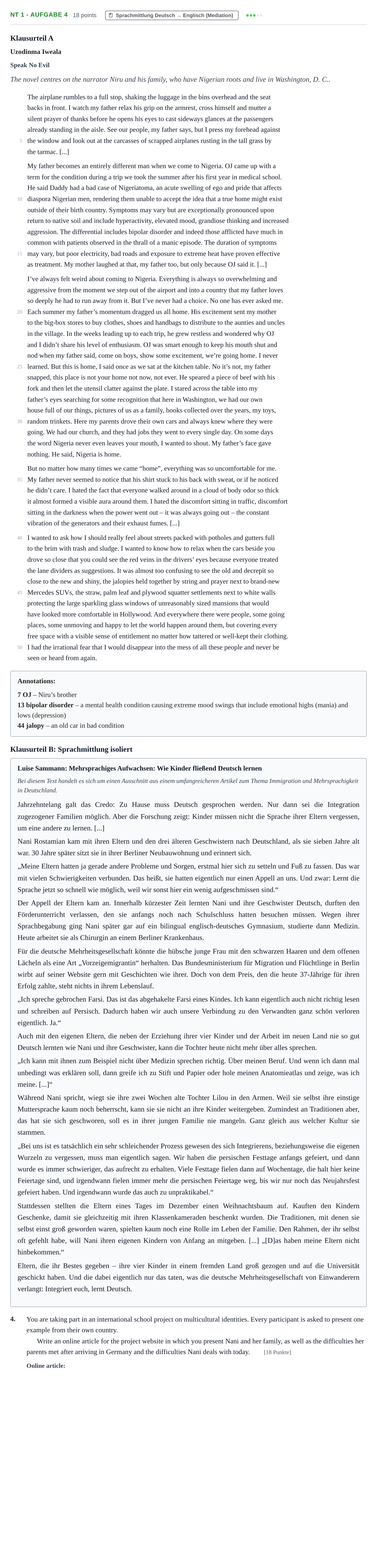
You are taking part in an international school project on multicultural identities. Every participant is asked to present one example from their own country.
Write an online article for the project website in which you present Nani and her family, as well as the difficulties her parents met after arriving in Germany and the difficulties Nani deals with today. [18 Punkte]
Lösung
Nach den offiziellen Korrekturhinweisen
4. Write an online article for the project website in which you present Nani and her family, as well as the difficulties her parents met after arriving in Germany and the difficulties Nani deals with today. (Mediation) (18 Punkte)
Lösung: Sample answer / Content requirements (online article): Title / Headline: e.g. *Success at a High Price – Growing Up Between Cultures in Germany* Introduction: Briefly engage the reader and introduce the context of the international project on multicultural identities. Presentation of Nani and her family: - Nani arrived in Germany from Iran at age seven as the youngest of four children. - Today, at 37, she is a successful surgeon at a hospital in Berlin and a mother of a newborn daughter (Lilou). Challenges faced by Nani's parents: - Overcoming significant language hurdles upon arrival. - Settling in, making a living, and securing the family's livelihood in a new country. - Establishing new social networks and relationships in an unfamiliar environment. - Urging their children to learn German quickly as a survival strategy. Challenges faced by Nani today: - Limited communication skills in her native language (Farsi), which she only speaks at a child's level and cannot read or write properly. - Language and communication barriers within the family: she cannot discuss her medical profession with her parents in German or Farsi without visual aids, and she has lost close contact with relatives abroad. - Inability to pass on her mother tongue to her daughter. - Dilemma between wanting to preserve cultural traditions and the inability or practical difficulties of maintaining them in daily life.
Die ausführliche Erklärung Schritt für Schritt (mit KI) gibt es mit Premium. Premium
Löse sie direkt hier: automatische Korrektur, Hinweise und Lösung Schritt für Schritt.
‹ Aufgabe 4 (NT 3) · GK · Nachtermin 2022 · Aufgabe NT 2 - Aufgabe 4 · GK · Nachtermin · Weiterbildungskolleg 2022 ›
Mehr Aufgaben zu Sprachmittlung Deutsch → Englisch (Mediation)
- Aufgabe HT 2 - Aufgabe 4 · GK · Haupttermin · Weiterbildungskolleg 2022
- Aufgabe HT 3 - Aufgabe 4 · GK · Haupttermin · Weiterbildungskolleg 2022
- Aufgabe 4 (NT 1) · GK · Nachtermin 2022
- Aufgabe 4 (NT 2) · GK · Nachtermin 2022
- Aufgabe 4 (NT 3) · GK · Nachtermin 2022
- Aufgabe NT 2 - Aufgabe 4 · GK · Nachtermin · Weiterbildungskolleg 2022
- Aufgabe NT 3 - Aufgabe 4 · GK · Nachtermin · Weiterbildungskolleg 2022
- Aufgabe HT 1 - Task 4 · LK · Haupttermin 2022
- Aufgabe HT 2 - Task 4 · LK · Haupttermin 2022
- Aufgabe HT 3 - Task 4 · LK · Haupttermin 2022