Part 2 · Inglés Selectividad Cataluña Juny Serie 5 2026
Tema: Reading comprehension · Del examen Juny Serie 5 (2026)
Enunciado
Part 2: Reading comprehension
THE SCIENCE OF FEAR: HOW IT AFFECTS YOUR BODY AND MIND
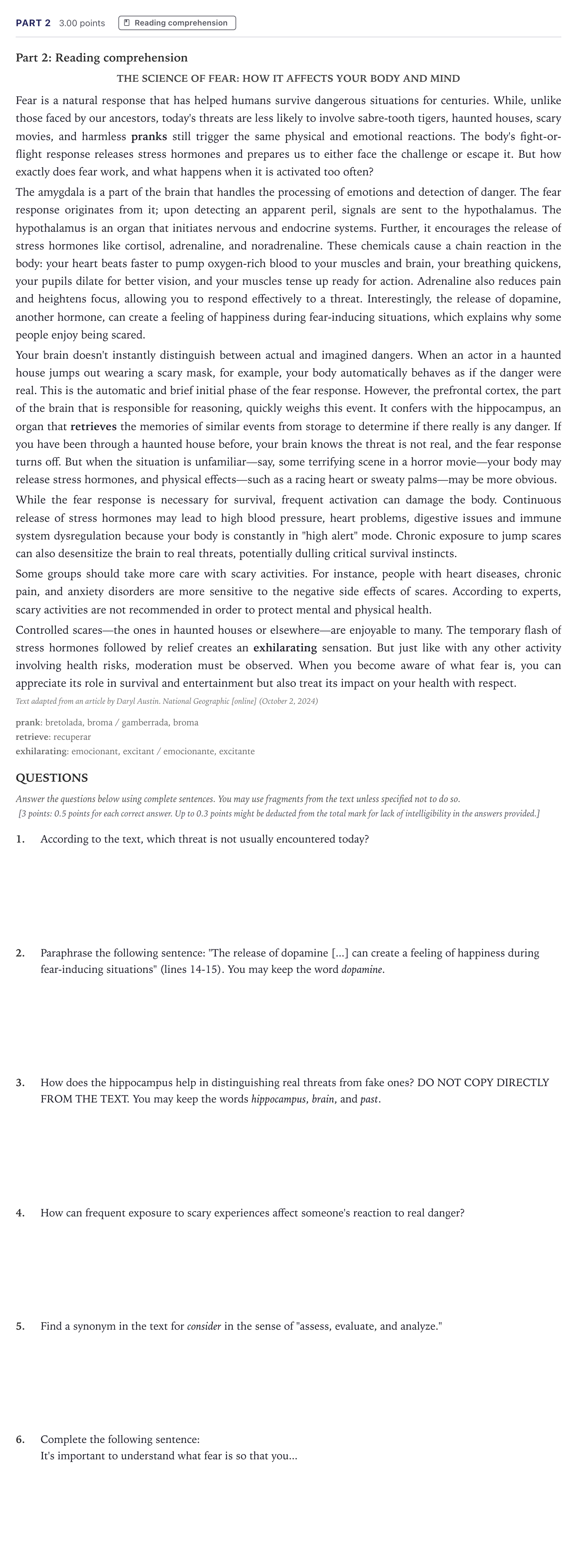
Fear is a natural response that has helped humans survive dangerous situations for centuries. While, unlike those faced by our ancestors, today's threats are less likely to involve sabre-tooth tigers, haunted houses, scary movies, and harmless pranks still trigger the same physical and emotional reactions. The body's fight-or-flight response releases stress hormones and prepares us to either face the challenge or escape it. But how exactly does fear work, and what happens when it is activated too often?
The amygdala is a part of the brain that handles the processing of emotions and detection of danger. The fear response originates from it; upon detecting an apparent peril, signals are sent to the hypothalamus. The hypothalamus is an organ that initiates nervous and endocrine systems. Further, it encourages the release of stress hormones like cortisol, adrenaline, and noradrenaline. These chemicals cause a chain reaction in the body: your heart beats faster to pump oxygen-rich blood to your muscles and brain, your breathing quickens, your pupils dilate for better vision, and your muscles tense up ready for action. Adrenaline also reduces pain and heightens focus, allowing you to respond effectively to a threat. Interestingly, the release of dopamine, another hormone, can create a feeling of happiness during fear-inducing situations, which explains why some people enjoy being scared.
Your brain doesn't instantly distinguish between actual and imagined dangers. When an actor in a haunted house jumps out wearing a scary mask, for example, your body automatically behaves as if the danger were real. This is the automatic and brief initial phase of the fear response. However, the prefrontal cortex, the part of the brain that is responsible for reasoning, quickly weighs this event. It confers with the hippocampus, an organ that retrieves the memories of similar events from storage to determine if there really is any danger. If you have been through a haunted house before, your brain knows the threat is not real, and the fear response turns off. But when the situation is unfamiliar—say, some terrifying scene in a horror movie—your body may release stress hormones, and physical effects—such as a racing heart or sweaty palms—may be more obvious.
While the fear response is necessary for survival, frequent activation can damage the body. Continuous release of stress hormones may lead to high blood pressure, heart problems, digestive issues and immune system dysregulation because your body is constantly in "high alert" mode. Chronic exposure to jump scares can also desensitize the brain to real threats, potentially dulling critical survival instincts.
Some groups should take more care with scary activities. For instance, people with heart diseases, chronic pain, and anxiety disorders are more sensitive to the negative side effects of scares. According to experts, scary activities are not recommended in order to protect mental and physical health.
Controlled scares—the ones in haunted houses or elsewhere—are enjoyable to many. The temporary flash of stress hormones followed by relief creates an exhilarating sensation. But just like with any other activity involving health risks, moderation must be observed. When you become aware of what fear is, you can appreciate its role in survival and entertainment but also treat its impact on your health with respect.
Text adapted from an article by Daryl Austin. National Geographic [online] (October 2, 2024)
prank: bretolada, broma / gamberrada, broma
retrieve: recuperar
exhilarating: emocionant, excitant / emocionante, excitante
QUESTIONS
Answer the questions below using complete sentences. You may use fragments from the text unless specified not to do so.
[3 points: 0.5 points for each correct answer. Up to 0.3 points might be deducted from the total mark for lack of intelligibility in the answers provided.]
1.
According to the text, which threat is not usually encountered today?
2.
Paraphrase the following sentence: "The release of dopamine [...] can create a feeling of happiness during fear-inducing situations" (lines 14-15). You may keep the word dopamine.
3.
How does the hippocampus help in distinguishing real threats from fake ones? DO NOT COPY DIRECTLY FROM THE TEXT. You may keep the words hippocampus, brain, and past.
4.
How can frequent exposure to scary experiences affect someone's reaction to real danger?
5.
Find a synonym in the text for consider in the sense of "assess, evaluate, and analyze."
6.
Complete the following sentence:
It's important to understand what fear is so that you...
Solución
Según los criterios oficiales de corrección
1. According to the text, which threat is not usually encountered today?
Solución: Sabre-tooth tigers are not usually encountered anymore.
2. Paraphrase the following sentence: "The release of dopamine [...] can create a feeling of happiness during fear-inducing situations" (lines 14-15). You may keep the word dopamine.
Solución: The production of dopamine can cause a sense of joy/satisfaction/bliss when experiencing/during/in frightening moments/events. (among others)
3. How does the hippocampus help in distinguishing real threats from fake ones? DO NOT COPY DIRECTLY FROM THE TEXT. You may keep the words hippocampus, brain, and past.
Solución: The hippocampus recalls familiar past events/thoughts/actions to aid the brain know whether the present danger is true or unreal. (among others)
4. How can frequent exposure to scary experiences affect someone's reaction to real danger?
Solución: Frequent exposure to scary experiences can desensitize the brain, reducing its ability to react strongly to real threats.
5. Find a synonym in the text for consider in the sense of "assess, evaluate, and analyze."
Solución: weigh(s) (line 20)
6. Complete the following sentence: It's important to understand what fear is so that you...
Solución: ... can appreciate its role in survival and entertainment but also treat its impact on your health with respect.
La explicación paso a paso, hecha con IA, es Premium. Premium
Resuélvelo aquí mismo: corrección automática, pistas y solución paso a paso.
‹ Part 2: Reading comprehension · Juny Serie 1 2026 · Part 2: Reading comprehension · Setembre Serie 2 2026 ›
Más ejercicios de Reading comprehension
- Part 2: Reading comprehension · Juny Serie 1 2026
- Part 2: Reading comprehension · Setembre Serie 2 2026
- Part 2: Reading comprehension · Juny Serie 1 2025
- Part 2: Reading comprehension · Juny Serie 4 2025
- Part 2: Reading comprehension · Setembre Serie 3 2025
- Part 2: Reading comprehension · Juny Serie 1 2024
- Part 2: Reading comprehension · Juny Serie 5 2024
- Part 2: Reading comprehension · Setembre Serie 3 2024
- Part 2: Reading comprehension · Juny Serie 1 2023
- Part 2 · Juny Serie 5 2023
Exámenes oficiales en PDF y soluciones: examenselectivitat.cat