Part 2: Reading comprehension · Inglés Selectividad Cataluña Setembre Serie 1 2021
Tema: Reading comprehension · Del examen Setembre Serie 1 (2021)
Enunciado
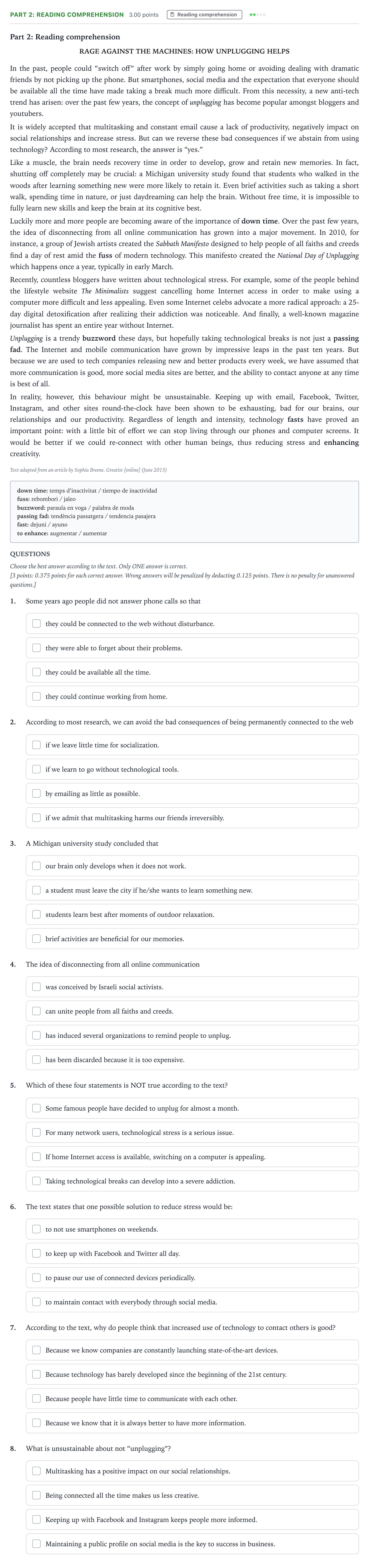
Part 2: Reading comprehension
RAGE AGAINST THE MACHINES: HOW UNPLUGGING HELPS
In the past, people could “switch off” after work by simply going home or avoiding dealing with dramatic friends by not picking up the phone. But smartphones, social media and the expectation that everyone should be available all the time have made taking a break much more difficult. From this necessity, a new anti-tech trend has arisen: over the past few years, the concept of unplugging has become popular amongst bloggers and youtubers.
It is widely accepted that multitasking and constant email cause a lack of productivity, negatively impact on social relationships and increase stress. But can we reverse these bad consequences if we abstain from using technology? According to most research, the answer is “yes.”
Like a muscle, the brain needs recovery time in order to develop, grow and retain new memories. In fact, shutting off completely may be crucial: a Michigan university study found that students who walked in the woods after learning something new were more likely to retain it. Even brief activities such as taking a short walk, spending time in nature, or just daydreaming can help the brain. Without free time, it is impossible to fully learn new skills and keep the brain at its cognitive best.
Luckily more and more people are becoming aware of the importance of down time. Over the past few years, the idea of disconnecting from all online communication has grown into a major movement. In 2010, for instance, a group of Jewish artists created the Sabbath Manifesto designed to help people of all faiths and creeds find a day of rest amid the fuss of modern technology. This manifesto created the National Day of Unplugging which happens once a year, typically in early March.
Recently, countless bloggers have written about technological stress. For example, some of the people behind the lifestyle website The Minimalists suggest cancelling home Internet access in order to make using a computer more difficult and less appealing. Even some Internet celebs advocate a more radical approach: a 25-day digital detoxification after realizing their addiction was noticeable. And finally, a well-known magazine journalist has spent an entire year without Internet.
Unplugging is a trendy buzzword these days, but hopefully taking technological breaks is not just a passing fad. The Internet and mobile communication have grown by impressive leaps in the past ten years. But because we are used to tech companies releasing new and better products every week, we have assumed that more communication is good, more social media sites are better, and the ability to contact anyone at any time is best of all.
In reality, however, this behaviour might be unsustainable. Keeping up with email, Facebook, Twitter, Instagram, and other sites round-the-clock have been shown to be exhausting, bad for our brains, our relationships and our productivity. Regardless of length and intensity, technology fasts have proved an important point: with a little bit of effort we can stop living through our phones and computer screens. It would be better if we could re-connect with other human beings, thus reducing stress and enhancing creativity.
Text adapted from an article by Sophia Breene. Greatist [online] (June 2015)
down time: temps d’inactivitat / tiempo de inactividad
fuss: rebombori / jaleo
buzzword: paraula en voga / palabra de moda
passing fad: tendència passatgera / tendencia pasajera
fast: dejuni / ayuno
to enhance: augmentar / aumentar
QUESTIONS
Choose the best answer according to the text. Only ONE answer is correct.
[3 points: 0.375 points for each correct answer. Wrong answers will be penalized by deducting 0.125 points. There is no penalty for unanswered questions.]
.
Solución
Según los criterios oficiales de corrección
1. Some years ago people did not answer phone calls so that
Solución: they were able to forget about their problems.
2. According to most research, we can avoid the bad consequences of being permanently connected to the web
Solución: if we learn to go without technological tools.
3. A Michigan university study concluded that
Solución: students learn best after moments of outdoor relaxation.
4. The idea of disconnecting from all online communication
Solución: has induced several organizations to remind people to unplug.
5. Which of these four statements is NOT true according to the text?
Solución: Taking technological breaks can develop into a severe addiction.
6. The text states that one possible solution to reduce stress would be:
Solución: to pause our use of connected devices periodically.
7. According to the text, why do people think that increased use of technology to contact others is good?
Solución: Because we know companies are constantly launching state-of-the-art devices.
8. What is unsustainable about not “unplugging”?
Solución: Being connected all the time makes us less creative.
La explicación paso a paso, hecha con IA, es Premium. Premium
Resuélvelo aquí mismo: corrección automática, pistas y solución paso a paso.
‹ Part 2: Reading comprehension · Juny Serie 5 2021
Más ejercicios de Reading comprehension
- Part 2: Reading comprehension · Juny Serie 2 2022
- Part 2: Reading comprehension · Juny Serie 5 2022
- Part 2: Reading comprehension · Setembre Serie 3 2022
- Part 2: Reading comprehension · Juny Serie 2 2021
- Part 2: Reading comprehension · Juny Serie 5 2021
Exámenes oficiales en PDF y soluciones: examenselectivitat.cat