Ejercicio 1.1 · Inglés PAU Galicia Ordinaria 2026
Tema: Verdadero, falso o no se dice, con cita del texto (True/False/Not Given) · Del examen Ordinaria (2026)
Enunciado
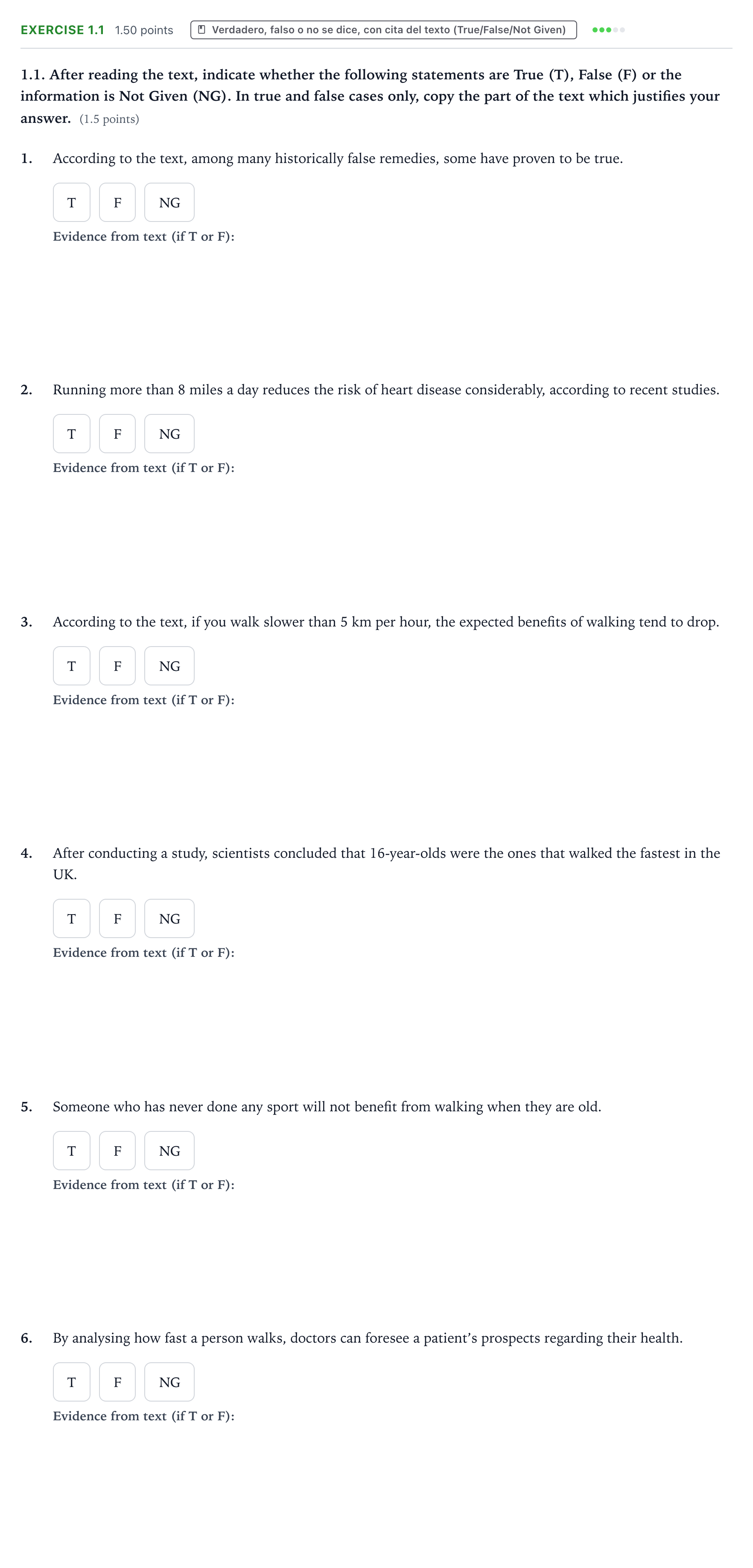
1.1. After reading the text, indicate whether the following statements are True (T), False (F) or the information is Not Given (NG). In true and false cases only, copy the part of the text which justifies your answer. (1.5 points)
.
Solución
Según los criterios oficiales de corrección
1. According to the text, among many historically false remedies, some have proven to be true.
Solución: True (T)
Evidence: According to the text, among many historically false remedies, some have proven to be true.
Solución: "Yet, amid the hype and hollow claims, a few golden truths remain."
2. Running more than 8 miles a day reduces the risk of heart disease considerably, according to recent studies.
Solución: Not Given (NG)
Evidence: Running more than 8 miles a day reduces the risk of heart disease considerably, according to recent studies.
Solución: No justification needed (Not Given)
3. According to the text, if you walk slower than 5 km per hour, the expected benefits of walking tend to drop.
Solución: Not Given (NG)
Evidence: According to the text, if you walk slower than 5 km per hour, the expected benefits of walking tend to drop.
Solución: No justification needed (Not Given)
4. After conducting a study, scientists concluded that 16-year-olds were the ones that walked the fastest in the UK.
Solución: False (F)
Evidence: After conducting a study, scientists concluded that 16-year-olds were the ones that walked the fastest in the UK.
Solución: "...by middle age, a lifetime of brisk walking reduces biological age by up to 16 years compared to a lifetime of slow walking."
5. Someone who has never done any sport will not benefit from walking when they are old.
Solución: False (F)
Evidence: Someone who has never done any sport will not benefit from walking when they are old.
Solución: "A follow-up study suggested it is never too late to benefit from brisk walking. An inactive 60-year-old woman or man was modelled to gain around an additional year of life expectancy through simply introducing a ten-minute brisk walk into their daily routine."
6. By analysing how fast a person walks, doctors can foresee a patient’s prospects regarding their health.
Solución: True (T)
Evidence: By analysing how fast a person walks, doctors can foresee a patient’s prospects regarding their health.
Solución: "The power of brisk walking can also be seen in its ability to predict future health outcomes." / "In fact, perhaps the single most informative question a doctor could ask their patient is: 'How fast is your walking pace in comparison to other people?'"
La explicación paso a paso, hecha con IA, es Premium. Premium
Resuélvelo aquí mismo: corrección automática, pistas y solución paso a paso.
‹ Ejercicio 1.1 · Extraordinaria (2ª lengua extranjera) 2026 · Ejercicio 1.1 · Ordinaria (2ª lengua extranjera) 2026 ›
Más ejercicios de Verdadero, falso o no se dice, con cita del texto (True/False/Not Given)
- Ejercicio 1.1 · Extraordinaria 2026
- Ejercicio 1.1 · Extraordinaria (2ª lengua extranjera) 2026
- Ejercicio 1.1 · Ordinaria (2ª lengua extranjera) 2026
- Ejercicio 1.1 · Extraordinaria 2025
- Ejercicio 1.1 · Extraordinaria (2ª lengua extranjera) 2025
- Ejercicio 1.1 · Ordinaria 2025
- Ejercicio 1.1 · Ordinaria (2ª lengua extranjera) 2025
- Ejercicio 1.1 · Extraordinaria 2024
- Ejercicio 2.1 · Extraordinaria 2024
- Ejercicio 1.1 · Extraordinaria (2ª lengua extranjera) 2024