Ejercicio 1.1 · Inglés PAU Galicia Extraordinaria 2026
Tema: Verdadero, falso o no se dice, con cita del texto (True/False/Not Given) · Del examen Extraordinaria (2026)
Enunciado
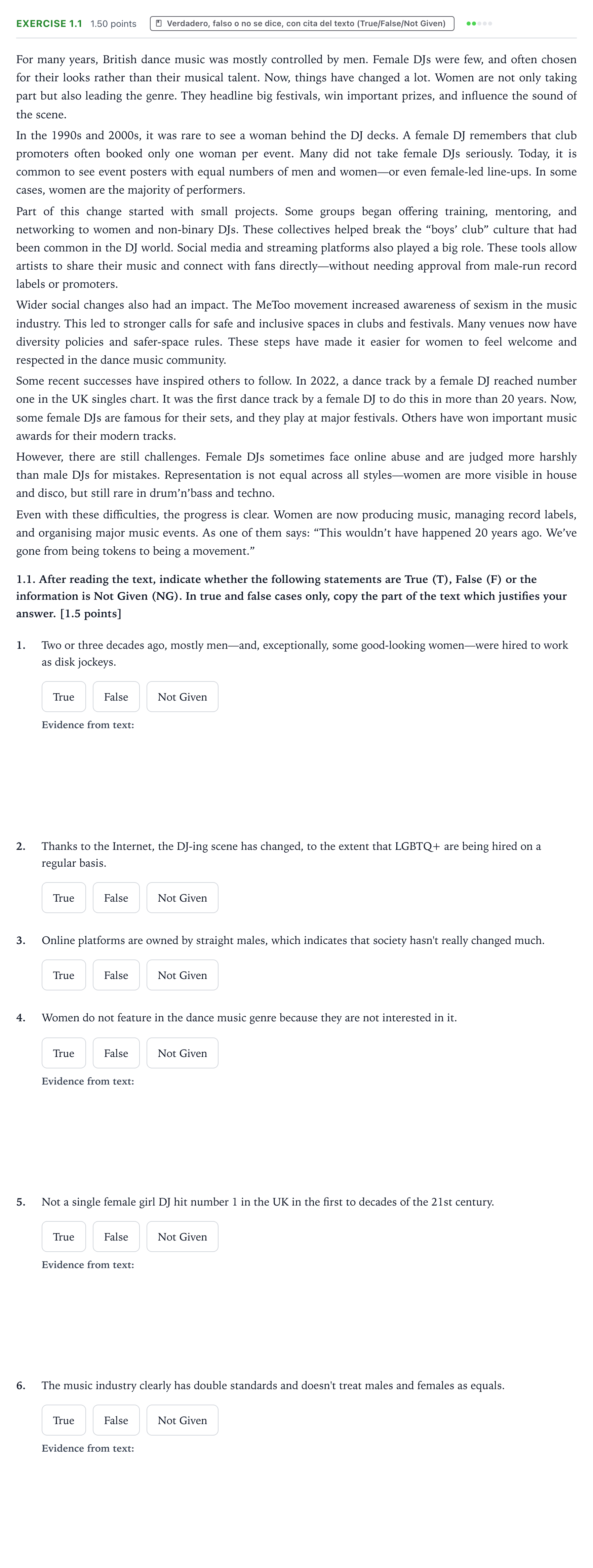
For many years, British dance music was mostly controlled by men. Female DJs were few, and often chosen for their looks rather than their musical talent. Now, things have changed a lot. Women are not only taking part but also leading the genre. They headline big festivals, win important prizes, and influence the sound of the scene.
In the 1990s and 2000s, it was rare to see a woman behind the DJ decks. A female DJ remembers that club promoters often booked only one woman per event. Many did not take female DJs seriously. Today, it is common to see event posters with equal numbers of men and women—or even female-led line-ups. In some cases, women are the majority of performers.
Part of this change started with small projects. Some groups began offering training, mentoring, and networking to women and non-binary DJs. These collectives helped break the “boys’ club” culture that had been common in the DJ world. Social media and streaming platforms also played a big role. These tools allow artists to share their music and connect with fans directly—without needing approval from male-run record labels or promoters.
Wider social changes also had an impact. The MeToo movement increased awareness of sexism in the music industry. This led to stronger calls for safe and inclusive spaces in clubs and festivals. Many venues now have diversity policies and safer-space rules. These steps have made it easier for women to feel welcome and respected in the dance music community.
Some recent successes have inspired others to follow. In 2022, a dance track by a female DJ reached number one in the UK singles chart. It was the first dance track by a female DJ to do this in more than 20 years. Now, some female DJs are famous for their sets, and they play at major festivals. Others have won important music awards for their modern tracks.
However, there are still challenges. Female DJs sometimes face online abuse and are judged more harshly than male DJs for mistakes. Representation is not equal across all styles—women are more visible in house and disco, but still rare in drum’n’bass and techno.
Even with these difficulties, the progress is clear. Women are now producing music, managing record labels, and organising major music events. As one of them says: “This wouldn’t have happened 20 years ago. We’ve gone from being tokens to being a movement.”
1.1. After reading the text, indicate whether the following statements are True (T), False (F) or the information is Not Given (NG). In true and false cases only, copy the part of the text which justifies your answer. [1.5 points]
1.
Two or three decades ago, mostly men—and, exceptionally, some good-looking women—were hired to work as disk jockeys.
2.
Thanks to the Internet, the DJ-ing scene has changed, to the extent that LGBTQ+ are being hired on a regular basis.
3.
Online platforms are owned by straight males, which indicates that society hasn't really changed much.
4.
Women do not feature in the dance music genre because they are not interested in it.
5.
Not a single female girl DJ hit number 1 in the UK in the first to decades of the 21st century.
6.
The music industry clearly has double standards and doesn't treat males and females as equals.
Solución
Según los criterios oficiales de corrección
1. Two or three decades ago, mostly men—and, exceptionally, some good-looking women—were hired to work as disk jockeys.
Solución: True
1. Justification evidence
Solución: "Female DJs were few, and often chosen for their looks rather than their musical talent" / "In the 1990s and 2000s, it was rare to see a woman behind the DJ decks. A female DJ remembers that club promoters often booked only one woman per event. Many did not take female DJs seriously."
2. Thanks to the Internet, the DJ-ing scene has changed, to the extent that LGBTQ+ are being hired on a regular basis.
Solución: Not Given
3. Online platforms are owned by straight males, which indicates that society hasn't really changed much.
Solución: Not Given
4. Women do not feature in the dance music genre because they are not interested in it.
Solución: False
4. Justification evidence
Solución: "Women are not only taking part but also leading the genre." / "Women are now producing music, managing record labels, and organising major music events."
5. Not a single female girl DJ hit number 1 in the UK in the first to decades of the 21st century.
Solución: True
5. Justification evidence
Solución: "In 2022, a dance track by a female DJ reached number one in the UK singles chart. It was the first dance track by a female DJ to do this in more than 20 years."
6. The music industry clearly has double standards and doesn't treat males and females as equals.
Solución: True
6. Justification evidence
Solución: "Female DJs sometimes face online abuse and are judged more harshly than male DJs for mistakes."
La explicación paso a paso, hecha con IA, es Premium. Premium
Resuélvelo aquí mismo: corrección automática, pistas y solución paso a paso.
Ejercicio 1.1 · Extraordinaria (2ª lengua extranjera) 2026 ›
Más ejercicios de Verdadero, falso o no se dice, con cita del texto (True/False/Not Given)
- Ejercicio 1.1 · Extraordinaria (2ª lengua extranjera) 2026
- Ejercicio 1.1 · Ordinaria 2026
- Ejercicio 1.1 · Ordinaria (2ª lengua extranjera) 2026
- Ejercicio 1.1 · Extraordinaria 2025
- Ejercicio 1.1 · Extraordinaria (2ª lengua extranjera) 2025
- Ejercicio 1.1 · Ordinaria 2025
- Ejercicio 1.1 · Ordinaria (2ª lengua extranjera) 2025
- Ejercicio 1.1 · Extraordinaria 2024
- Ejercicio 2.1 · Extraordinaria 2024
- Ejercicio 1.1 · Extraordinaria (2ª lengua extranjera) 2024