Ejercicio 1.1 · Inglés PAU Galicia Ordinaria (2ª lengua extranjera) 2025
Tema: Verdadero, falso o no se dice, con cita del texto (True/False/Not Given) · Del examen Ordinaria (2ª lengua extranjera) (2025)
Enunciado
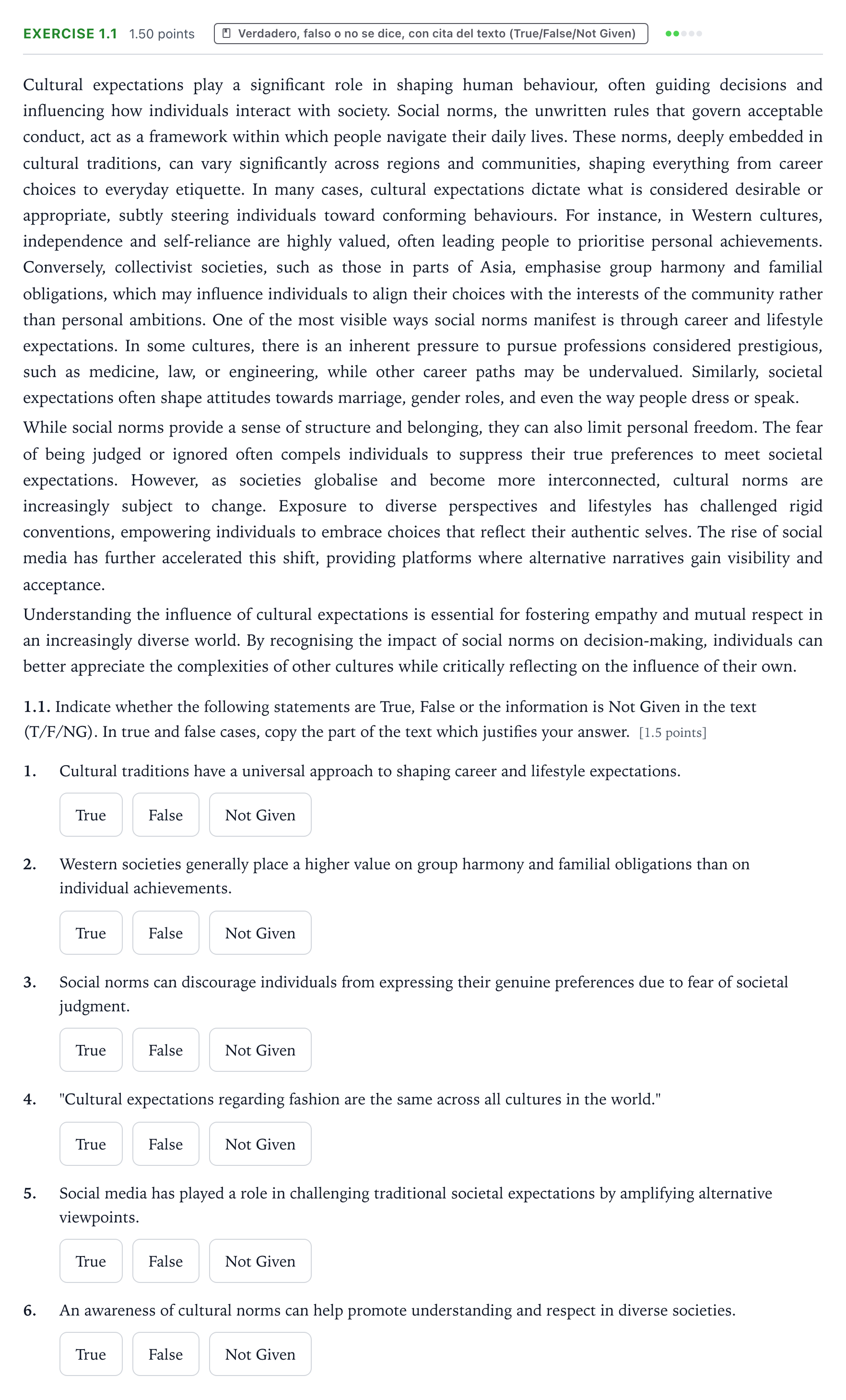
Cultural expectations play a significant role in shaping human behaviour, often guiding decisions and influencing how individuals interact with society. Social norms, the unwritten rules that govern acceptable conduct, act as a framework within which people navigate their daily lives. These norms, deeply embedded in cultural traditions, can vary significantly across regions and communities, shaping everything from career choices to everyday etiquette. In many cases, cultural expectations dictate what is considered desirable or appropriate, subtly steering individuals toward conforming behaviours. For instance, in Western cultures, independence and self-reliance are highly valued, often leading people to prioritise personal achievements. Conversely, collectivist societies, such as those in parts of Asia, emphasise group harmony and familial obligations, which may influence individuals to align their choices with the interests of the community rather than personal ambitions. One of the most visible ways social norms manifest is through career and lifestyle expectations. In some cultures, there is an inherent pressure to pursue professions considered prestigious, such as medicine, law, or engineering, while other career paths may be undervalued. Similarly, societal expectations often shape attitudes towards marriage, gender roles, and even the way people dress or speak.
While social norms provide a sense of structure and belonging, they can also limit personal freedom. The fear of being judged or ignored often compels individuals to suppress their true preferences to meet societal expectations. However, as societies globalise and become more interconnected, cultural norms are increasingly subject to change. Exposure to diverse perspectives and lifestyles has challenged rigid conventions, empowering individuals to embrace choices that reflect their authentic selves. The rise of social media has further accelerated this shift, providing platforms where alternative narratives gain visibility and acceptance.
Understanding the influence of cultural expectations is essential for fostering empathy and mutual respect in an increasingly diverse world. By recognising the impact of social norms on decision-making, individuals can better appreciate the complexities of other cultures while critically reflecting on the influence of their own.
1.1. Indicate whether the following statements are True, False or the information is Not Given in the text (T/F/NG). In true and false cases, copy the part of the text which justifies your answer. [1.5 points]
.
Solución
Según los criterios oficiales de corrección
1. Cultural traditions have a universal approach to shaping career and lifestyle expectations.
Solución: False
Justification 1: Cultural traditions have a universal approach to shaping career and lifestyle expectations.
Solución: "These norms, deeply embedded in cultural traditions, can vary significantly across regions and communities, shaping everything from career choices to everyday etiquette."
2. Western societies generally place a higher value on group harmony and familial obligations than on individual achievements.
Solución: False
Justification 2: Western societies generally place a higher value on group harmony and familial obligations than on individual achievements.
Solución: "in Western cultures, independence and self-reliance are highly valued, often leading people to prioritise personal achievements. Conversely, collectivist societies, such as those in parts of Asia, emphasise group harmony and familial obligations"
3. Social norms can discourage individuals from expressing their genuine preferences due to fear of societal judgment.
Solución: True
Justification 3: Social norms can discourage individuals from expressing their genuine preferences due to fear of societal judgment.
Solución: "The fear of being judged or ignored often compels individuals to suppress their true preferences to meet societal expectations."
4. "Cultural expectations regarding fashion are the same across all cultures in the world."
Solución: False
Justification 4: "Cultural expectations regarding fashion are the same across all cultures in the world."
Solución: "These norms, deeply embedded in cultural traditions, can vary significantly across regions and communities" / "societal expectations often shape attitudes towards marriage, gender roles, and even the way people dress or speak."
5. Social media has played a role in challenging traditional societal expectations by amplifying alternative viewpoints.
Solución: True
Justification 5: Social media has played a role in challenging traditional societal expectations by amplifying alternative viewpoints.
Solución: "The rise of social media has further accelerated this shift, providing platforms where alternative narratives gain visibility and acceptance."
6. An awareness of cultural norms can help promote understanding and respect in diverse societies.
Solución: True
Justification 6: An awareness of cultural norms can help promote understanding and respect in diverse societies.
Solución: "Understanding the influence of cultural expectations is essential for fostering empathy and mutual respect in an increasingly diverse world."
La explicación paso a paso, hecha con IA, es Premium. Premium
Resuélvelo aquí mismo: corrección automática, pistas y solución paso a paso.
‹ Ejercicio 1.1 · Ordinaria 2025 · Ejercicio 1.1 · Extraordinaria 2024 ›
Más ejercicios de Verdadero, falso o no se dice, con cita del texto (True/False/Not Given)
- Ejercicio 1.1 · Ordinaria 2026
- Ejercicio 1.1 · Ordinaria (2ª lengua extranjera) 2026
- Ejercicio 1.1 · Extraordinaria 2025
- Ejercicio 1.1 · Extraordinaria (2ª lengua extranjera) 2025
- Ejercicio 1.1 · Ordinaria 2025
- Ejercicio 1.1 · Extraordinaria 2024
- Ejercicio 2.1 · Extraordinaria 2024
- Ejercicio 1.1 · Extraordinaria (2ª lengua extranjera) 2024
- Ejercicio 2.1 · Extraordinaria (2ª lengua extranjera) 2024
- Question 1.1 - True/False · Ordinaria 2024