Ejercicio 2.1 · Inglés PAU Galicia Extraordinaria 2024
Tema: Verdadero, falso o no se dice, con cita del texto (True/False/Not Given) · Del examen Extraordinaria (2024)
Enunciado
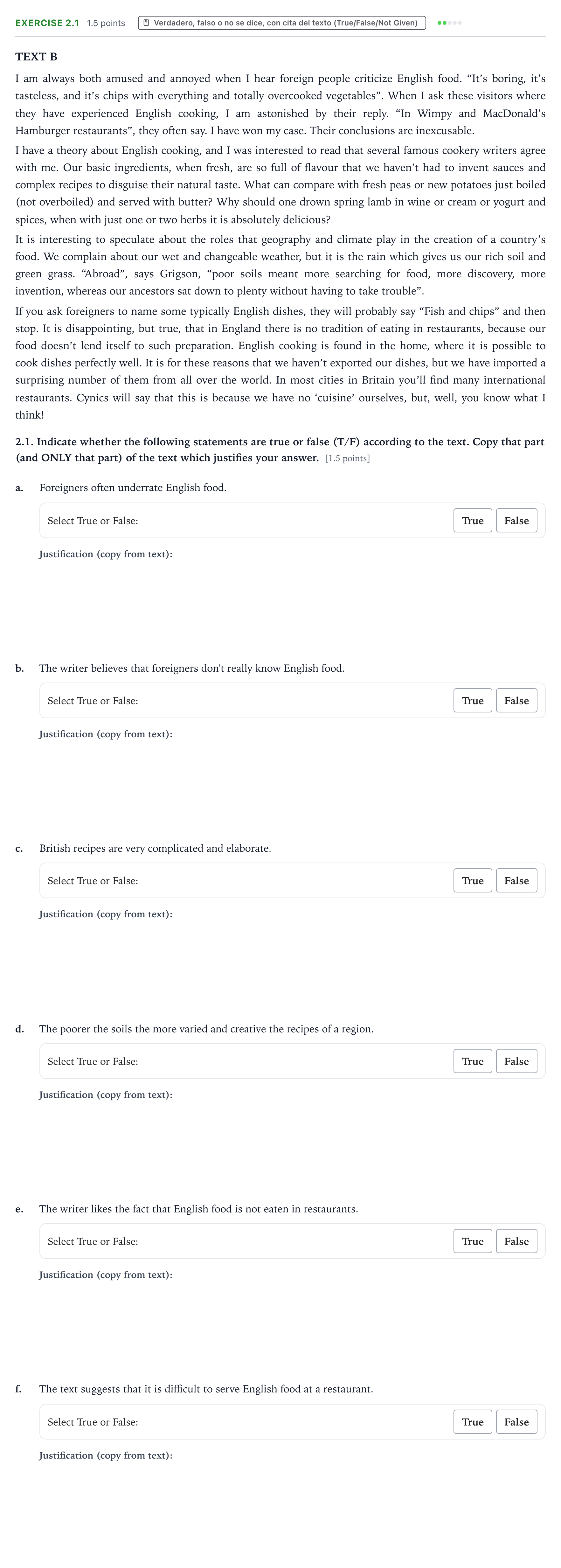
TEXT B
I am always both amused and annoyed when I hear foreign people criticize English food. “It’s boring, it’s tasteless, and it’s chips with everything and totally overcooked vegetables”. When I ask these visitors where they have experienced English cooking, I am astonished by their reply. “In Wimpy and MacDonald’s Hamburger restaurants”, they often say. I have won my case. Their conclusions are inexcusable.
I have a theory about English cooking, and I was interested to read that several famous cookery writers agree with me. Our basic ingredients, when fresh, are so full of flavour that we haven’t had to invent sauces and complex recipes to disguise their natural taste. What can compare with fresh peas or new potatoes just boiled (not overboiled) and served with butter? Why should one drown spring lamb in wine or cream or yogurt and spices, when with just one or two herbs it is absolutely delicious?
It is interesting to speculate about the roles that geography and climate play in the creation of a country’s food. We complain about our wet and changeable weather, but it is the rain which gives us our rich soil and green grass. “Abroad”, says Grigson, “poor soils meant more searching for food, more discovery, more invention, whereas our ancestors sat down to plenty without having to take trouble”.
If you ask foreigners to name some typically English dishes, they will probably say “Fish and chips” and then stop. It is disappointing, but true, that in England there is no tradition of eating in restaurants, because our food doesn’t lend itself to such preparation. English cooking is found in the home, where it is possible to cook dishes perfectly well. It is for these reasons that we haven’t exported our dishes, but we have imported a surprising number of them from all over the world. In most cities in Britain you’ll find many international restaurants. Cynics will say that this is because we have no ‘cuisine’ ourselves, but, well, you know what I think!
2.1. Indicate whether the following statements are true or false (T/F) according to the text. Copy that part (and ONLY that part) of the text which justifies your answer. [1.5 points]
a.
Foreigners often underrate English food.
Select True or False:
b.
The writer believes that foreigners don't really know English food.
Select True or False:
c.
British recipes are very complicated and elaborate.
Select True or False:
d.
The poorer the soils the more varied and creative the recipes of a region.
Select True or False:
e.
The writer likes the fact that English food is not eaten in restaurants.
Select True or False:
f.
The text suggests that it is difficult to serve English food at a restaurant.
Select True or False:
Solución
Según los criterios oficiales de corrección
a. Foreigners often underrate English food.
Solución: True
Justification for a: Foreigners often underrate English food.
Solución: «I am always both amused and annoyed when I hear foreign people criticize English food.» / «"It's boring, it's tasteless, and it's chips with everything and totally overcooked vegetables"»
b. The writer believes that foreigners don't really know English food.
Solución: True
Justification for b: The writer believes that foreigners don't really know English food.
Solución: «When I ask these visitors where they have experienced English cooking, I am astonished by their reply. "In Wimpy and MacDonald's Hamburger restaurants", they often say. I have won my case. Their conclusions are inexcusable.»
c. British recipes are very complicated and elaborate.
Solución: False
Justification for c: British recipes are very complicated and elaborate.
Solución: «Our basic ingredients, when fresh, are so full of flavour that we haven't had to invent sauces and complex recipes to disguise their natural taste.»
d. The poorer the soils the more varied and creative the recipes of a region.
Solución: True
Justification for d: The poorer the soils the more varied and creative the recipes of a region.
Solución: «"poor soils meant more searching for food, more discovery, more invention, whereas our ancestors sat down to plenty without having to take trouble".»
e. The writer likes the fact that English food is not eaten in restaurants.
Solución: False
Justification for e: The writer likes the fact that English food is not eaten in restaurants.
Solución: «It is disappointing, but true, that in England there is no tradition of eating in restaurants»
f. The text suggests that it is difficult to serve English food at a restaurant.
Solución: True
Justification for f: The text suggests that it is difficult to serve English food at a restaurant.
Solución: «our food doesn't lend itself to such preparation.» / «English cooking is found in the home, where it is possible to cook dishes perfectly well.»
La explicación paso a paso, hecha con IA, es Premium. Premium
Resuélvelo aquí mismo: corrección automática, pistas y solución paso a paso.
‹ Ejercicio 1.1 · Extraordinaria 2024 · Ejercicio 1.1 · Extraordinaria (2ª lengua extranjera) 2024 ›
Más ejercicios de Verdadero, falso o no se dice, con cita del texto (True/False/Not Given)
- Ejercicio 1.1 · Extraordinaria 2025
- Ejercicio 1.1 · Extraordinaria (2ª lengua extranjera) 2025
- Ejercicio 1.1 · Ordinaria 2025
- Ejercicio 1.1 · Ordinaria (2ª lengua extranjera) 2025
- Ejercicio 1.1 · Extraordinaria 2024
- Ejercicio 1.1 · Extraordinaria (2ª lengua extranjera) 2024
- Ejercicio 2.1 · Extraordinaria (2ª lengua extranjera) 2024
- Question 1.1 - True/False · Ordinaria 2024
- Question 2.1 - True/False · Ordinaria 2024
- Question 1.1 · Ordinaria (2ª lengua extranjera) 2024