Ejercicio 1.1 · Inglés PAU Galicia Ordinaria (2ª lengua extranjera) 2026
Tema: Verdadero, falso o no se dice, con cita del texto (True/False/Not Given) · Del examen Ordinaria (2ª lengua extranjera) (2026)
Enunciado
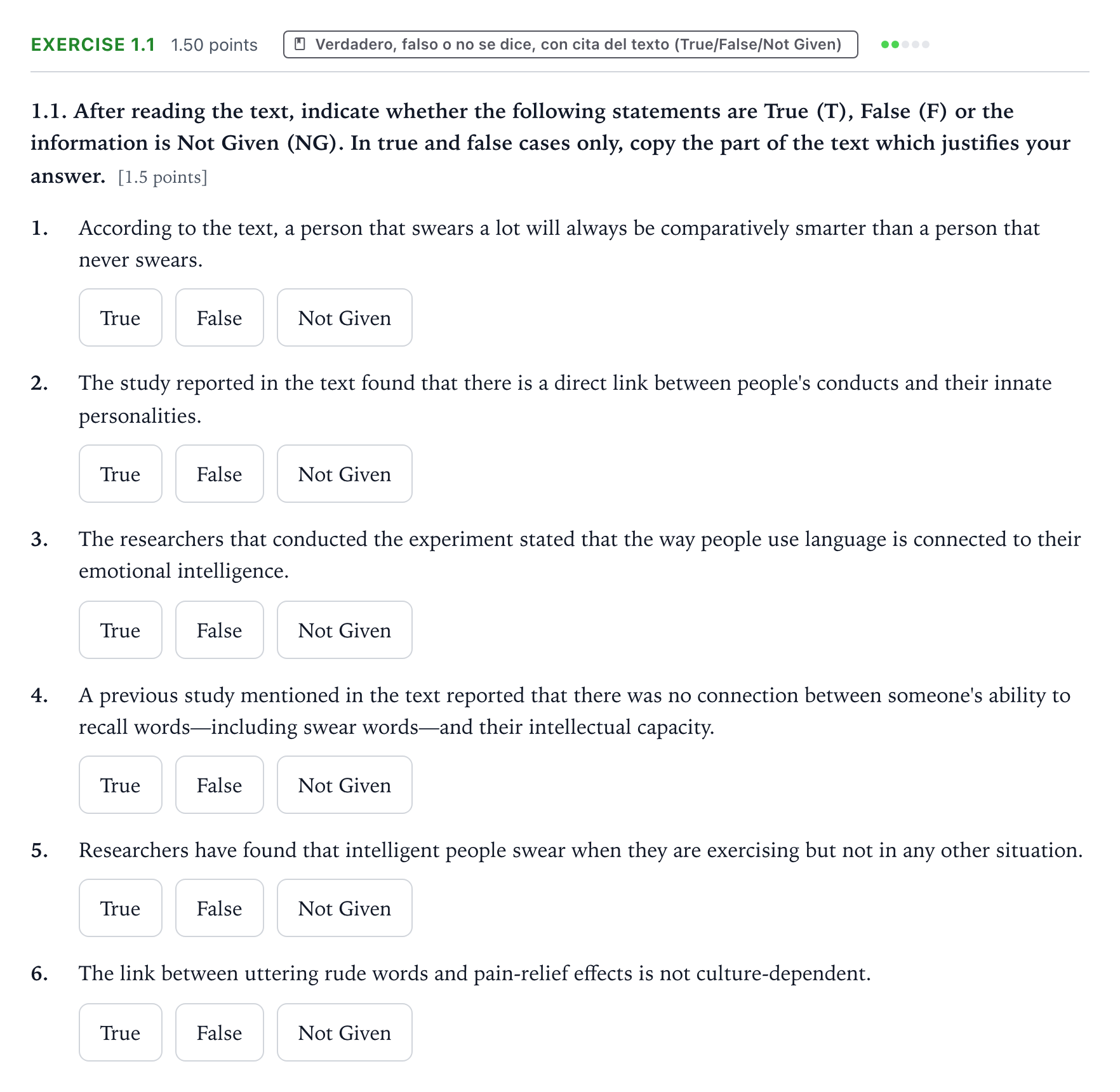
1.1. After reading the text, indicate whether the following statements are True (T), False (F) or the information is Not Given (NG). In true and false cases only, copy the part of the text which justifies your answer.
[1.5 points]
.
Solución
Según los criterios oficiales de corrección
1. According to the text, a person that swears a lot will always be comparatively smarter than a person that never swears.
Solución: False
1. Justification (Evidence from text):
Solución: "A recent study has found that intelligent people are more likely to swear." / "These findings suggest that intelligence may correlate not just with knowledge, but also with a more flexible approach to social norms."
2. The study reported in the text found that there is a direct link between people's conducts and their innate personalities.
Solución: True
2. Justification (Evidence from text):
Solución: "...researchers emphasised that everyday actions can reveal hidden aspects of our psychological makeup." / "The contrast between these groups highlights how personality traits influence the ways people express themselves..."
3. The researchers that conducted the experiment stated that the way people use language is connected to their emotional intelligence.
Solución: True
3. Justification (Evidence from text):
Solución: "They argued that small, seemingly trivial choices—like language use or morning routines—can serve as powerful indicators of cognitive and emotional patterns."
4. A previous study mentioned in the text reported that there was no connection between someone's ability to recall words—including swear words—and their intellectual capacity.
Solución: False
4. Justification (Evidence from text):
Solución: "Another study previously found that people who can name the most swear words in a minute tend to score higher on IQ tests."
5. Researchers have found that intelligent people swear when they are exercising but not in any other situation.
Solución: False
5. Justification (Evidence from text):
Solución: "Participants with higher intellects were found to be more likely to curse, eat spicy breakfasts, and walk around the house naked." / "They also reported greater creativity, emotional awareness, and a tendency to question rules or traditions that didn't make sense to them."
6. The link between uttering rude words and pain-relief effects is not culture-dependent.
Solución: Not Given
La explicación paso a paso, hecha con IA, es Premium. Premium
Resuélvelo aquí mismo: corrección automática, pistas y solución paso a paso.
‹ Ejercicio 1.1 · Ordinaria 2026 · Ejercicio 1.1 · Extraordinaria 2025 ›
Más ejercicios de Verdadero, falso o no se dice, con cita del texto (True/False/Not Given)
- Ejercicio 1.1 · Extraordinaria 2026
- Ejercicio 1.1 · Extraordinaria (2ª lengua extranjera) 2026
- Ejercicio 1.1 · Ordinaria 2026
- Ejercicio 1.1 · Extraordinaria 2025
- Ejercicio 1.1 · Extraordinaria (2ª lengua extranjera) 2025
- Ejercicio 1.1 · Ordinaria 2025
- Ejercicio 1.1 · Ordinaria (2ª lengua extranjera) 2025
- Ejercicio 1.1 · Extraordinaria 2024
- Ejercicio 2.1 · Extraordinaria 2024
- Ejercicio 1.1 · Extraordinaria (2ª lengua extranjera) 2024