Ejercicio 1 · Matemáticas II PAU Cantabria Ordinaria 2021

Tema: Matrices, determinantes y ecuaciones matriciales · Del examen Ordinaria (2021)

Enunciado

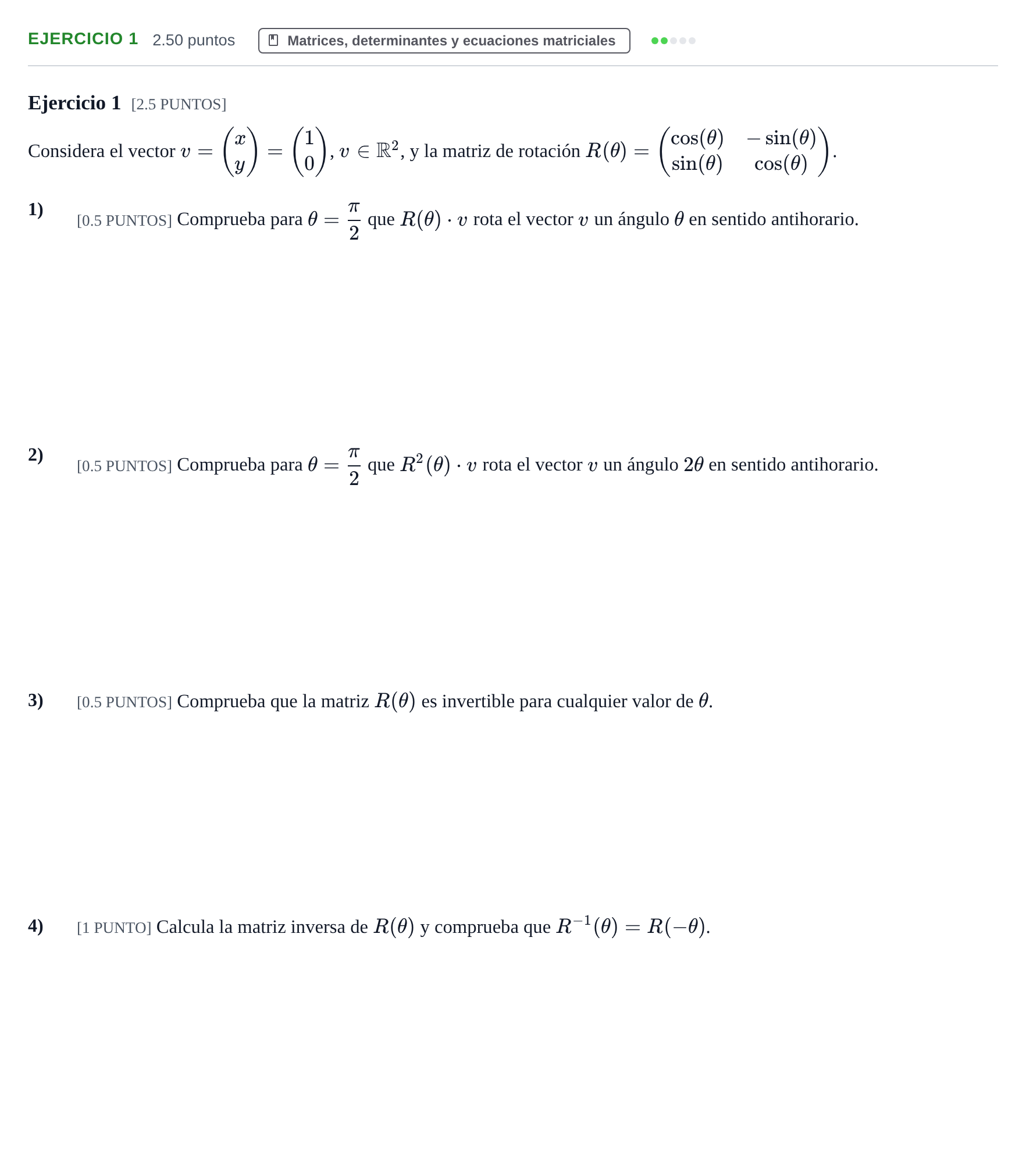
Ejercicio 1 [2.5 PUNTOS]

Considera el vector v=(xy)=(10)v = \begin{pmatrix} x \\ y \end{pmatrix} = \begin{pmatrix} 1 \\ 0 \end{pmatrix}, v∈R2v \in \mathbb{R}^2, y la matriz de rotación R(θ)=(cos⁡(θ)−sin⁡(θ)sin⁡(θ)cos⁡(θ))R(\theta) = \begin{pmatrix} \cos(\theta) & -\sin(\theta) \\ \sin(\theta) & \cos(\theta) \end{pmatrix}.

1)

[0.5 PUNTOS] Comprueba para θ=π2\theta = \frac{\pi}{2} que R(θ)⋅vR(\theta) \cdot v rota el vector vv un ángulo θ\theta en sentido antihorario.

2)

[0.5 PUNTOS] Comprueba para θ=π2\theta = \frac{\pi}{2} que R2(θ)⋅vR^2(\theta) \cdot v rota el vector vv un ángulo 2θ2\theta en sentido antihorario.

3)

[0.5 PUNTOS] Comprueba que la matriz R(θ)R(\theta) es invertible para cualquier valor de θ\theta.

4)

[1 PUNTO] Calcula la matriz inversa de R(θ)R(\theta) y comprueba que R−1(θ)=R(−θ)R^{-1}(\theta) = R(-\theta).

Enunciado: Ejercicio 1 · Matemáticas II PAU Cantabria Ordinaria 2021

Solución

Según los criterios oficiales de corrección

1) Comprueba para θ=π2\theta = \frac{\pi}{2} que R(θ)⋅vR(\theta) \cdot v rota el vector vv un ángulo θ\theta en sentido antihorario.

Solución: R(π/2)⋅v=(0−110)(10)=(01)R(\pi/2) \cdot v = \begin{pmatrix} 0 & -1 \\ 1 & 0 \end{pmatrix} \begin{pmatrix} 1 \\ 0 \end{pmatrix} = \begin{pmatrix} 0 \\ 1 \end{pmatrix}

2) Comprueba para θ=π2\theta = \frac{\pi}{2} que R2(θ)⋅vR^2(\theta) \cdot v rota el vector vv un ángulo 2θ2\theta en sentido antihorario.

Solución: R2(π/2)⋅v=(−10)R^2(\pi/2) \cdot v = \begin{pmatrix} -1 \\ 0 \end{pmatrix}

3) Comprueba que la matriz R(θ)R(\theta) es invertible para cualquier valor de θ\theta.

Solución: det⁡(R(θ))=cos⁡2(θ)+sin⁡2(θ)=1≠0\det(R(\theta)) = \cos^2(\theta) + \sin^2(\theta) = 1 \neq 0, por lo que R(θ)R(\theta) es invertible para todo θ\theta.

4) Calcula la matriz inversa de R(θ)R(\theta) y comprueba que R−1(θ)=R(−θ)R^{-1}(\theta) = R(-\theta).

Solución: R−1(θ)=(cos⁡(θ)sin⁡(θ)−sin⁡(θ)cos⁡(θ))=R(−θ)R^{-1}(\theta) = \begin{pmatrix} \cos(\theta) & \sin(\theta) \\ -\sin(\theta) & \cos(\theta) \end{pmatrix} = R(-\theta)

La explicación paso a paso, hecha con IA, es Premium. Premium

Resuélvelo aquí mismo: corrección automática, pistas y solución paso a paso.

‹ Ejercicio 5 · Extraordinaria 2021

Más ejercicios de Matrices, determinantes y ecuaciones matriciales