Ejercicio Option B - II * USE OF ENGLISH · Inglés PAU Andalucía Extraordinaria Titular 2013
Tema: Uso de la Lengua · Del examen Extraordinaria Titular (2013)
Enunciado
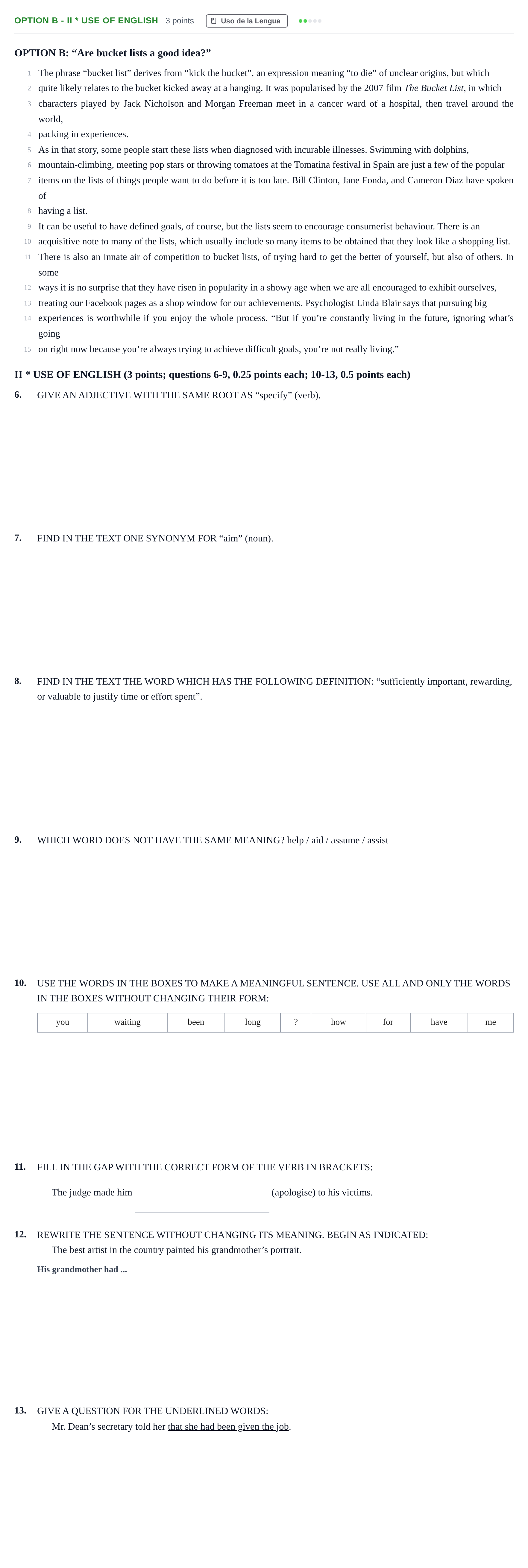
OPTION B: “Are bucket lists a good idea?”
1 The phrase “bucket list” derives from “kick the bucket”, an expression meaning “to die” of unclear origins, but which
2 quite likely relates to the bucket kicked away at a hanging. It was popularised by the 2007 film The Bucket List, in which
3 characters played by Jack Nicholson and Morgan Freeman meet in a cancer ward of a hospital, then travel around the world,
4 packing in experiences.
5 As in that story, some people start these lists when diagnosed with incurable illnesses. Swimming with dolphins,
6 mountain-climbing, meeting pop stars or throwing tomatoes at the Tomatina festival in Spain are just a few of the popular
7 items on the lists of things people want to do before it is too late. Bill Clinton, Jane Fonda, and Cameron Diaz have spoken of
8 having a list.
9 It can be useful to have defined goals, of course, but the lists seem to encourage consumerist behaviour. There is an
10 acquisitive note to many of the lists, which usually include so many items to be obtained that they look like a shopping list.
11 There is also an innate air of competition to bucket lists, of trying hard to get the better of yourself, but also of others. In some
12 ways it is no surprise that they have risen in popularity in a showy age when we are all encouraged to exhibit ourselves,
13 treating our Facebook pages as a shop window for our achievements. Psychologist Linda Blair says that pursuing big
14 experiences is worthwhile if you enjoy the whole process. “But if you’re constantly living in the future, ignoring what’s going
15 on right now because you’re always trying to achieve difficult goals, you’re not really living.”
II * USE OF ENGLISH (3 points; questions 6-9, 0.25 points each; 10-13, 0.5 points each)
6.
GIVE AN ADJECTIVE WITH THE SAME ROOT AS “specify” (verb).
7.
FIND IN THE TEXT ONE SYNONYM FOR “aim” (noun).
8.
FIND IN THE TEXT THE WORD WHICH HAS THE FOLLOWING DEFINITION: “sufficiently important, rewarding, or valuable to justify time or effort spent”.
9.
WHICH WORD DOES NOT HAVE THE SAME MEANING? help / aid / assume / assist
10.
USE THE WORDS IN THE BOXES TO MAKE A MEANINGFUL SENTENCE. USE ALL AND ONLY THE WORDS IN THE BOXES WITHOUT CHANGING THEIR FORM:
you
waiting
been
long
?
how
for
have
me
11.
FILL IN THE GAP WITH THE CORRECT FORM OF THE VERB IN BRACKETS:
The judge made him (apologise) to his victims.
12.
REWRITE THE SENTENCE WITHOUT CHANGING ITS MEANING. BEGIN AS INDICATED:
The best artist in the country painted his grandmother’s portrait.
13.
GIVE A QUESTION FOR THE UNDERLINED WORDS:
Mr. Dean’s secretary told her that she had been given the job.
Solución
Según los criterios oficiales de corrección
6. GIVE AN ADJECTIVE WITH THE SAME ROOT AS “specify” (verb).
Solución: specific / specified / specifiable
7. FIND IN THE TEXT ONE SYNONYM FOR “aim” (noun).
Solución: goal / goals
8. FIND IN THE TEXT THE WORD WHICH HAS THE FOLLOWING DEFINITION: “sufficiently important, rewarding, or valuable to justify time or effort spent”.
Solución: worthwhile
9. WHICH WORD DOES NOT HAVE THE SAME MEANING? help / aid / assume / assist
Solución: assume
10. USE THE WORDS IN THE BOXES TO MAKE A MEANINGFUL SENTENCE: you / waiting / been / long / ? / how / for / have / me
Solución: How long have you been waiting for me?
11. FILL IN THE GAP WITH THE CORRECT FORM OF THE VERB IN BRACKETS: The judge made him ..... (apologise) to his victims.
Solución: apologise / apologize
12. REWRITE THE SENTENCE WITHOUT CHANGING ITS MEANING. BEGIN AS INDICATED: The best artist in the country painted his grandmother’s portrait. His grandmother had ...
Solución: her portrait painted by the best artist in the country
13. GIVE A QUESTION FOR THE UNDERLINED WORDS: Mr. Dean’s secretary told her that she had been given the job.
Solución: What did Mr. Dean’s secretary tell her?
La explicación paso a paso, hecha con IA, es Premium. Premium
Resuélvelo aquí mismo: corrección automática, pistas y solución paso a paso.
‹ Ejercicio Option A - II * USE OF ENGLISH · Extraordinaria Titular 2013 · Opción A - II * Use of English · Ordinaria Reserva A 2013 ›
Más ejercicios de Uso de la Lengua
- Opción A - II. Use of English · Extraordinaria Reserva A 2013
- Opción B - II. Use of English · Extraordinaria Reserva A 2013
- Ejercicio Option A - II * USE OF ENGLISH · Extraordinaria Reserva B 2013
- Ejercicio Option B - II * USE OF ENGLISH · Extraordinaria Reserva B 2013
- Ejercicio Option A - II * USE OF ENGLISH · Extraordinaria Titular 2013
- Opción A - II * Use of English · Ordinaria Reserva A 2013
- Opción B - II * Use of English · Ordinaria Reserva A 2013
- Opción A - II * USE OF ENGLISH · Ordinaria Reserva B 2013
- Opción B - II * USE OF ENGLISH · Ordinaria Reserva B 2013
- Ejercicio Option A - II * Use of English · Ordinaria Titular 2013