Ejercicio Option A - II * USE OF ENGLISH · Inglés PAU Andalucía Extraordinaria Reserva B 2013
Tema: Uso de la Lengua · Del examen Extraordinaria Reserva B (2013)
Enunciado
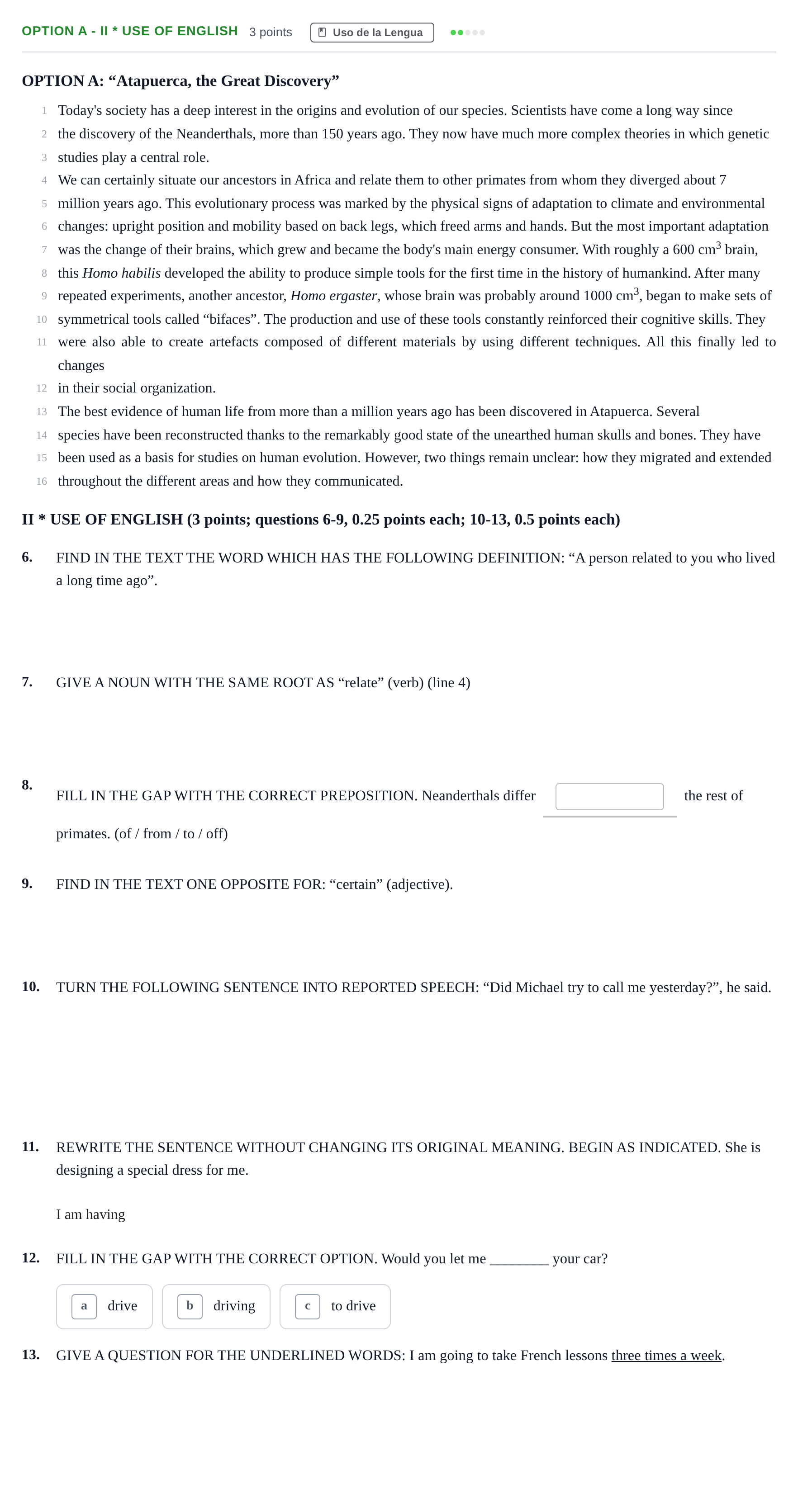
OPTION A: “Atapuerca, the Great Discovery”
1 Today's society has a deep interest in the origins and evolution of our species. Scientists have come a long way since
2 the discovery of the Neanderthals, more than 150 years ago. They now have much more complex theories in which genetic
3 studies play a central role.
4 We can certainly situate our ancestors in Africa and relate them to other primates from whom they diverged about 7
5 million years ago. This evolutionary process was marked by the physical signs of adaptation to climate and environmental
6 changes: upright position and mobility based on back legs, which freed arms and hands. But the most important adaptation
7 was the change of their brains, which grew and became the body's main energy consumer. With roughly a 600 cm 3 brain,
8 this Homo habilis developed the ability to produce simple tools for the first time in the history of humankind. After many
9 repeated experiments, another ancestor, Homo ergaster, whose brain was probably around 1000 cm 3, began to make sets of
10 symmetrical tools called “bifaces”. The production and use of these tools constantly reinforced their cognitive skills. They
11 were also able to create artefacts composed of different materials by using different techniques. All this finally led to changes
12 in their social organization.
13 The best evidence of human life from more than a million years ago has been discovered in Atapuerca. Several
14 species have been reconstructed thanks to the remarkably good state of the unearthed human skulls and bones. They have
15 been used as a basis for studies on human evolution. However, two things remain unclear: how they migrated and extended
16 throughout the different areas and how they communicated.
II * USE OF ENGLISH (3 points; questions 6-9, 0.25 points each; 10-13, 0.5 points each)
6.
FIND IN THE TEXT THE WORD WHICH HAS THE FOLLOWING DEFINITION: “A person related to you who lived a long time ago”.
7.
GIVE A NOUN WITH THE SAME ROOT AS “relate” (verb) (line 4)
8.
FILL IN THE GAP WITH THE CORRECT PREPOSITION. Neanderthals differ
the rest of primates. (of / from / to / off)
9.
FIND IN THE TEXT ONE OPPOSITE FOR: “certain” (adjective).
10.
TURN THE FOLLOWING SENTENCE INTO REPORTED SPEECH: “Did Michael try to call me yesterday?”, he said.
11.
REWRITE THE SENTENCE WITHOUT CHANGING ITS ORIGINAL MEANING. BEGIN AS INDICATED. She is designing a special dress for me.
I am having
12.
FILL IN THE GAP WITH THE CORRECT OPTION. Would you let me ________ your car?
13.
GIVE A QUESTION FOR THE UNDERLINED WORDS: I am going to take French lessons three times a week.
Solución
Solución de AprenAI (no es la oficial)
6. FIND IN THE TEXT THE WORD WHICH HAS THE FOLLOWING DEFINITION: “A person related to you who lived a long time ago”.
Solución: ancestor / ancestors
7. GIVE A NOUN WITH THE SAME ROOT AS “relate” (verb) (line 4)
Solución: relation / relationship / relative / relativity
8. FILL IN THE GAP WITH THE CORRECT PREPOSITION. Neanderthals differ ________ the rest of primates.
Solución: from
9. FIND IN THE TEXT ONE OPPOSITE FOR: “certain” (adjective).
Solución: unclear
Las soluciones de los 4 apartados que faltan y la explicación paso a paso son Premium. Premium
Resuélvelo aquí mismo: corrección automática, pistas y solución paso a paso.
‹ Opción B - II. Use of English · Extraordinaria Reserva A 2013 · Ejercicio Option B - II * USE OF ENGLISH · Extraordinaria Reserva B 2013 ›
Más ejercicios de Uso de la Lengua
- Ejercicio Option B - 12 · Reserva B 2019
- Ejercicio Option B - 13 · Reserva B 2019
- Ejercicio Option B - 14 · Reserva B 2019
- Opción A - II. Use of English · Extraordinaria Reserva A 2013
- Opción B - II. Use of English · Extraordinaria Reserva A 2013
- Ejercicio Option B - II * USE OF ENGLISH · Extraordinaria Reserva B 2013
- Ejercicio Option A - II * USE OF ENGLISH · Extraordinaria Titular 2013
- Ejercicio Option B - II * USE OF ENGLISH · Extraordinaria Titular 2013
- Opción A - II * Use of English · Ordinaria Reserva A 2013
- Opción B - II * Use of English · Ordinaria Reserva A 2013