Problema 14 · Biología URV Test Practice: Eukaryotes and Fungi
Tema: Fongs, liquens i micorizes · Del examen Test Practice: Eukaryotes and Fungi
Enunciado
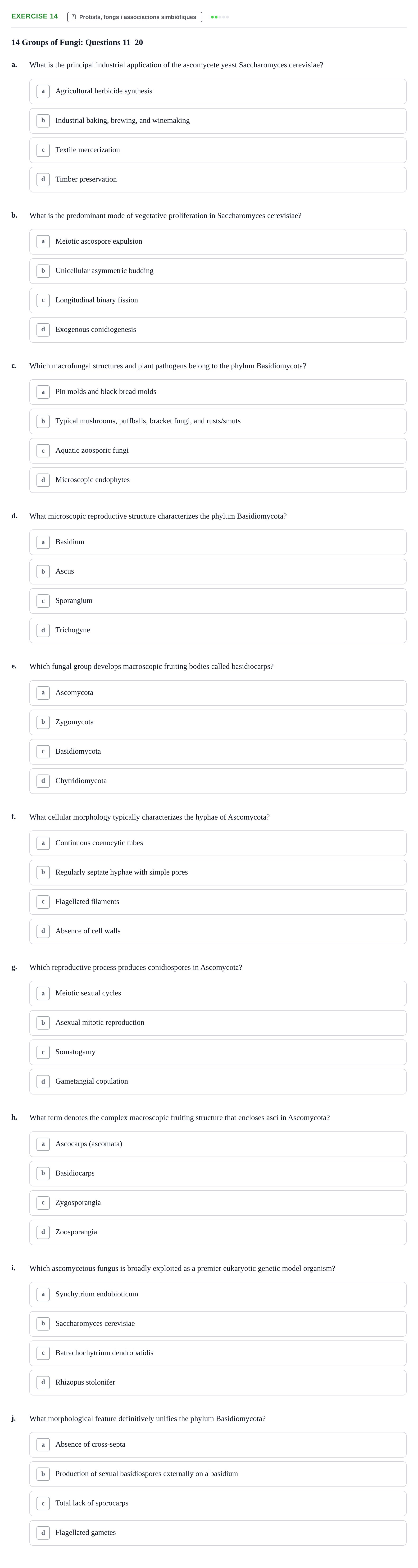
14 Groups of Fungi: Questions 11–20
Solución
Según los criterios oficiales de corrección
a. What is the principal industrial application of the ascomycete yeast Saccharomyces cerevisiae?
Solución: b) Industrial baking, brewing, and winemaking
b. What is the predominant mode of vegetative proliferation in Saccharomyces cerevisiae?
Solución: b) Unicellular asymmetric budding
c. Which macrofungal structures and plant pathogens belong to the phylum Basidiomycota?
Solución: b) Typical mushrooms, puffballs, bracket fungi, and rusts/smuts
d. What microscopic reproductive structure characterizes the phylum Basidiomycota?
Solución: a) Basidium
e. Which fungal group develops macroscopic fruiting bodies called basidiocarps?
Solución: c) Basidiomycota
f. What cellular morphology typically characterizes the hyphae of Ascomycota?
Solución: b) Regularly septate hyphae with simple pores
g. Which reproductive process produces conidiospores in Ascomycota?
Solución: b) Asexual mitotic reproduction
h. What term denotes the complex macroscopic fruiting structure that encloses asci in Ascomycota?
Solución: a) Ascocarps (ascomata)
i. Which ascomycetous fungus is broadly exploited as a premier eukaryotic genetic model organism?
Solución: b) Saccharomyces cerevisiae
j. What morphological feature definitively unifies the phylum Basidiomycota?
Solución: b) Production of sexual basidiospores externally on a basidium
La explicación paso a paso, hecha con IA, es Premium. Premium
Resuélvelo aquí mismo: corrección automática, pistas y solución paso a paso.
‹ Problema 13 · Test Practice: Eukaryotes and Fungi · Problema 15 · Test Practice: Eukaryotes and Fungi ›
Más ejercicios de Fongs, liquens i micorizes
- Problema 9 · Test Practice: Eukaryotes and Fungi
- Problema 10 · Test Practice: Eukaryotes and Fungi
- Problema 11 · Test Practice: Eukaryotes and Fungi
- Problema 12 · Test Practice: Eukaryotes and Fungi
- Problema 13 · Test Practice: Eukaryotes and Fungi
- Problema 15 · Test Practice: Eukaryotes and Fungi
- Problema 16 · Test Practice: Eukaryotes and Fungi
- Problema 17 · Test Practice: Eukaryotes and Fungi