Problema 16 · Biología URV Test Practice: Eukaryotes and Fungi
Tema: Fongs, liquens i micorizes · Del examen Test Practice: Eukaryotes and Fungi
Enunciado
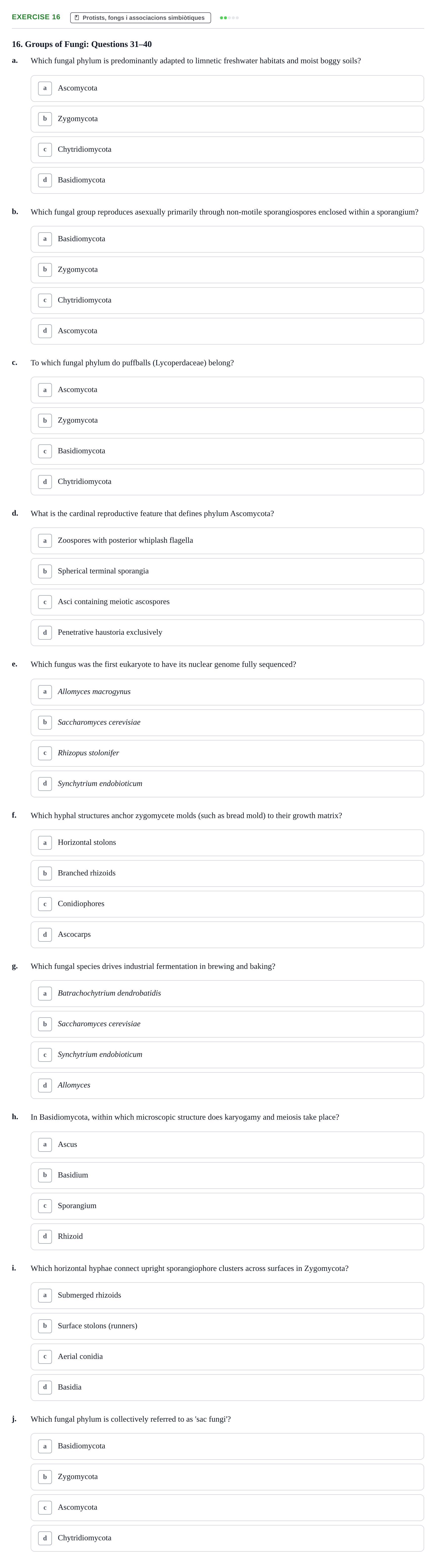
16. Groups of Fungi: Questions 31–40
.
Solución
Según los criterios oficiales de corrección
a. Which fungal phylum is predominantly adapted to limnetic freshwater habitats and moist boggy soils?
Solución: c) Chytridiomycota
b. Which fungal group reproduces asexually primarily through non-motile sporangiospores enclosed within a sporangium?
Solución: b) Zygomycota
c. To which fungal phylum do puffballs (Lycoperdaceae) belong?
Solución: c) Basidiomycota
d. What is the cardinal reproductive feature that defines phylum Ascomycota?
Solución: c) Asci containing meiotic ascospores
e. Which fungus was the first eukaryote to have its nuclear genome fully sequenced?
Solución: b) Saccharomyces cerevisiae
f. Which hyphal structures anchor zygomycete molds (such as bread mold) to their growth matrix?
Solución: b) Branched rhizoids
g. Which fungal species drives industrial fermentation in brewing and baking?
Solución: b) Saccharomyces cerevisiae
h. In Basidiomycota, within which microscopic structure does karyogamy and meiosis take place?
Solución: b) Basidium
i. Which horizontal hyphae connect upright sporangiophore clusters across surfaces in Zygomycota?
Solución: b) Surface stolons (runners)
j. Which fungal phylum is collectively referred to as 'sac fungi'?
Solución: c) Ascomycota
La explicación paso a paso, hecha con IA, es Premium. Premium
Resuélvelo aquí mismo: corrección automática, pistas y solución paso a paso.
‹ Problema 15 · Test Practice: Eukaryotes and Fungi · Problema 17 · Test Practice: Eukaryotes and Fungi ›