Aufgabe GE BIL E GK HT 2 · Abitur NRW Geschichte GK · Haupttermin · bilingual Englisch 2021
Thema: Revolution 1918/19, Versailler Frieden und Weimarer Republik · Aus der Prüfung GK · Haupttermin · bilingual Englisch (2021)
Aufgabenstellung
Abiturprüfung 2021 · Geschichte bilingual-englisch, Grundkurs
GE BIL E GK HT 2
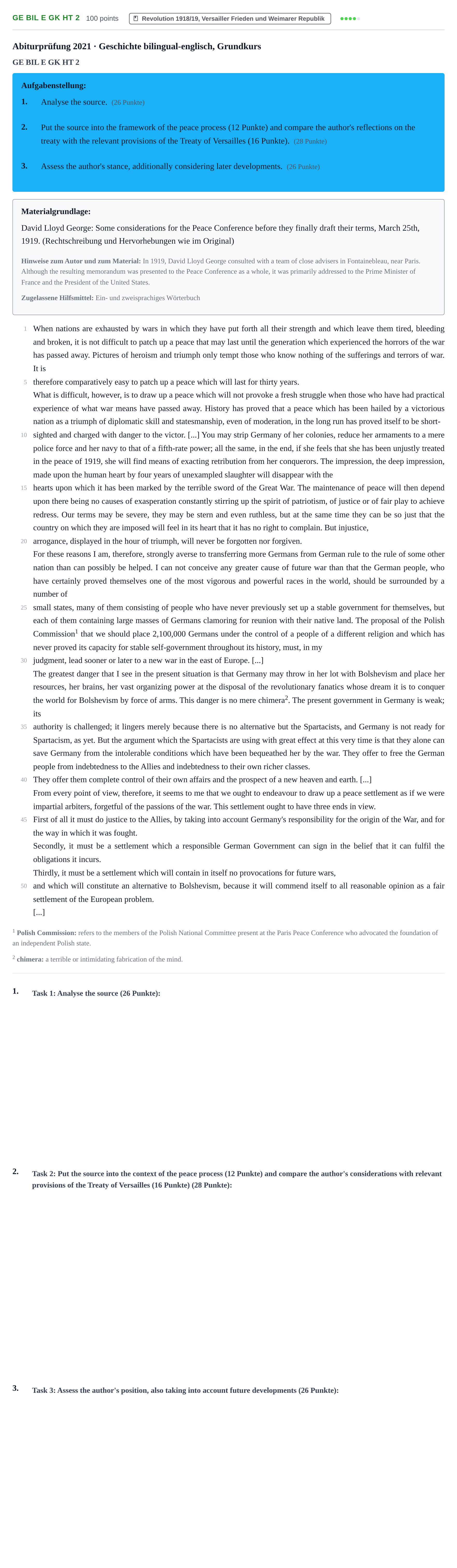
Aufgabenstellung:
1.
Analyse the source. (26 Punkte)
2.
Put the source into the framework of the peace process (12 Punkte) and compare the author's reflections on the treaty with the relevant provisions of the Treaty of Versailles (16 Punkte). (28 Punkte)
3.
Assess the author's stance, additionally considering later developments. (26 Punkte)
Materialgrundlage:
David Lloyd George: Some considerations for the Peace Conference before they finally draft their terms, March 25th, 1919. (Rechtschreibung und Hervorhebungen wie im Original)
Hinweise zum Autor und zum Material: In 1919, David Lloyd George consulted with a team of close advisers in Fontainebleau, near Paris. Although the resulting memorandum was presented to the Peace Conference as a whole, it was primarily addressed to the Prime Minister of France and the President of the United States.
Zugelassene Hilfsmittel: Ein- und zweisprachiges Wörterbuch
1 When nations are exhausted by wars in which they have put forth all their strength and which leave them tired, bleeding and broken, it is not difficult to patch up a peace that may last until the generation which experienced the horrors of the war has passed away. Pictures of heroism and triumph only tempt those who know nothing of the sufferings and terrors of war. It is
5 therefore comparatively easy to patch up a peace which will last for thirty years.
What is difficult, however, is to draw up a peace which will not provoke a fresh struggle when those who have had practical experience of what war means have passed away. History has proved that a peace which has been hailed by a victorious nation as a triumph of diplomatic skill and statesmanship, even of moderation, in the long run has proved itself to be short-
10 sighted and charged with danger to the victor. [...] You may strip Germany of her colonies, reduce her armaments to a mere police force and her navy to that of a fifth-rate power; all the same, in the end, if she feels that she has been unjustly treated in the peace of 1919, she will find means of exacting retribution from her conquerors. The impression, the deep impression, made upon the human heart by four years of unexampled slaughter will disappear with the
15 hearts upon which it has been marked by the terrible sword of the Great War. The maintenance of peace will then depend upon there being no causes of exasperation constantly stirring up the spirit of patriotism, of justice or of fair play to achieve redress. Our terms may be severe, they may be stern and even ruthless, but at the same time they can be so just that the country on which they are imposed will feel in its heart that it has no right to complain. But injustice,
20 arrogance, displayed in the hour of triumph, will never be forgotten nor forgiven.
For these reasons I am, therefore, strongly averse to transferring more Germans from German rule to the rule of some other nation than can possibly be helped. I can not conceive any greater cause of future war than that the German people, who have certainly proved themselves one of the most vigorous and powerful races in the world, should be surrounded by a number of
25 small states, many of them consisting of people who have never previously set up a stable government for themselves, but each of them containing large masses of Germans clamoring for reunion with their native land. The proposal of the Polish Commission 1 that we should place 2,100,000 Germans under the control of a people of a different religion and which has never proved its capacity for stable self-government throughout its history, must, in my
30 judgment, lead sooner or later to a new war in the east of Europe. [...]
The greatest danger that I see in the present situation is that Germany may throw in her lot with Bolshevism and place her resources, her brains, her vast organizing power at the disposal of the revolutionary fanatics whose dream it is to conquer the world for Bolshevism by force of arms. This danger is no mere chimera 2. The present government in Germany is weak; its
35 authority is challenged; it lingers merely because there is no alternative but the Spartacists, and Germany is not ready for Spartacism, as yet. But the argument which the Spartacists are using with great effect at this very time is that they alone can save Germany from the intolerable conditions which have been bequeathed her by the war. They offer to free the German people from indebtedness to the Allies and indebtedness to their own richer classes.
40 They offer them complete control of their own affairs and the prospect of a new heaven and earth. [...]
From every point of view, therefore, it seems to me that we ought to endeavour to draw up a peace settlement as if we were impartial arbiters, forgetful of the passions of the war. This settlement ought to have three ends in view.
45 First of all it must do justice to the Allies, by taking into account Germany's responsibility for the origin of the War, and for the way in which it was fought.
Secondly, it must be a settlement which a responsible German Government can sign in the belief that it can fulfil the obligations it incurs.
Thirdly, it must be a settlement which will contain in itself no provocations for future wars,
50 and which will constitute an alternative to Bolshevism, because it will commend itself to all reasonable opinion as a fair settlement of the European problem.
[...]
1 Polish Commission: refers to the members of the Polish National Committee present at the Paris Peace Conference who advocated the foundation of an independent Polish state.
2 chimera: a terrible or intimidating fabrication of the mind.
1.
2.
3.
Lösung
Nach den offiziellen Korrekturhinweisen
1. Analyse the source. (26 Punkte)
Lösung: Analyse der vorliegenden Quelle hinsichtlich formaler Aspekte (Autor, Adressat, Textsorte, Entstehungszeit, historischer Kontext, Thema, Intention) sowie Wiedergabe des Inhalts und Gedankengangs.
2. Put the source into the framework of the peace process (12 Punkte) and compare the author's reflections on the treaty with the relevant provisions of the Treaty of Versailles (16 Punkte). (28 Punkte)
Lösung: Historische Einordnung in den Friedensprozess nach dem Ersten Weltkrieg sowie kriterienorientierter Vergleich der Vorstellungen Lloyd Georges mit den tatsächlichen Bestimmungen des Versailler Vertrags.
3. Assess the author's stance, additionally considering later developments. (26 Punkte)
Lösung: Differenzierte Beurteilung von Lloyd Georges Position unter Einbeziehung der weiteren historischen Entwicklung der Zwischenkriegszeit.
Die ausführliche Erklärung Schritt für Schritt (mit KI) gibt es mit Premium. Premium
Löse sie direkt hier: automatische Korrektur, Hinweise und Lösung Schritt für Schritt.
‹ Aufgabe 3 · GK · Haupttermin 2021 · Aufgabe 3 (GE LK NT 3) · LK · Nachtermin 2021 ›