Aufgabe 1 · Abitur NRW Geschichte GK · Haupttermin · bilingual Englisch 2022
Thema: Revolution 1918/19, Versailler Frieden und Weimarer Republik · Aus der Prüfung GK · Haupttermin · bilingual Englisch (2022)
Aufgabenstellung
Aufgabenstellung:
1.
Analyse the source. (26 Punkte)
2.
Put the source into the context of the peace process (14 Punkte) and examine how the speaker backs up his position on Germany (14 Punkte). (28 Punkte)
3.
Take a critical stand on the statements made by the author. (26 Punkte)
Materialgrundlage:
Henry Cabot Lodge: America’s War Aims. What the United States Will Demand as a Just and Righteous Peace. An address delivered in the United States Senate, Aug 23, 1918, by the Republican leader of the Senate, in: Current History 9, 1 (Oct 1, 1918), S. 141 – 143.
(Rechtschreibung und Hervorhebungen wie im Original)
Hinweise zum Autor/Material:
Henry Cabot Lodge (1850 – 1924): highly influential American politician in the United States Senate (1893 – 1924), supporting American entry into World War I, but opposing Woodrow Wilson’s suggestions for the Treaty of Versailles.
Current History: an American periodical founded in 1914, focusing on contemporary international affairs.
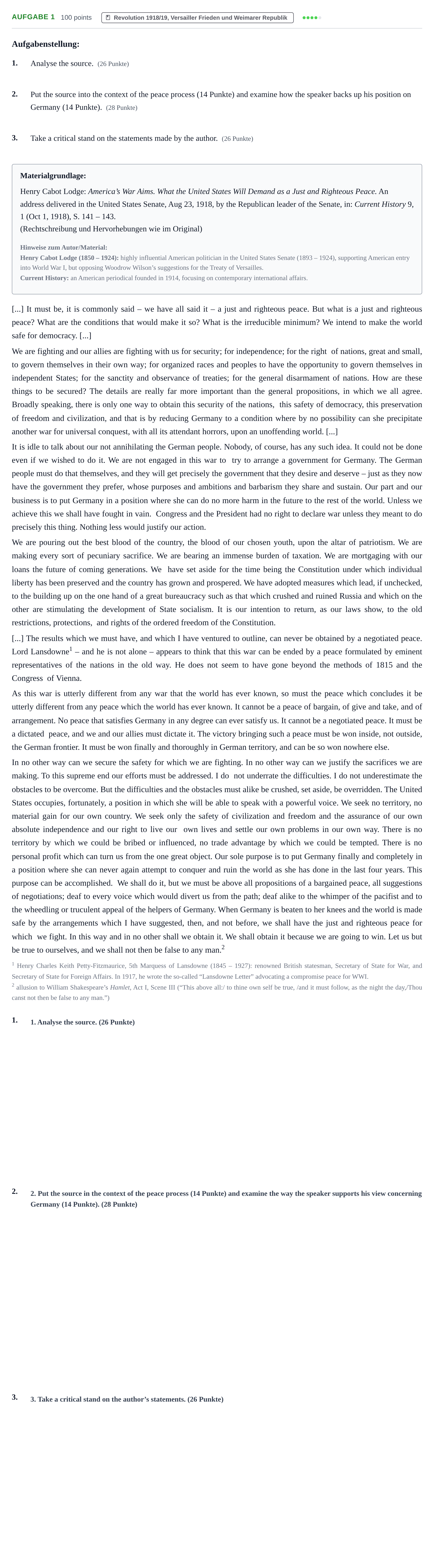
[...] It must be, it is commonly said – we have all said it – a just and righteous peace. But what is a just and righteous peace? What are the conditions that would make it so? What is the irreducible minimum? We intend to make the world safe for democracy. [...]
We are fighting and our allies are fighting with us for security; for independence; for the right 5 of nations, great and small, to govern themselves in their own way; for organized races and peoples to have the opportunity to govern themselves in independent States; for the sanctity and observance of treaties; for the general disarmament of nations. How are these things to be secured? The details are really far more important than the general propositions, in which we all agree. Broadly speaking, there is only one way to obtain this security of the nations, 10 this safety of democracy, this preservation of freedom and civilization, and that is by reducing Germany to a condition where by no possibility can she precipitate another war for universal conquest, with all its attendant horrors, upon an unoffending world. [...]
It is idle to talk about our not annihilating the German people. Nobody, of course, has any such idea. It could not be done even if we wished to do it. We are not engaged in this war to 15 try to arrange a government for Germany. The German people must do that themselves, and they will get precisely the government that they desire and deserve – just as they now have the government they prefer, whose purposes and ambitions and barbarism they share and sustain. Our part and our business is to put Germany in a position where she can do no more harm in the future to the rest of the world. Unless we achieve this we shall have fought in vain. 20 Congress and the President had no right to declare war unless they meant to do precisely this thing. Nothing less would justify our action.
We are pouring out the best blood of the country, the blood of our chosen youth, upon the altar of patriotism. We are making every sort of pecuniary sacrifice. We are bearing an immense burden of taxation. We are mortgaging with our loans the future of coming generations. We 25 have set aside for the time being the Constitution under which individual liberty has been preserved and the country has grown and prospered. We have adopted measures which lead, if unchecked, to the building up on the one hand of a great bureaucracy such as that which crushed and ruined Russia and which on the other are stimulating the development of State socialism. It is our intention to return, as our laws show, to the old restrictions, protections, 30 and rights of the ordered freedom of the Constitution.
[...] The results which we must have, and which I have ventured to outline, can never be obtained by a negotiated peace. Lord Lansdowne 1 – and he is not alone – appears to think that this war can be ended by a peace formulated by eminent representatives of the nations in the old way. He does not seem to have gone beyond the methods of 1815 and the Congress 35 of Vienna.
As this war is utterly different from any war that the world has ever known, so must the peace which concludes it be utterly different from any peace which the world has ever known. It cannot be a peace of bargain, of give and take, and of arrangement. No peace that satisfies Germany in any degree can ever satisfy us. It cannot be a negotiated peace. It must be a dictated 40 peace, and we and our allies must dictate it. The victory bringing such a peace must be won inside, not outside, the German frontier. It must be won finally and thoroughly in German territory, and can be so won nowhere else.
In no other way can we secure the safety for which we are fighting. In no other way can we justify the sacrifices we are making. To this supreme end our efforts must be addressed. I do 45 not underrate the difficulties. I do not underestimate the obstacles to be overcome. But the difficulties and the obstacles must alike be crushed, set aside, be overridden. The United States occupies, fortunately, a position in which she will be able to speak with a powerful voice. We seek no territory, no material gain for our own country. We seek only the safety of civilization and freedom and the assurance of our own absolute independence and our right to live our 50 own lives and settle our own problems in our own way. There is no territory by which we could be bribed or influenced, no trade advantage by which we could be tempted. There is no personal profit which can turn us from the one great object. Our sole purpose is to put Germany finally and completely in a position where she can never again attempt to conquer and ruin the world as she has done in the last four years. This purpose can be accomplished. 55 We shall do it, but we must be above all propositions of a bargained peace, all suggestions of negotiations; deaf to every voice which would divert us from the path; deaf alike to the whimper of the pacifist and to the wheedling or truculent appeal of the helpers of Germany. When Germany is beaten to her knees and the world is made safe by the arrangements which I have suggested, then, and not before, we shall have the just and righteous peace for which 60 we fight. In this way and in no other shall we obtain it. We shall obtain it because we are going to win. Let us but be true to ourselves, and we shall not then be false to any man. 2
1 Henry Charles Keith Petty-Fitzmaurice, 5th Marquess of Lansdowne (1845 – 1927): renowned British statesman, Secretary of State for War, and Secretary of State for Foreign Affairs. In 1917, he wrote the so-called “Lansdowne Letter” advocating a compromise peace for WWI.
2 allusion to William Shakespeare’s Hamlet, Act I, Scene III (“This above all:/ to thine own self be true, /and it must follow, as the night the day,/Thou canst not then be false to any man.”)
1.
2.
3.
Lösung
Nach den offiziellen Korrekturhinweisen
1. Analyse the source. (26 Punkte)
Lösung: Analyse der Quelle nach formalen Kriterien und inhaltlichem Gedankengang.
2. Put the source into the context of the peace process (14 Punkte) and examine how the speaker backs up his position on Germany (14 Punkte). (28 Punkte)
Lösung: Historische Einordnung in den Friedensprozess und rhetorisch-argumentative Analyse der Darstellung Deutschlands.
3. Take a critical stand on the statements made by the author. (26 Punkte)
Lösung: Kritische Stellungnahme und differenziertes historisches Urteil.
Die ausführliche Erklärung Schritt für Schritt (mit KI) gibt es mit Premium. Premium
Löse sie direkt hier: automatische Korrektur, Hinweise und Lösung Schritt für Schritt.
‹ Aufgabe GE LK NT 2 · LK · Nachtermin 2023 · Aufgabe 1 · GK · Nachtermin 2022 ›