Aufgabe NT 2 · Abitur NRW Geschichte GK · Nachtermin · bilingual Englisch 2022
Thema: Revolution 1918/19, Versailler Frieden und Weimarer Republik · Aus der Prüfung GK · Nachtermin · bilingual Englisch (2022)
Aufgabenstellung
Abiturprüfung 2022 – Geschichte bilingual-englisch, Grundkurs
Aufgabe NT 2
Materialgrundlage & Hinweise zum Autor:
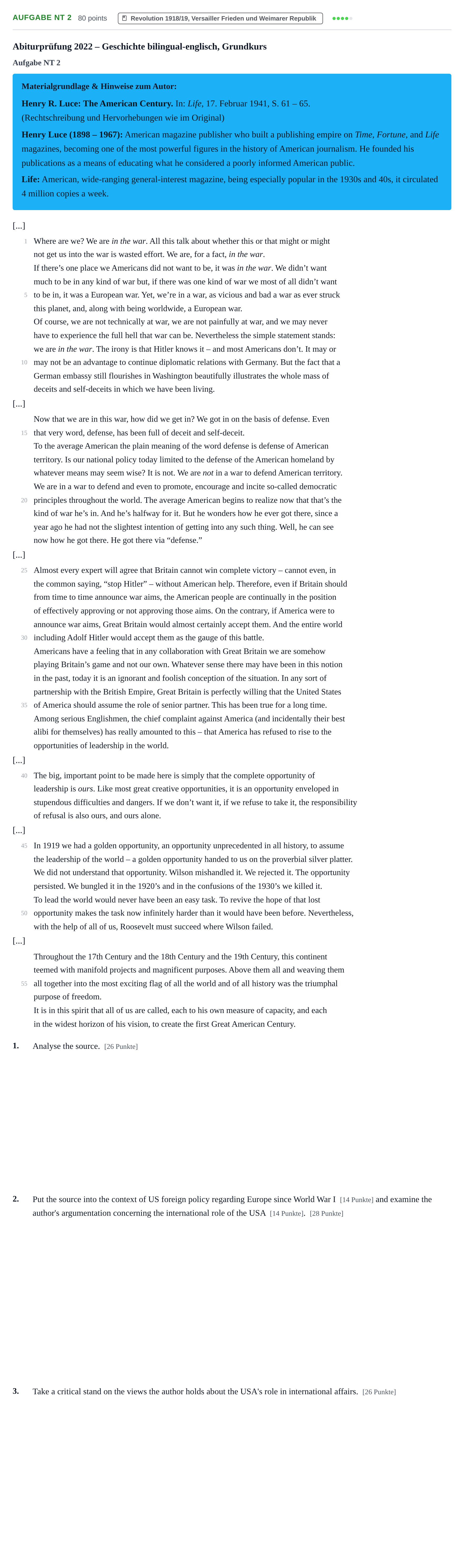
Henry R. Luce: The American Century. In: Life, 17. Februar 1941, S. 61 – 65.
(Rechtschreibung und Hervorhebungen wie im Original)
Henry Luce (1898 – 1967): American magazine publisher who built a publishing empire on Time, Fortune, and Life magazines, becoming one of the most powerful figures in the history of American journalism. He founded his publications as a means of educating what he considered a poorly informed American public.
Life: American, wide-ranging general-interest magazine, being especially popular in the 1930s and 40s, it circulated 4 million copies a week.
[...]
1 Where are we? We are in the war. All this talk about whether this or that might or might
not get us into the war is wasted effort. We are, for a fact, in the war.
If there’s one place we Americans did not want to be, it was in the war. We didn’t want
much to be in any kind of war but, if there was one kind of war we most of all didn’t want
5 to be in, it was a European war. Yet, we’re in a war, as vicious and bad a war as ever struck
this planet, and, along with being worldwide, a European war.
Of course, we are not technically at war, we are not painfully at war, and we may never
have to experience the full hell that war can be. Nevertheless the simple statement stands:
we are in the war. The irony is that Hitler knows it – and most Americans don’t. It may or
10 may not be an advantage to continue diplomatic relations with Germany. But the fact that a
German embassy still flourishes in Washington beautifully illustrates the whole mass of
deceits and self-deceits in which we have been living.
[...]
Now that we are in this war, how did we get in? We got in on the basis of defense. Even
15 that very word, defense, has been full of deceit and self-deceit.
To the average American the plain meaning of the word defense is defense of American
territory. Is our national policy today limited to the defense of the American homeland by
whatever means may seem wise? It is not. We are not in a war to defend American territory.
We are in a war to defend and even to promote, encourage and incite so-called democratic
20 principles throughout the world. The average American begins to realize now that that’s the
kind of war he’s in. And he’s halfway for it. But he wonders how he ever got there, since a
year ago he had not the slightest intention of getting into any such thing. Well, he can see
now how he got there. He got there via “defense.”
[...]
25 Almost every expert will agree that Britain cannot win complete victory – cannot even, in
the common saying, “stop Hitler” – without American help. Therefore, even if Britain should
from time to time announce war aims, the American people are continually in the position
of effectively approving or not approving those aims. On the contrary, if America were to
announce war aims, Great Britain would almost certainly accept them. And the entire world
30 including Adolf Hitler would accept them as the gauge of this battle.
Americans have a feeling that in any collaboration with Great Britain we are somehow
playing Britain’s game and not our own. Whatever sense there may have been in this notion
in the past, today it is an ignorant and foolish conception of the situation. In any sort of
partnership with the British Empire, Great Britain is perfectly willing that the United States
35 of America should assume the role of senior partner. This has been true for a long time.
Among serious Englishmen, the chief complaint against America (and incidentally their best
alibi for themselves) has really amounted to this – that America has refused to rise to the
opportunities of leadership in the world.
[...]
40 The big, important point to be made here is simply that the complete opportunity of
leadership is ours. Like most great creative opportunities, it is an opportunity enveloped in
stupendous difficulties and dangers. If we don’t want it, if we refuse to take it, the responsibility
of refusal is also ours, and ours alone.
[...]
45 In 1919 we had a golden opportunity, an opportunity unprecedented in all history, to assume
the leadership of the world – a golden opportunity handed to us on the proverbial silver platter.
We did not understand that opportunity. Wilson mishandled it. We rejected it. The opportunity
persisted. We bungled it in the 1920’s and in the confusions of the 1930’s we killed it.
To lead the world would never have been an easy task. To revive the hope of that lost
50 opportunity makes the task now infinitely harder than it would have been before. Nevertheless,
with the help of all of us, Roosevelt must succeed where Wilson failed.
[...]
Throughout the 17th Century and the 18th Century and the 19th Century, this continent
teemed with manifold projects and magnificent purposes. Above them all and weaving them
55 all together into the most exciting flag of all the world and of all history was the triumphal
purpose of freedom.
It is in this spirit that all of us are called, each to his own measure of capacity, and each
in the widest horizon of his vision, to create the first Great American Century.
1.
Analyse the source. [26 Punkte]
2.
Put the source into the context of US foreign policy regarding Europe since World War I [14 Punkte] and examine the author's argumentation concerning the international role of the USA [14 Punkte]. [28 Punkte]
3.
Take a critical stand on the views the author holds about the USA's role in international affairs. [26 Punkte]
Lösung
Nach den offiziellen Korrekturhinweisen
1. Analyse the source. (26 Punkte)
Lösung: Individuelle Schülerleistung gemäss den Erwartungen des Erwartungshorizonts.
2. Put the source into the context of US foreign policy regarding Europe since World War I (14 Punkte) and examine the author's argumentation concerning the international role of the USA (14 Punkte). (28 Punkte)
Lösung: Individuelle Schülerleistung gemäss den Erwartungen des Erwartungshorizonts.
3. Take a critical stand on the views the author holds about the USA's role in international affairs. (26 Punkte)
Lösung: Individuelle Schülerleistung gemäss den Erwartungen des Erwartungshorizonts.
Die ausführliche Erklärung Schritt für Schritt (mit KI) gibt es mit Premium. Premium
Löse sie direkt hier: automatische Korrektur, Hinweise und Lösung Schritt für Schritt.
‹ Aufgabe 1 · GK · Nachtermin 2022 · Aufgabe 3 · GK · Haupttermin 2021 ›