Aufgabe NT 1 - Aufgabe 4 · Abitur NRW Englisch LK · Nachtermin 2022
Thema: Sprachmittlung Deutsch → Englisch (Mediation) · Aus der Prüfung LK · Nachtermin (2022)
Aufgabenstellung
Klausurteil A
Ian McEwan
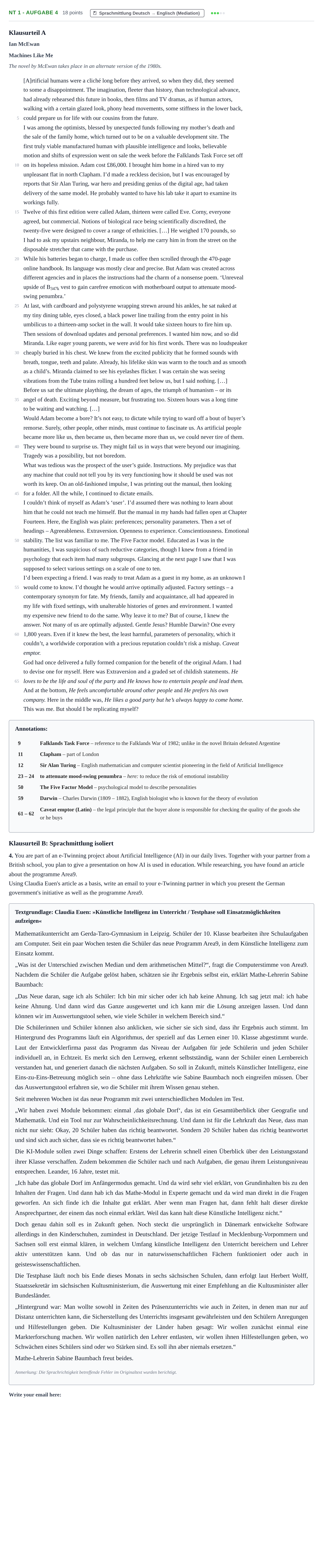
Machines Like Me
The novel by McEwan takes place in an alternate version of the 1980s.
[A]rtificial humans were a cliché long before they arrived, so when they did, they seemed
to some a disappointment. The imagination, fleeter than history, than technological advance,
had already rehearsed this future in books, then films and TV dramas, as if human actors,
walking with a certain glazed look, phony head movements, some stiffness in the lower back,
5 could prepare us for life with our cousins from the future.
I was among the optimists, blessed by unexpected funds following my mother’s death and
the sale of the family home, which turned out to be on a valuable development site. The
first truly viable manufactured human with plausible intelligence and looks, believable
motion and shifts of expression went on sale the week before the Falklands Task Force set off
10 on its hopeless mission. Adam cost £86,000. I brought him home in a hired van to my
unpleasant flat in north Clapham. I’d made a reckless decision, but I was encouraged by
reports that Sir Alan Turing, war hero and presiding genius of the digital age, had taken
delivery of the same model. He probably wanted to have his lab take it apart to examine its
workings fully.
15 Twelve of this first edition were called Adam, thirteen were called Eve. Corny, everyone
agreed, but commercial. Notions of biological race being scientifically discredited, the
twenty-five were designed to cover a range of ethnicities. […] He weighed 170 pounds, so
I had to ask my upstairs neighbour, Miranda, to help me carry him in from the street on the
disposable stretcher that came with the purchase.
20 While his batteries began to charge, I made us coffee then scrolled through the 470-page
online handbook. Its language was mostly clear and precise. But Adam was created across
different agencies and in places the instructions had the charm of a nonsense poem. ‘Unreveal
upside of B 347k vest to gain carefree emoticon with motherboard output to attenuate mood-
swing penumbra.’
25 At last, with cardboard and polystyrene wrapping strewn around his ankles, he sat naked at
my tiny dining table, eyes closed, a black power line trailing from the entry point in his
umbilicus to a thirteen-amp socket in the wall. It would take sixteen hours to fire him up.
Then sessions of download updates and personal preferences. I wanted him now, and so did
Miranda. Like eager young parents, we were avid for his first words. There was no loudspeaker
30 cheaply buried in his chest. We knew from the excited publicity that he formed sounds with
breath, tongue, teeth and palate. Already, his lifelike skin was warm to the touch and as smooth
as a child’s. Miranda claimed to see his eyelashes flicker. I was certain she was seeing
vibrations from the Tube trains rolling a hundred feet below us, but I said nothing. […]
Before us sat the ultimate plaything, the dream of ages, the triumph of humanism – or its
35 angel of death. Exciting beyond measure, but frustrating too. Sixteen hours was a long time
to be waiting and watching. […]
Would Adam become a bore? It’s not easy, to dictate while trying to ward off a bout of buyer’s
remorse. Surely, other people, other minds, must continue to fascinate us. As artificial people
became more like us, then became us, then became more than us, we could never tire of them.
40 They were bound to surprise us. They might fail us in ways that were beyond our imagining.
Tragedy was a possibility, but not boredom.
What was tedious was the prospect of the user’s guide. Instructions. My prejudice was that
any machine that could not tell you by its very functioning how it should be used was not
worth its keep. On an old-fashioned impulse, I was printing out the manual, then looking
45 for a folder. All the while, I continued to dictate emails.
I couldn’t think of myself as Adam’s ‘user’. I’d assumed there was nothing to learn about
him that he could not teach me himself. But the manual in my hands had fallen open at Chapter
Fourteen. Here, the English was plain: preferences; personality parameters. Then a set of
headings – Agreeableness. Extraversion. Openness to experience. Conscientiousness. Emotional
50 stability. The list was familiar to me. The Five Factor model. Educated as I was in the
humanities, I was suspicious of such reductive categories, though I knew from a friend in
psychology that each item had many subgroups. Glancing at the next page I saw that I was
supposed to select various settings on a scale of one to ten.
I’d been expecting a friend. I was ready to treat Adam as a guest in my home, as an unknown I
55 would come to know. I’d thought he would arrive optimally adjusted. Factory settings – a
contemporary synonym for fate. My friends, family and acquaintance, all had appeared in
my life with fixed settings, with unalterable histories of genes and environment. I wanted
my expensive new friend to do the same. Why leave it to me? But of course, I knew the
answer. Not many of us are optimally adjusted. Gentle Jesus? Humble Darwin? One every
60 1,800 years. Even if it knew the best, the least harmful, parameters of personality, which it
couldn’t, a worldwide corporation with a precious reputation couldn’t risk a mishap. Caveat
emptor.
God had once delivered a fully formed companion for the benefit of the original Adam. I had
to devise one for myself. Here was Extraversion and a graded set of childish statements. He
65 loves to be the life and soul of the party and He knows how to entertain people and lead them.
And at the bottom, He feels uncomfortable around other people and He prefers his own
company. Here in the middle was, He likes a good party but he’s always happy to come home.
This was me. But should I be replicating myself?
Annotations:
9
Falklands Task Force – reference to the Falklands War of 1982; unlike in the novel Britain defeated Argentine
11
Clapham – part of London
12
Sir Alan Turing – English mathematician and computer scientist pioneering in the field of Artificial Intelligence
23 – 24
to attenuate mood-swing penumbra – here: to reduce the risk of emotional instability
50
The Five Factor Model – psychological model to describe personalities
59
Darwin – Charles Darwin (1809 – 1882), English biologist who is known for the theory of evolution
61 – 62
Caveat emptor (Latin) – the legal principle that the buyer alone is responsible for checking the quality of the goods she or he buys
Klausurteil B: Sprachmittlung isoliert
4. You are part of an e-Twinning project about Artificial Intelligence (AI) in our daily lives. Together with your partner from a British school, you plan to give a presentation on how AI is used in education. While researching, you have found an article about the programme Area9.
Using Claudia Euen's article as a basis, write an email to your e-Twinning partner in which you present the German government's initiative as well as the programme Area9.
Textgrundlage: Claudia Euen: »Künstliche Intelligenz im Unterricht / Testphase soll Einsatzmöglichkeiten aufzeigen«
Mathematikunterricht am Gerda-Taro-Gymnasium in Leipzig. Schüler der 10. Klasse bearbeiten ihre Schulaufgaben am Computer. Seit ein paar Wochen testen die Schüler das neue Programm Area9, in dem Künstliche Intelligenz zum Einsatz kommt.
„Was ist der Unterschied zwischen Median und dem arithmetischen Mittel?“, fragt die Computerstimme von Area9. Nachdem die Schüler die Aufgabe gelöst haben, schätzen sie ihr Ergebnis selbst ein, erklärt Mathe-Lehrerin Sabine Baumbach:
„Das Neue daran, sage ich als Schüler: Ich bin mir sicher oder ich hab keine Ahnung. Ich sag jetzt mal: ich habe keine Ahnung. Und dann wird das Ganze ausgewertet und ich kann mir die Lösung anzeigen lassen. Und dann können wir im Auswertungstool sehen, wie viele Schüler in welchem Bereich sind.“
Die Schülerinnen und Schüler können also anklicken, wie sicher sie sich sind, dass ihr Ergebnis auch stimmt. Im Hintergrund des Programms läuft ein Algorithmus, der speziell auf das Lernen einer 10. Klasse abgestimmt wurde. Laut der Entwicklerfirma passt das Programm das Niveau der Aufgaben für jede Schülerin und jeden Schüler individuell an, in Echtzeit. Es merkt sich den Lernweg, erkennt selbstständig, wann der Schüler einen Lernbereich verstanden hat, und generiert danach die nächsten Aufgaben. So soll in Zukunft, mittels Künstlicher Intelligenz, eine Eins-zu-Eins-Betreuung möglich sein – ohne dass Lehrkräfte wie Sabine Baumbach noch eingreifen müssen. Über das Auswertungstool erfahren sie, wo die Schüler mit ihrem Wissen genau stehen.
Seit mehreren Wochen ist das neue Programm mit zwei unterschiedlichen Modulen im Test.
„Wir haben zwei Module bekommen: einmal ‚das globale Dorf‘, das ist ein Gesamtüberblick über Geografie und Mathematik. Und ein Tool nur zur Wahrscheinlichkeitsrechnung. Und dann ist für die Lehrkraft das Neue, dass man nicht nur sieht: Okay, 20 Schüler haben das richtig beantwortet. Sondern 20 Schüler haben das richtig beantwortet und sind sich auch sicher, dass sie es richtig beantwortet haben.“
Die KI-Module sollen zwei Dinge schaffen: Erstens der Lehrerin schnell einen Überblick über den Leistungsstand ihrer Klasse verschaffen. Zudem bekommen die Schüler nach und nach Aufgaben, die genau ihrem Leistungsniveau entsprechen. Leander, 16 Jahre, testet mit.
„Ich habe das globale Dorf im Anfängermodus gemacht. Und da wird sehr viel erklärt, von Grundinhalten bis zu den Inhalten der Fragen. Und dann hab ich das Mathe-Modul in Experte gemacht und da wird man direkt in die Fragen geworfen. An sich finde ich die Inhalte gut erklärt. Aber wenn man Fragen hat, dann fehlt halt dieser direkte Ansprechpartner, der einem das noch einmal erklärt. Weil das kann halt diese Künstliche Intelligenz nicht.“
Doch genau dahin soll es in Zukunft gehen. Noch steckt die ursprünglich in Dänemark entwickelte Software allerdings in den Kinderschuhen, zumindest in Deutschland. Der jetzige Testlauf in Mecklenburg-Vorpommern und Sachsen soll erst einmal klären, in welchem Umfang künstliche Intelligenz den Unterricht bereichern und Lehrer aktiv unterstützen kann. Und ob das nur in naturwissenschaftlichen Fächern funktioniert oder auch in geisteswissenschaftlichen.
Die Testphase läuft noch bis Ende dieses Monats in sechs sächsischen Schulen, dann erfolgt laut Herbert Wolff, Staatssekretär im sächsischen Kultusministerium, die Auswertung mit einer Empfehlung an die Kultusminister aller Bundesländer.
„Hintergrund war: Man wollte sowohl in Zeiten des Präsenzunterrichts wie auch in Zeiten, in denen man nur auf Distanz unterrichten kann, die Sicherstellung des Unterrichts insgesamt gewährleisten und den Schülern Anregungen und Hilfestellungen geben. Die Kultusminister der Länder haben gesagt: Wir wollen zunächst einmal eine Markterforschung machen. Wir wollen natürlich den Lehrer entlasten, wir wollen ihnen Hilfestellungen geben, wo Schwächen eines Schülers sind oder wo Stärken sind. Es soll ihn aber niemals ersetzen.“
Mathe-Lehrerin Sabine Baumbach freut beides.
Anmerkung: Die Sprachrichtigkeit betreffende Fehler im Originaltext wurden berichtigt.
Lösung
Nach den offiziellen Korrekturhinweisen
4. Using Claudia Euen's article as a basis, write an email to your e-Twinning partner in which you present the German government's initiative as well as the programme Area9. (Mediation) (18 Punkte)
Lösung: Subject: Presentation on AI in Education – German Initiative and Area9 Dear [Partner's Name], I hope you are doing well! As we agreed, I have been looking into real-life examples for our joint presentation on Artificial Intelligence in education, and I found a really interesting German pilot project that I would like to share with you. The initiative was launched by German educational authorities to explore how AI can enrich school lessons and support teachers. Currently, an AI-based learning software called Area9 is being tested in selected schools across two federal states (Saxony and Mecklenburg-Western Pomerania). The main goal of this trial is to determine whether AI can provide individual support both during regular in-person classes and during distance learning. The ministers of education want to test whether the software works not only in STEM subjects but also in the humanities, with the clear intention of relieving teachers—by highlighting individual students' strengths and weaknesses—without ever replacing educators. Once the test phase concludes, the results will be evaluated and recommendations may be issued to all German federal states. The programme itself, Area9 (originally developed in Denmark), provides digital learning modules that students work through independently on computers. It uses algorithms tailored to specific grade levels that continuously analyse both the students' answers and their self-assessed confidence level (indicating whether they are certain of their solution or guessing). In real time, the system tracks each student's learning progress and automatically generates customized follow-up tasks adapted to their exact level of understanding. Meanwhile, an evaluation tool gives the teacher an immediate overview of each student's comprehension without requiring direct intervention during the exercises. I think this project would serve as a great case study for our presentation. Let me know what you think! Best regards, [Your Name]
Die ausführliche Erklärung Schritt für Schritt (mit KI) gibt es mit Premium. Premium
Löse sie direkt hier: automatische Korrektur, Hinweise und Lösung Schritt für Schritt.
‹ Aufgabe · LK · Hergt/Hilgenstock: Zurück zur Tisch 2022 · Aufgabe NT 2 - Aufgabe 4 · LK · Nachtermin 2022 ›
Mehr Aufgaben zu Sprachmittlung Deutsch → Englisch (Mediation)
- Aufgabe HT 3 - Task 4 · LK · Haupttermin 2022
- Aufgabe HT 1 - Aufgabe 4 · LK · Haupttermin · Weiterbildungskolleg 2022
- Aufgabe HT 2 - Aufgabe 4 · LK · Haupttermin · Weiterbildungskolleg 2022
- Aufgabe HT 3 - Aufgabe 4 · LK · Haupttermin · Weiterbildungskolleg 2022
- Aufgabe · LK · Hergt/Hilgenstock: Zurück zur Tisch 2022
- Aufgabe NT 2 - Aufgabe 4 · LK · Nachtermin 2022
- Aufgabe NT 3 - Aufgabe 4 · LK · Nachtermin 2022
- Aufgabe · LK · Nolte: Wertevermittlung in der Schu 2022
- Aufgabe 1 · LK · Scholz/Schnabel: Handschrift: Die A 2022
- Aufgabe · GK · Allmann: Raus aus der Metropole 2021