Aufgabe HT 1 - Aufgabe 4 · Abitur NRW Englisch LK · Haupttermin · Weiterbildungskolleg 2021
Thema: Sprachmittlung Deutsch → Englisch (Mediation) · Aus der Prüfung LK · Haupttermin · Weiterbildungskolleg (Kolleg) (2021)
Aufgabenstellung
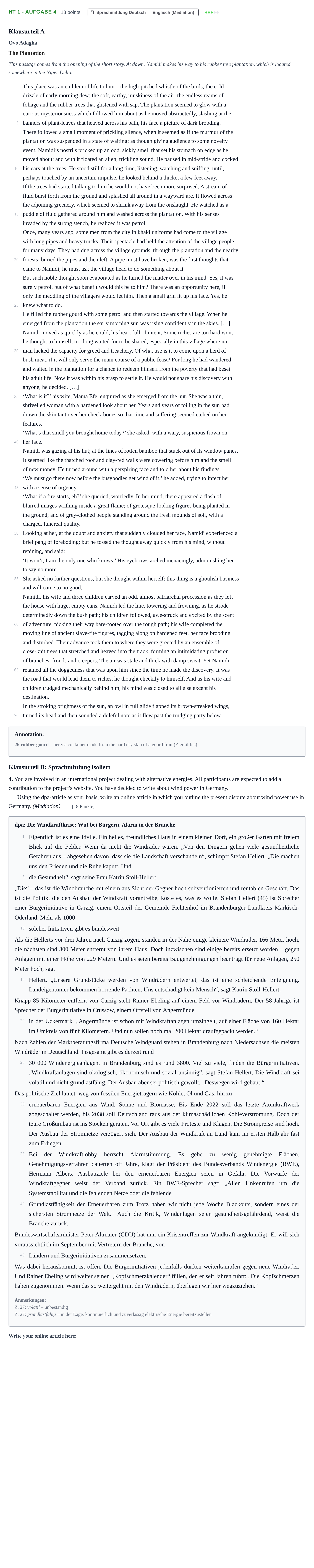
Klausurteil A
Ovo Adagha
The Plantation
This passage comes from the opening of the short story. At dawn, Namidi makes his way to his rubber tree plantation, which is located somewhere in the Niger Delta.
This place was an emblem of life to him – the high-pitched whistle of the birds; the cold
drizzle of early morning dew; the soft, earthy, muskiness of the air; the endless reams of
foliage and the rubber trees that glistened with sap. The plantation seemed to glow with a
curious mysteriousness which followed him about as he moved abstractedly, slashing at the
5 banners of plant-leaves that heaved across his path, his face a picture of dark brooding.
There followed a small moment of prickling silence, when it seemed as if the murmur of the
plantation was suspended in a state of waiting; as though giving audience to some novelty
event. Namidi’s nostrils pricked up an odd, sickly smell that set his stomach on edge as he
moved about; and with it floated an alien, trickling sound. He paused in mid-stride and cocked
10 his ears at the trees. He stood still for a long time, listening, watching and sniffing, until,
perhaps touched by an uncertain impulse, he looked behind a thicket a few feet away.
If the trees had started talking to him he would not have been more surprised. A stream of
fluid burst forth from the ground and splashed all around in a wayward arc. It flowed across
the adjoining greenery, which seemed to shrink away from the onslaught. He watched as a
15 puddle of fluid gathered around him and washed across the plantation. With his senses
invaded by the strong stench, he realized it was petrol.
Once, many years ago, some men from the city in khaki uniforms had come to the village
with long pipes and heavy trucks. Their spectacle had held the attention of the village people
for many days. They had dug across the village grounds, through the plantation and the nearby
20 forests; buried the pipes and then left. A pipe must have broken, was the first thoughts that
came to Namidi; he must ask the village head to do something about it.
But such noble thought soon evaporated as he turned the matter over in his mind. Yes, it was
surely petrol, but of what benefit would this be to him? There was an opportunity here, if
only the meddling of the villagers would let him. Then a small grin lit up his face. Yes, he
25 knew what to do.
He filled the rubber gourd with some petrol and then started towards the village. When he
emerged from the plantation the early morning sun was rising confidently in the skies. […]
Namidi moved as quickly as he could, his heart full of intent. Some riches are too hard won,
he thought to himself, too long waited for to be shared, especially in this village where no
30 man lacked the capacity for greed and treachery. Of what use is it to come upon a herd of
bush meat, if it will only serve the main course of a public feast? For long he had wandered
and waited in the plantation for a chance to redeem himself from the poverty that had beset
his adult life. Now it was within his grasp to settle it. He would not share his discovery with
anyone, he decided. […]
35 ‘What is it?’ his wife, Mama Efe, enquired as she emerged from the hut. She was a thin,
shrivelled woman with a hardened look about her. Years and years of toiling in the sun had
drawn the skin taut over her cheek-bones so that time and suffering seemed etched on her
features.
‘What’s that smell you brought home today?’ she asked, with a wary, suspicious frown on
40 her face.
Namidi was gazing at his hut; at the lines of rotten bamboo that stuck out of its window panes.
It seemed like the thatched roof and clay-red walls were cowering before him and the smell
of new money. He turned around with a perspiring face and told her about his findings.
‘We must go there now before the busybodies get wind of it,’ he added, trying to infect her
45 with a sense of urgency.
‘What if a fire starts, eh?’ she queried, worriedly. In her mind, there appeared a flash of
blurred images writhing inside a great flame; of grotesque-looking figures being planted in
the ground; and of grey-clothed people standing around the fresh mounds of soil, with a
charged, funereal quality.
50 Looking at her, at the doubt and anxiety that suddenly clouded her face, Namidi experienced a
brief pang of foreboding; but he tossed the thought away quickly from his mind, without
repining, and said:
‘It won’t, I am the only one who knows.’ His eyebrows arched menacingly, admonishing her
to say no more.
55 She asked no further questions, but she thought within herself: this thing is a ghoulish business
and will come to no good.
Namidi, his wife and three children carved an odd, almost patriarchal procession as they left
the house with huge, empty cans. Namidi led the line, towering and frowning, as he strode
determinedly down the bush path; his children followed, awe-struck and excited by the scent
60 of adventure, picking their way bare-footed over the rough path; his wife completed the
moving line of ancient slave-rite figures, tagging along on hardened feet, her face brooding
and disturbed. Their advance took them to where they were greeted by an ensemble of
close-knit trees that stretched and heaved into the track, forming an intimidating profusion
of branches, fronds and creepers. The air was stale and thick with damp sweat. Yet Namidi
65 retained all the doggedness that was upon him since the time he made the discovery. It was
the road that would lead them to riches, he thought cheekily to himself. And as his wife and
children trudged mechanically behind him, his mind was closed to all else except his
destination.
In the stroking brightness of the sun, an owl in full glide flapped its brown-streaked wings,
70 turned its head and then sounded a doleful note as it flew past the trudging party below.
Annotation:
26 rubber gourd – here: a container made from the hard dry skin of a gourd fruit (Zierkürbis)
Klausurteil B: Sprachmittlung isoliert
4. You are involved in an international project dealing with alternative energies. All participants are expected to add a contribution to the project's website. You have decided to write about wind power in Germany.
Using the dpa-article as your basis, write an online article in which you outline the present dispute about wind power use in Germany.
(Mediation)
[18 Punkte]
dpa: Die Windkraftkrise: Wut bei Bürgern, Alarm in der Branche
1 Eigentlich ist es eine Idylle. Ein helles, freundliches Haus in einem kleinen Dorf, ein großer Garten mit freiem Blick auf die Felder. Wenn da nicht die Windräder wären. „Von den Dingern gehen viele gesundheitliche Gefahren aus – abgesehen davon, dass sie die Landschaft verschandeln“, schimpft Stefan Hellert. „Die machen uns den Frieden und die Ruhe kaputt. Und
5 die Gesundheit“, sagt seine Frau Katrin Stoll-Hellert.
„Die“ – das ist die Windbranche mit einem aus Sicht der Gegner hoch subventionierten und rentablen Geschäft. Das ist die Politik, die den Ausbau der Windkraft vorantreibe, koste es, was es wolle. Stefan Hellert (45) ist Sprecher einer Bürgerinitiative in Carzig, einem Ortsteil der Gemeinde Fichtenhof im Brandenburger Landkreis Märkisch-Oderland. Mehr als 1000
10 solcher Initiativen gibt es bundesweit.
Als die Hellerts vor drei Jahren nach Carzig zogen, standen in der Nähe einige kleinere Windräder, 166 Meter hoch, die nächsten sind 800 Meter entfernt von ihrem Haus. Doch inzwischen sind einige bereits ersetzt worden – gegen Anlagen mit einer Höhe von 229 Metern. Und es seien bereits Baugenehmigungen beantragt für neue Anlagen, 250 Meter hoch, sagt
15 Hellert. „Unsere Grundstücke werden von Windrädern entwertet, das ist eine schleichende Enteignung. Landeigentümer bekommen horrende Pachten. Uns entschädigt kein Mensch“, sagt Katrin Stoll-Hellert.
Knapp 85 Kilometer entfernt von Carzig steht Rainer Ebeling auf einem Feld vor Windrädern. Der 58-Jährige ist Sprecher der Bürgerinitiative in Crussow, einem Ortsteil von Angermünde
20 in der Uckermark. „Angermünde ist schon mit Windkraftanlagen umzingelt, auf einer Fläche von 160 Hektar im Umkreis von fünf Kilometern. Und nun sollen noch mal 200 Hektar draufgepackt werden.“
Nach Zahlen der Marktberatungsfirma Deutsche Windguard stehen in Brandenburg nach Niedersachsen die meisten Windräder in Deutschland. Insgesamt gibt es derzeit rund
25 30 000 Windenergieanlagen, in Brandenburg sind es rund 3800. Viel zu viele, finden die Bürgerinitiativen. „Windkraftanlagen sind ökologisch, ökonomisch und sozial unsinnig“, sagt Stefan Hellert. Die Windkraft sei volatil und nicht grundlastfähig. Der Ausbau aber sei politisch gewollt. „Deswegen wird gebaut.“
Das politische Ziel lautet: weg von fossilen Energieträgern wie Kohle, Öl und Gas, hin zu
30 erneuerbaren Energien aus Wind, Sonne und Biomasse. Bis Ende 2022 soll das letzte Atomkraftwerk abgeschaltet werden, bis 2038 soll Deutschland raus aus der klimaschädlichen Kohleverstromung. Doch der teure Großumbau ist ins Stocken geraten. Vor Ort gibt es viele Proteste und Klagen. Die Strompreise sind hoch. Der Ausbau der Stromnetze verzögert sich. Der Ausbau der Windkraft an Land kam im ersten Halbjahr fast zum Erliegen.
35 Bei der Windkraftlobby herrscht Alarmstimmung. Es gebe zu wenig genehmigte Flächen, Genehmigungsverfahren dauerten oft Jahre, klagt der Präsident des Bundesverbands Windenergie (BWE), Hermann Albers. Ausbauziele bei den erneuerbaren Energien seien in Gefahr. Die Vorwürfe der Windkraftgegner weist der Verband zurück. Ein BWE-Sprecher sagt: „Allen Unkenrufen um die Systemstabilität und die fehlenden Netze oder die fehlende
40 Grundlastfähigkeit der Erneuerbaren zum Trotz haben wir nicht jede Woche Blackouts, sondern eines der sichersten Stromnetze der Welt.“ Auch die Kritik, Windanlagen seien gesundheitsgefährdend, weist die Branche zurück.
Bundeswirtschaftsminister Peter Altmaier (CDU) hat nun ein Krisentreffen zur Windkraft angekündigt. Er will sich voraussichtlich im September mit Vertretern der Branche, von
45 Ländern und Bürgerinitiativen zusammensetzen.
Was dabei herauskommt, ist offen. Die Bürgerinitiativen jedenfalls dürften weiterkämpfen gegen neue Windräder. Und Rainer Ebeling wird weiter seinen „Kopfschmerzkalender“ füllen, den er seit Jahren führt: „Die Kopfschmerzen haben zugenommen. Wenn das so weitergeht mit den Windrädern, überlegen wir hier wegzuziehen.“
Anmerkungen:
Z. 27: volatil – unbeständig
Z. 27: grundlastfähig – in der Lage, kontinuierlich und zuverlässig elektrische Energie bereitzustellen
Lösung
Nach den offiziellen Korrekturhinweisen
Using the dpa-article as your basis, write an online article in which you outline the present dispute about wind power use in Germany. (Mediation)
Lösung: An adequate online article in English outlining the controversy over wind power in Germany based on the German text. Requirements: 1. Form and style: - Headline / title suitable for an online article on an international project website. - Engaging introductory and concluding remarks appropriate for an international audience interested in alternative energy. 2. Current situation of wind power in Germany: - Germany's political goals to transition to renewable energy sources (wind, solar, biomass) while phasing out nuclear power (by end of 2022) and coal (by 2038). - Existing massive scale: around 30,000 wind turbines nationwide. - Current expansion has almost stalled due to numerous lawsuits, protests, delayed grid expansion, and high electricity costs. - The federal government plans a crisis meeting involving representatives from politics, the wind energy industry, and local action groups. 3. Perspective of the opponents (citizens' initiatives / local residents): - Health concerns (noise, sleep disturbance, headaches). - Destruction of the natural landscape and devaluation of adjacent properties without financial compensation. - Doubt about reliability: wind is volatile and not base-load capable; wind farms are viewed as ecologically, economically, and socially questionable. 4. Perspective of the wind power industry (BWE): - Climate and expansion targets are at risk due to overly lengthy approval procedures and a lack of designated land. - They defend the stability of the grid (one of the safest in the world, no frequent blackouts) despite fluctuating generation. - They reject claims that wind turbines pose a threat to human health.
Die ausführliche Erklärung Schritt für Schritt (mit KI) gibt es mit Premium. Premium
Löse sie direkt hier: automatische Korrektur, Hinweise und Lösung Schritt für Schritt.
‹ Aufgabe HT 3 - 4 · LK · Haupttermin 2021 · Aufgabe HT 2 - Aufgabe 4 · LK · Haupttermin · Weiterbildungskolleg 2021 ›
Mehr Aufgaben zu Sprachmittlung Deutsch → Englisch (Mediation)
- Aufgabe 1 · LK · Erhardt: Integration - ist sie wirk 2021
- Aufgabe 1 · LK · Hasselhorst: Kleingärten könnten We 2021
- Aufgabe HT 1 - 4 · LK · Haupttermin 2021
- Aufgabe HT 2 - 4 · LK · Haupttermin 2021
- Aufgabe HT 3 - 4 · LK · Haupttermin 2021
- Aufgabe HT 2 - Aufgabe 4 · LK · Haupttermin · Weiterbildungskolleg 2021
- Aufgabe HT 3 - Aufgabe 4 · LK · Haupttermin · Weiterbildungskolleg 2021
- Aufgabe 1 · LK · Heuer: „Die Uhr tickt” 2021
- Aufgabe 1 · LK · Höll: Freiwillige Feuerwehr. Es bre 2021
- Aufgabe NT 1 - Aufgabe 4 · LK · Nachtermin 2021