Aufgabe NT 2 - Aufgabe 4 · Abitur NRW Englisch GK · Nachtermin · Weiterbildungskolleg 2021
Thema: Sprachmittlung Deutsch → Englisch (Mediation) · Aus der Prüfung GK · Nachtermin · Weiterbildungskolleg (2021)
Aufgabenstellung
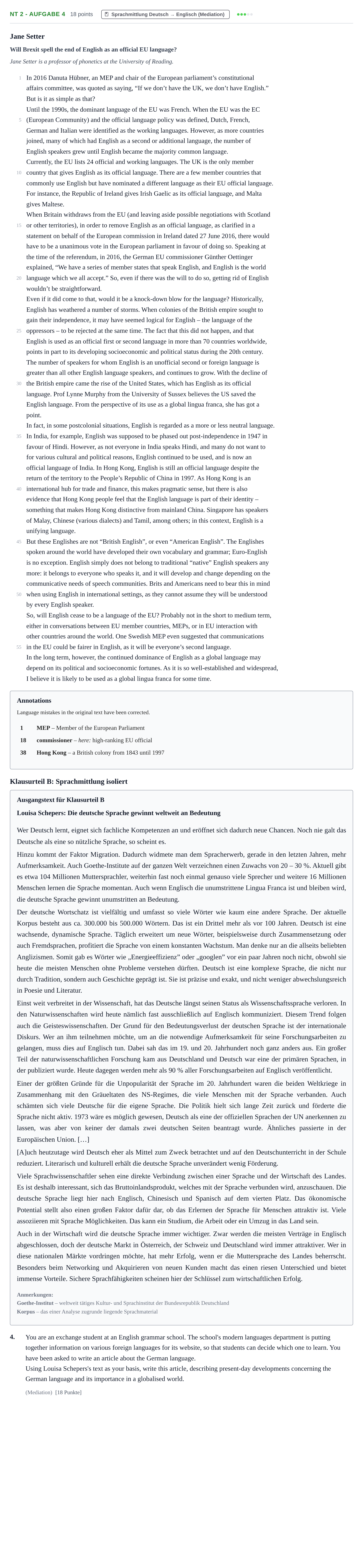
Jane Setter
Will Brexit spell the end of English as an official EU language?
Jane Setter is a professor of phonetics at the University of Reading.
1 In 2016 Danuta Hübner, an MEP and chair of the European parliament’s constitutional
affairs committee, was quoted as saying, “If we don’t have the UK, we don’t have English.”
But is it as simple as that?
Until the 1990s, the dominant language of the EU was French. When the EU was the EC
5 (European Community) and the official language policy was defined, Dutch, French,
German and Italian were identified as the working languages. However, as more countries
joined, many of which had English as a second or additional language, the number of
English speakers grew until English became the majority common language.
Currently, the EU lists 24 official and working languages. The UK is the only member
10 country that gives English as its official language. There are a few member countries that
commonly use English but have nominated a different language as their EU official language.
For instance, the Republic of Ireland gives Irish Gaelic as its official language, and Malta
gives Maltese.
When Britain withdraws from the EU (and leaving aside possible negotiations with Scotland
15 or other territories), in order to remove English as an official language, as clarified in a
statement on behalf of the European commission in Ireland dated 27 June 2016, there would
have to be a unanimous vote in the European parliament in favour of doing so. Speaking at
the time of the referendum, in 2016, the German EU commissioner Günther Oettinger
explained, “We have a series of member states that speak English, and English is the world
20 language which we all accept.” So, even if there was the will to do so, getting rid of English
wouldn’t be straightforward.
Even if it did come to that, would it be a knock-down blow for the language? Historically,
English has weathered a number of storms. When colonies of the British empire sought to
gain their independence, it may have seemed logical for English – the language of the
25 oppressors – to be rejected at the same time. The fact that this did not happen, and that
English is used as an official first or second language in more than 70 countries worldwide,
points in part to its developing socioeconomic and political status during the 20th century.
The number of speakers for whom English is an unofficial second or foreign language is
greater than all other English language speakers, and continues to grow. With the decline of
30 the British empire came the rise of the United States, which has English as its official
language. Prof Lynne Murphy from the University of Sussex believes the US saved the
English language. From the perspective of its use as a global lingua franca, she has got a
point.
In fact, in some postcolonial situations, English is regarded as a more or less neutral language.
35 In India, for example, English was supposed to be phased out post-independence in 1947 in
favour of Hindi. However, as not everyone in India speaks Hindi, and many do not want to
for various cultural and political reasons, English continued to be used, and is now an
official language of India. In Hong Kong, English is still an official language despite the
return of the territory to the People’s Republic of China in 1997. As Hong Kong is an
40 international hub for trade and finance, this makes pragmatic sense, but there is also
evidence that Hong Kong people feel that the English language is part of their identity –
something that makes Hong Kong distinctive from mainland China. Singapore has speakers
of Malay, Chinese (various dialects) and Tamil, among others; in this context, English is a
unifying language.
45 But these Englishes are not “British English”, or even “American English”. The Englishes
spoken around the world have developed their own vocabulary and grammar; Euro-English
is no exception. English simply does not belong to traditional “native” English speakers any
more: it belongs to everyone who speaks it, and it will develop and change depending on the
communicative needs of speech communities. Brits and Americans need to bear this in mind
50 when using English in international settings, as they cannot assume they will be understood
by every English speaker.
So, will English cease to be a language of the EU? Probably not in the short to medium term,
either in conversations between EU member countries, MEPs, or in EU interaction with
other countries around the world. One Swedish MEP even suggested that communications
55 in the EU could be fairer in English, as it will be everyone’s second language.
In the long term, however, the continued dominance of English as a global language may
depend on its political and socioeconomic fortunes. As it is so well-established and widespread,
I believe it is likely to be used as a global lingua franca for some time.
Annotations
Language mistakes in the original text have been corrected.
1 · MEP – Member of the European Parliament
18 · commissioner – here: high-ranking EU official
38 · Hong Kong – a British colony from 1843 until 1997
Klausurteil B: Sprachmittlung isoliert
Ausgangstext für Klausurteil B
Louisa Schepers: Die deutsche Sprache gewinnt weltweit an Bedeutung
Wer Deutsch lernt, eignet sich fachliche Kompetenzen an und eröffnet sich dadurch neue Chancen. Noch nie galt das Deutsche als eine so nützliche Sprache, so scheint es.
Hinzu kommt der Faktor Migration. Dadurch widmete man dem Spracherwerb, gerade in den letzten Jahren, mehr Aufmerksamkeit. Auch Goethe-Institute auf der ganzen Welt verzeichnen einen Zuwachs von 20 – 30 %. Aktuell gibt es etwa 104 Millionen Muttersprachler, weiterhin fast noch einmal genauso viele Sprecher und weitere 16 Millionen Menschen lernen die Sprache momentan. Auch wenn Englisch die unumstrittene Lingua Franca ist und bleiben wird, die deutsche Sprache gewinnt unumstritten an Bedeutung.
Der deutsche Wortschatz ist vielfältig und umfasst so viele Wörter wie kaum eine andere Sprache. Der aktuelle Korpus besteht aus ca. 300.000 bis 500.000 Wörtern. Das ist ein Drittel mehr als vor 100 Jahren. Deutsch ist eine wachsende, dynamische Sprache. Täglich erweitert um neue Wörter, beispielsweise durch Zusammensetzung oder auch Fremdsprachen, profitiert die Sprache von einem konstanten Wachstum. Man denke nur an die allseits beliebten Anglizismen. Somit gab es Wörter wie „Energieeffizienz” oder „googlen” vor ein paar Jahren noch nicht, obwohl sie heute die meisten Menschen ohne Probleme verstehen dürften. Deutsch ist eine komplexe Sprache, die nicht nur durch Tradition, sondern auch Geschichte geprägt ist. Sie ist präzise und exakt, und nicht weniger abwechslungsreich in Poesie und Literatur.
Einst weit verbreitet in der Wissenschaft, hat das Deutsche längst seinen Status als Wissenschaftssprache verloren. In den Naturwissenschaften wird heute nämlich fast ausschließlich auf Englisch kommuniziert. Diesem Trend folgen auch die Geisteswissenschaften. Der Grund für den Bedeutungsverlust der deutschen Sprache ist der internationale Diskurs. Wer an ihm teilnehmen möchte, um an die notwendige Aufmerksamkeit für seine Forschungsarbeiten zu gelangen, muss dies auf Englisch tun. Dabei sah das im 19. und 20. Jahrhundert noch ganz anders aus. Ein großer Teil der naturwissenschaftlichen Forschung kam aus Deutschland und Deutsch war eine der primären Sprachen, in der publiziert wurde. Heute dagegen werden mehr als 90 % aller Forschungsarbeiten auf Englisch veröffentlicht.
Einer der größten Gründe für die Unpopularität der Sprache im 20. Jahrhundert waren die beiden Weltkriege in Zusammenhang mit den Gräueltaten des NS-Regimes, die viele Menschen mit der Sprache verbanden. Auch schämten sich viele Deutsche für die eigene Sprache. Die Politik hielt sich lange Zeit zurück und förderte die Sprache nicht aktiv. 1973 wäre es möglich gewesen, Deutsch als eine der offiziellen Sprachen der UN anerkennen zu lassen, was aber von keiner der damals zwei deutschen Seiten beantragt wurde. Ähnliches passierte in der Europäischen Union. […]
[A]uch heutzutage wird Deutsch eher als Mittel zum Zweck betrachtet und auf den Deutschunterricht in der Schule reduziert. Literarisch und kulturell erhält die deutsche Sprache unverändert wenig Förderung.
Viele Sprachwissenschaftler sehen eine direkte Verbindung zwischen einer Sprache und der Wirtschaft des Landes. Es ist deshalb interessant, sich das Bruttoinlandsprodukt, welches mit der Sprache verbunden wird, anzuschauen. Die deutsche Sprache liegt hier nach Englisch, Chinesisch und Spanisch auf dem vierten Platz. Das ökonomische Potential stellt also einen großen Faktor dafür dar, ob das Erlernen der Sprache für Menschen attraktiv ist. Viele assoziieren mit Sprache Möglichkeiten. Das kann ein Studium, die Arbeit oder ein Umzug in das Land sein.
Auch in der Wirtschaft wird die deutsche Sprache immer wichtiger. Zwar werden die meisten Verträge in Englisch abgeschlossen, doch der deutsche Markt in Österreich, der Schweiz und Deutschland wird immer attraktiver. Wer in diese nationalen Märkte vordringen möchte, hat mehr Erfolg, wenn er die Muttersprache des Landes beherrscht. Besonders beim Networking und Akquirieren von neuen Kunden macht das einen riesen Unterschied und bietet immense Vorteile. Sichere Sprachfähigkeiten scheinen hier der Schlüssel zum wirtschaftlichen Erfolg.
Anmerkungen:
Goethe-Institut – weltweit tätiges Kultur- und Sprachinstitut der Bundesrepublik Deutschland
Korpus – das einer Analyse zugrunde liegende Sprachmaterial
4.
You are an exchange student at an English grammar school. The school's modern languages department is putting together information on various foreign languages for its website, so that students can decide which one to learn. You have been asked to write an article about the German language.
Using Louisa Schepers's text as your basis, write this article, describing present-day developments concerning the German language and its importance in a globalised world.
(Mediation) [18 Punkte]
Lösung
Nach den offiziellen Korrekturhinweisen
4. Write this article, describing present-day developments concerning the German language and its importance in a globalised world.
Lösung: An article in English for the school website (modern languages department) addressing English students, containing the following central aspects: - Introduction / Headline: Engaging title and opening setting the purpose of the article (why learn German?). - Current developments of the German language: - Growing global importance and interest, partly driven by migration. - High and rising numbers: around 104 million native speakers, roughly as many second-language speakers, and about 16 million current learners worldwide; Goethe-Instituts report 20–30% increases in course participants. - A rich, dynamic, and constantly growing vocabulary (300,000–500,000 words; a third more than a century ago) incorporating compounds and loanwords (e.g., anglicisms). - Characteristics: precise, historical, complex, as well as culturally and literarily expressive. - Low/declining importance in science: - Loss of its former historic status as a leading language of scientific research and publication. - Over 90% of scientific research is now published in English due to the need for international scientific discourse; humanities follow the same trend. - Historic reasons for unpopularity in the 20th century (two world wars, Nazi regime crimes, lack of political promotion at UN/EU levels). - High relevance and economic potential: - German ranks 4th worldwide in associated GDP (after English, Chinese, and Spanish). - Economically attractive markets in Germany, Austria, and Switzerland. - Essential asset for career opportunities, international networking, business relations, and customer acquisition. - Conclusion: Encouraging closing statement advising students to consider German for their studies and future careers.
Die ausführliche Erklärung Schritt für Schritt (mit KI) gibt es mit Premium. Premium
Löse sie direkt hier: automatische Korrektur, Hinweise und Lösung Schritt für Schritt.
‹ Aufgabe NT 1 - Aufgabe 4 · GK · Nachtermin · Weiterbildungskolleg 2021 · Aufgabe NT 3 - Aufgabe 4 · GK · Nachtermin · Weiterbildungskolleg 2021 ›
Mehr Aufgaben zu Sprachmittlung Deutsch → Englisch (Mediation)
- Aufgabe HT 3 - Aufgabe 4 · GK · Haupttermin · Weiterbildungskolleg 2021
- Aufgabe NT 1 - Teilaufgabe 4 · GK · Nachtermin 2021
- Aufgabe NT 2 - Teilaufgabe 4 · GK · Nachtermin 2021
- Aufgabe NT 3 - Teilaufgabe 4 · GK · Nachtermin 2021
- Aufgabe NT 1 - Aufgabe 4 · GK · Nachtermin · Weiterbildungskolleg 2021
- Aufgabe NT 3 - Aufgabe 4 · GK · Nachtermin · Weiterbildungskolleg 2021
- Aufgabe 1 · GK · Teuffel: Sinnvoll regulierend/Ferbe 2021
- Aufgabe 1 · GK · Uhtenwoldt: Mut zur Lücke! 2021
- Aufgabe 1 · LK · Brettspiele sind wieder im Trend / 2021
- Aufgabe · LK · Döring: Mit Stock und Hut auf Wande 2021