Aufgabe HT 3 - Aufgabe 4 · Abitur NRW Englisch GK · Haupttermin · Weiterbildungskolleg 2021
Thema: Sprachmittlung Deutsch → Englisch (Mediation) · Aus der Prüfung GK · Haupttermin · Weiterbildungskolleg (Kolleg) (2021)
Aufgabenstellung
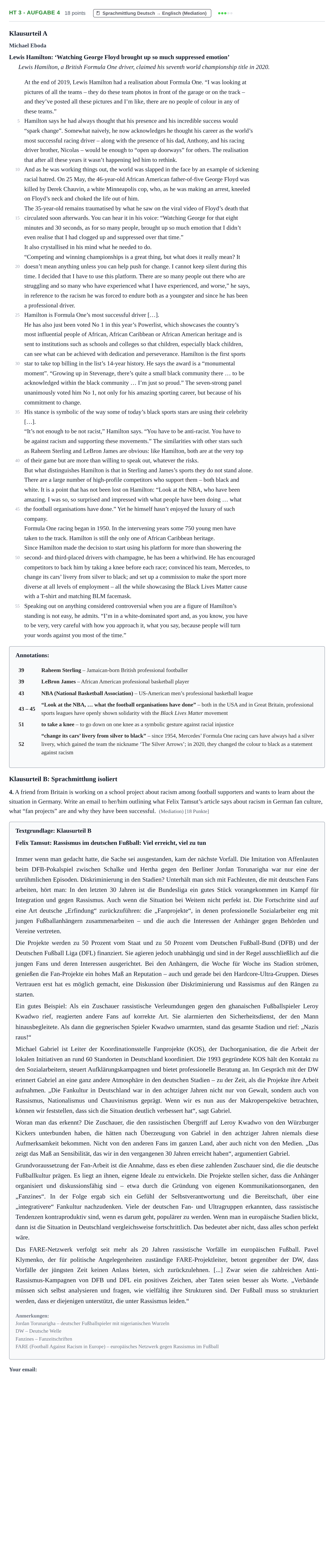
Klausurteil A
Michael Eboda
Lewis Hamilton: ‘Watching George Floyd brought up so much suppressed emotion’
Lewis Hamilton, a British Formula One driver, claimed his seventh world championship title in 2020.
At the end of 2019, Lewis Hamilton had a realisation about Formula One. “I was looking at
pictures of all the teams – they do these team photos in front of the garage or on the track –
and they’ve posted all these pictures and I’m like, there are no people of colour in any of
these teams.”
5 Hamilton says he had always thought that his presence and his incredible success would
“spark change”. Somewhat naively, he now acknowledges he thought his career as the world’s
most successful racing driver – along with the presence of his dad, Anthony, and his racing
driver brother, Nicolas – would be enough to “open up doorways” for others. The realisation
that after all these years it wasn’t happening led him to rethink.
10 And as he was working things out, the world was slapped in the face by an example of sickening
racial hatred. On 25 May, the 46-year-old African American father-of-five George Floyd was
killed by Derek Chauvin, a white Minneapolis cop, who, as he was making an arrest, kneeled
on Floyd’s neck and choked the life out of him.
The 35-year-old remains traumatised by what he saw on the viral video of Floyd’s death that
15 circulated soon afterwards. You can hear it in his voice: “Watching George for that eight
minutes and 30 seconds, as for so many people, brought up so much emotion that I didn’t
even realise that I had clogged up and suppressed over that time.”
It also crystallised in his mind what he needed to do.
“Competing and winning championships is a great thing, but what does it really mean? It
20 doesn’t mean anything unless you can help push for change. I cannot keep silent during this
time. I decided that I have to use this platform. There are so many people out there who are
struggling and so many who have experienced what I have experienced, and worse,” he says,
in reference to the racism he was forced to endure both as a youngster and since he has been
a professional driver.
25 Hamilton is Formula One’s most successful driver […].
He has also just been voted No 1 in this year’s Powerlist, which showcases the country’s
most influential people of African, African Caribbean or African American heritage and is
sent to institutions such as schools and colleges so that children, especially black children,
can see what can be achieved with dedication and perseverance. Hamilton is the first sports
30 star to take top billing in the list’s 14-year history. He says the award is a “monumental
moment”. “Growing up in Stevenage, there’s quite a small black community there … to be
acknowledged within the black community … I’m just so proud.” The seven-strong panel
unanimously voted him No 1, not only for his amazing sporting career, but because of his
commitment to change.
35 His stance is symbolic of the way some of today’s black sports stars are using their celebrity
[…].
“It’s not enough to be not racist,” Hamilton says. “You have to be anti-racist. You have to
be against racism and supporting these movements.” The similarities with other stars such
as Raheem Sterling and LeBron James are obvious: like Hamilton, both are at the very top
40 of their game but are more than willing to speak out, whatever the risks.
But what distinguishes Hamilton is that in Sterling and James’s sports they do not stand alone.
There are a large number of high-profile competitors who support them – both black and
white. It is a point that has not been lost on Hamilton: “Look at the NBA, who have been
amazing. I was so, so surprised and impressed with what people have been doing … what
45 the football organisations have done.” Yet he himself hasn’t enjoyed the luxury of such
company.
Formula One racing began in 1950. In the intervening years some 750 young men have
taken to the track. Hamilton is still the only one of African Caribbean heritage.
Since Hamilton made the decision to start using his platform for more than showering the
50 second- and third-placed drivers with champagne, he has been a whirlwind. He has encouraged
competitors to back him by taking a knee before each race; convinced his team, Mercedes, to
change its cars’ livery from silver to black; and set up a commission to make the sport more
diverse at all levels of employment – all the while showcasing the Black Lives Matter cause
with a T-shirt and matching BLM facemask.
55 Speaking out on anything considered controversial when you are a figure of Hamilton’s
standing is not easy, he admits. “I’m in a white-dominated sport and, as you know, you have
to be very, very careful with how you approach it, what you say, because people will turn
your words against you most of the time.”
Annotations:
39 · Raheem Sterling – Jamaican-born British professional footballer
39 · LeBron James – African American professional basketball player
43 · NBA (National Basketball Association) – US-American men’s professional basketball league
43 – 45 · “Look at the NBA, … what the football organisations have done” – both in the USA and in Great Britain, professional sports leagues have openly shown solidarity with the Black Lives Matter movement
51 · to take a knee – to go down on one knee as a symbolic gesture against racial injustice
52 · “change its cars’ livery from silver to black” – since 1954, Mercedes’ Formula One racing cars have always had a silver livery, which gained the team the nickname ‘The Silver Arrows’; in 2020, they changed the colour to black as a statement against racism
Klausurteil B: Sprachmittlung isoliert
4. A friend from Britain is working on a school project about racism among football supporters and wants to learn about the situation in Germany. Write an email to her/him outlining what Felix Tamsut’s article says about racism in German fan culture, what “fan projects” are and why they have been successful.
(Mediation) [18 Punkte]
Textgrundlage: Klausurteil B
Felix Tamsut: Rassismus im deutschen Fußball: Viel erreicht, viel zu tun
Immer wenn man gedacht hatte, die Sache sei ausgestanden, kam der nächste Vorfall. Die Imitation von Affenlauten beim DFB-Pokalspiel zwischen Schalke und Hertha gegen den Berliner Jordan Torunarigha war nur eine der unrühmlichen Episoden. Diskriminierung in den Stadien? Unterhält man sich mit Fachleuten, die mit deutschen Fans arbeiten, hört man: In den letzten 30 Jahren ist die Bundesliga ein gutes Stück vorangekommen im Kampf für Integration und gegen Rassismus. Auch wenn die Situation bei Weitem nicht perfekt ist. Die Fortschritte sind auf eine Art deutsche „Erfindung“ zurückzuführen: die „Fanprojekte“, in denen professionelle Sozialarbeiter eng mit jungen Fußballanhängern zusammenarbeiten – und die auch die Interessen der Anhänger gegen Behörden und Vereine vertreten.
Die Projekte werden zu 50 Prozent vom Staat und zu 50 Prozent vom Deutschen Fußball-Bund (DFB) und der Deutschen Fußball Liga (DFL) finanziert. Sie agieren jedoch unabhängig und sind in der Regel ausschließlich auf die jungen Fans und deren Interessen ausgerichtet. Bei den Anhängern, die Woche für Woche ins Stadion strömen, genießen die Fan-Projekte ein hohes Maß an Reputation – auch und gerade bei den Hardcore-Ultra-Gruppen. Dieses Vertrauen erst hat es möglich gemacht, eine Diskussion über Diskriminierung und Rassismus auf den Rängen zu starten.
Ein gutes Beispiel: Als ein Zuschauer rassistische Verleumdungen gegen den ghanaischen Fußballspieler Leroy Kwadwo rief, reagierten andere Fans auf korrekte Art. Sie alarmierten den Sicherheitsdienst, der den Mann hinausbegleitete. Als dann die gegnerischen Spieler Kwadwo umarmten, stand das gesamte Stadion und rief: „Nazis raus!“
Michael Gabriel ist Leiter der Koordinationsstelle Fanprojekte (KOS), der Dachorganisation, die die Arbeit der lokalen Initiativen an rund 60 Standorten in Deutschland koordiniert. Die 1993 gegründete KOS hält den Kontakt zu den Sozialarbeitern, steuert Aufklärungskampagnen und bietet professionelle Beratung an. Im Gespräch mit der DW erinnert Gabriel an eine ganz andere Atmosphäre in den deutschen Stadien – zu der Zeit, als die Projekte ihre Arbeit aufnahmen. „Die Fankultur in Deutschland war in den achtziger Jahren nicht nur von Gewalt, sondern auch von Rassismus, Nationalismus und Chauvinismus geprägt. Wenn wir es nun aus der Makroperspektive betrachten, können wir feststellen, dass sich die Situation deutlich verbessert hat“, sagt Gabriel.
Woran man das erkennt? Die Zuschauer, die den rassistischen Übergriff auf Leroy Kwadwo von den Würzburger Kickers unterbunden haben, die hätten nach Überzeugung von Gabriel in den achtziger Jahren niemals diese Aufmerksamkeit bekommen. Nicht von den anderen Fans im ganzen Land, aber auch nicht von den Medien. „Das zeigt das Maß an Sensibilität, das wir in den vergangenen 30 Jahren erreicht haben“, argumentiert Gabriel.
Grundvoraussetzung der Fan-Arbeit ist die Annahme, dass es eben diese zahlenden Zuschauer sind, die die deutsche Fußballkultur prägen. Es liegt an ihnen, eigene Ideale zu entwickeln. Die Projekte stellen sicher, dass die Anhänger organisiert und diskussionsfähig sind – etwa durch die Gründung von eigenen Kommunikationsorganen, den „Fanzines“. In der Folge ergab sich ein Gefühl der Selbstverantwortung und die Bereitschaft, über eine „integrativere“ Fankultur nachzudenken. Viele der deutschen Fan- und Ultragruppen erkannten, dass rassistische Tendenzen kontraproduktiv sind, wenn es darum geht, populärer zu werden. Wenn man in europäische Stadien blickt, dann ist die Situation in Deutschland vergleichsweise fortschrittlich. Das bedeutet aber nicht, dass alles schon perfekt wäre.
Das FARE-Netzwerk verfolgt seit mehr als 20 Jahren rassistische Vorfälle im europäischen Fußball. Pavel Klymenko, der für politische Angelegenheiten zuständige FARE-Projektleiter, betont gegenüber der DW, dass Vorfälle der jüngsten Zeit keinen Anlass bieten, sich zurückzulehnen. [...] Zwar seien die zahlreichen Anti-Rassismus-Kampagnen von DFB und DFL ein positives Zeichen, aber Taten seien besser als Worte. „Verbände müssen sich selbst analysieren und fragen, wie vielfältig ihre Strukturen sind. Der Fußball muss so strukturiert werden, dass er diejenigen unterstützt, die unter Rassismus leiden.“
Anmerkungen:
Jordan Torunarigha – deutscher Fußballspieler mit nigerianischen Wurzeln
DW – Deutsche Welle
Fanzines – Fanzeitschriften
FARE (Football Against Racism in Europe) – europäisches Netzwerk gegen Rassismus im Fußball
Lösung
Nach den offiziellen Korrekturhinweisen
A friend from Britain is working on a school project about racism among football supporters and wants to learn about the situation in Germany. Write an email to her/him outlining what Felix Tamsut’s article says about racism in German fan culture, what “fan projects” are and why they have been successful.
Lösung: Sample email: Subject: Info for your project on racism in German football / Fan projects Hi [Friend's Name], I heard you're doing a school project on racism among football fans, so I thought I'd share some interesting information from an article by Felix Tamsut about the situation here in Germany. Historically, German fan culture during the 1980s was severely affected by violence, nationalism, and racism. While the situation has significantly improved over the last 30 years and Germany is often seen as comparatively progressive in European football, racism is still an issue today (for example, recent monkey chants directed at Jordan Torunarigha). However, unlike in the past, there is now much greater awareness and solidarity: when player Leroy Kwadwo was racially abused, fellow supporters immediately alerted security, stood together, and chanted against Nazis. A key factor in this progress is the unique German concept of "fan projects" (Fanprojekte), coordinated by a central body (KOS). In around 60 locations, professional social workers collaborate closely with young supporters. Although financed equally by the state and football associations (DFB/DFL), the projects operate completely independently to represent fans' interests, run awareness campaigns, and establish communication platforms like fan magazines ("fanzines"). The main reasons for their success are the high level of trust and respect they enjoy among supporters—even hardcore "ultras". Fans are actively involved and encouraged to develop their own ideals and take responsibility for an inclusive fan culture. In addition, fan groups have realized that racist behavior is counterproductive to their own reputation and popularity. Hope this helps with your project! Let me know if you need more details. Best, [Your Name]
Die ausführliche Erklärung Schritt für Schritt (mit KI) gibt es mit Premium. Premium
Löse sie direkt hier: automatische Korrektur, Hinweise und Lösung Schritt für Schritt.
‹ Aufgabe HT 2 - Aufgabe 4 · GK · Haupttermin · Weiterbildungskolleg 2021 · Aufgabe NT 1 - Teilaufgabe 4 · GK · Nachtermin 2021 ›
Mehr Aufgaben zu Sprachmittlung Deutsch → Englisch (Mediation)
- Aufgabe HT 1 - 4 · GK · Haupttermin · Weiterbildungskolleg 2021
- Aufgabe HT 2 - 4 · GK · Haupttermin · Weiterbildungskolleg 2021
- Aufgabe HT 3 - 4 · GK · Haupttermin · Weiterbildungskolleg 2021
- Aufgabe HT 1 - Aufgabe 4 · GK · Haupttermin · Weiterbildungskolleg 2021
- Aufgabe HT 2 - Aufgabe 4 · GK · Haupttermin · Weiterbildungskolleg 2021
- Aufgabe NT 1 - Teilaufgabe 4 · GK · Nachtermin 2021
- Aufgabe NT 2 - Teilaufgabe 4 · GK · Nachtermin 2021
- Aufgabe NT 3 - Teilaufgabe 4 · GK · Nachtermin 2021
- Aufgabe NT 1 - Aufgabe 4 · GK · Nachtermin · Weiterbildungskolleg 2021
- Aufgabe NT 2 - Aufgabe 4 · GK · Nachtermin · Weiterbildungskolleg 2021