Aufgabe NT 3 - Aufgabe 4 · Abitur NRW Englisch GK · Nachtermin · Weiterbildungskolleg 2021
Thema: Sprachmittlung Deutsch → Englisch (Mediation) · Aus der Prüfung GK · Nachtermin · Weiterbildungskolleg (2021)
Aufgabenstellung
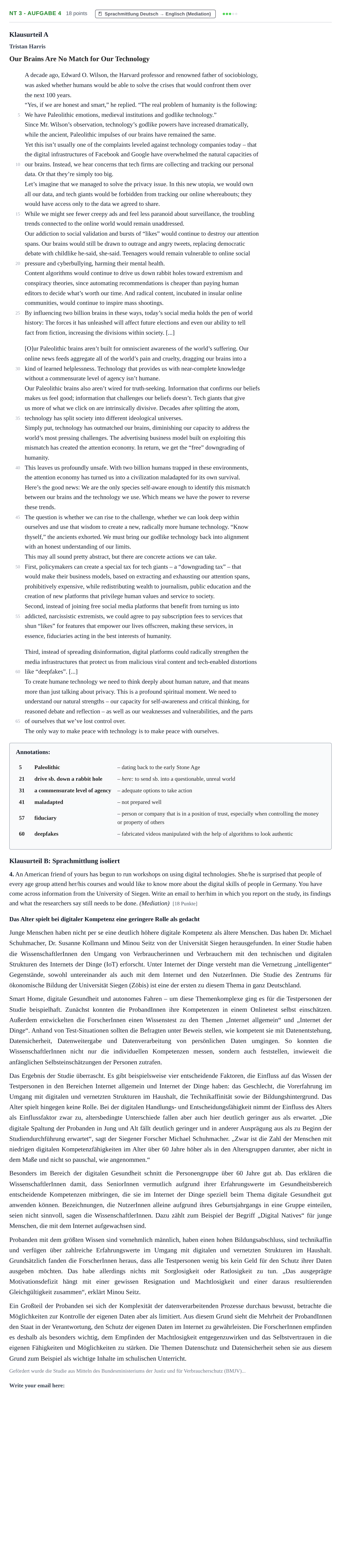
Klausurteil A
Tristan Harris
Our Brains Are No Match for Our Technology
A decade ago, Edward O. Wilson, the Harvard professor and renowned father of sociobiology,
was asked whether humans would be able to solve the crises that would confront them over
the next 100 years.
“Yes, if we are honest and smart,” he replied. “The real problem of humanity is the following:
5 We have Paleolithic emotions, medieval institutions and godlike technology.”
Since Mr. Wilson’s observation, technology’s godlike powers have increased dramatically,
while the ancient, Paleolithic impulses of our brains have remained the same.
Yet this isn’t usually one of the complaints leveled against technology companies today – that
the digital infrastructures of Facebook and Google have overwhelmed the natural capacities of
10 our brains. Instead, we hear concerns that tech firms are collecting and tracking our personal
data. Or that they’re simply too big.
Let’s imagine that we managed to solve the privacy issue. In this new utopia, we would own
all our data, and tech giants would be forbidden from tracking our online whereabouts; they
would have access only to the data we agreed to share.
15 While we might see fewer creepy ads and feel less paranoid about surveillance, the troubling
trends connected to the online world would remain unaddressed.
Our addiction to social validation and bursts of “likes” would continue to destroy our attention
spans. Our brains would still be drawn to outrage and angry tweets, replacing democratic
debate with childlike he-said, she-said. Teenagers would remain vulnerable to online social
20 pressure and cyberbullying, harming their mental health.
Content algorithms would continue to drive us down rabbit holes toward extremism and
conspiracy theories, since automating recommendations is cheaper than paying human
editors to decide what’s worth our time. And radical content, incubated in insular online
communities, would continue to inspire mass shootings.
25 By influencing two billion brains in these ways, today’s social media holds the pen of world
history: The forces it has unleashed will affect future elections and even our ability to tell
fact from fiction, increasing the divisions within society. [...]
[O]ur Paleolithic brains aren’t built for omniscient awareness of the world’s suffering. Our
online news feeds aggregate all of the world’s pain and cruelty, dragging our brains into a
30 kind of learned helplessness. Technology that provides us with near-complete knowledge
without a commensurate level of agency isn’t humane.
Our Paleolithic brains also aren’t wired for truth-seeking. Information that confirms our beliefs
makes us feel good; information that challenges our beliefs doesn’t. Tech giants that give
us more of what we click on are intrinsically divisive. Decades after splitting the atom,
35 technology has split society into different ideological universes.
Simply put, technology has outmatched our brains, diminishing our capacity to address the
world’s most pressing challenges. The advertising business model built on exploiting this
mismatch has created the attention economy. In return, we get the “free” downgrading of
humanity.
40 This leaves us profoundly unsafe. With two billion humans trapped in these environments,
the attention economy has turned us into a civilization maladapted for its own survival.
Here’s the good news: We are the only species self-aware enough to identify this mismatch
between our brains and the technology we use. Which means we have the power to reverse
these trends.
45 The question is whether we can rise to the challenge, whether we can look deep within
ourselves and use that wisdom to create a new, radically more humane technology. “Know
thyself,” the ancients exhorted. We must bring our godlike technology back into alignment
with an honest understanding of our limits.
This may all sound pretty abstract, but there are concrete actions we can take.
50 First, policymakers can create a special tax for tech giants – a “downgrading tax” – that
would make their business models, based on extracting and exhausting our attention spans,
prohibitively expensive, while redistributing wealth to journalism, public education and the
creation of new platforms that privilege human values and service to society.
Second, instead of joining free social media platforms that benefit from turning us into
55 addicted, narcissistic extremists, we could agree to pay subscription fees to services that
shun “likes” for features that empower our lives offscreen, making these services, in
essence, fiduciaries acting in the best interests of humanity.
Third, instead of spreading disinformation, digital platforms could radically strengthen the
media infrastructures that protect us from malicious viral content and tech-enabled distortions
60 like “deepfakes”. [...]
To create humane technology we need to think deeply about human nature, and that means
more than just talking about privacy. This is a profound spiritual moment. We need to
understand our natural strengths – our capacity for self-awareness and critical thinking, for
reasoned debate and reflection – as well as our weaknesses and vulnerabilities, and the parts
65 of ourselves that we’ve lost control over.
The only way to make peace with technology is to make peace with ourselves.
Annotations:
5 · Paleolithic · – dating back to the early Stone Age
21 · drive sb. down a rabbit hole · – here: to send sb. into a questionable, unreal world
31 · a commensurate level of agency · – adequate options to take action
41 · maladapted · – not prepared well
57 · fiduciary · – person or company that is in a position of trust, especially when controlling the money or property of others
60 · deepfakes · – fabricated videos manipulated with the help of algorithms to look authentic
Klausurteil B: Sprachmittlung isoliert
4. An American friend of yours has begun to run workshops on using digital technologies. She/he is surprised that people of every age group attend her/his courses and would like to know more about the digital skills of people in Germany. You have come across information from the University of Siegen. Write an email to her/him in which you report on the study, its findings and what the researchers say still needs to be done. (Mediation) [18 Punkte]
Das Alter spielt bei digitaler Kompetenz eine geringere Rolle als gedacht
Junge Menschen haben nicht per se eine deutlich höhere digitale Kompetenz als ältere Menschen. Das haben Dr. Michael Schuhmacher, Dr. Susanne Kollmann und Minou Seitz von der Universität Siegen herausgefunden. In einer Studie haben die WissenschaftlerInnen den Umgang von Verbraucherinnen und Verbrauchern mit den technischen und digitalen Strukturen des Internets der Dinge (IoT) erforscht. Unter Internet der Dinge versteht man die Vernetzung „intelligenter“ Gegenstände, sowohl untereinander als auch mit dem Internet und den NutzerInnen. Die Studie des Zentrums für ökonomische Bildung der Universität Siegen (Zöbis) ist eine der ersten zu diesem Thema in ganz Deutschland.
Smart Home, digitale Gesundheit und autonomes Fahren – um diese Themenkomplexe ging es für die Testpersonen der Studie beispielhaft. Zunächst konnten die ProbandInnen ihre Kompetenzen in einem Onlinetest selbst einschätzen. Außerdem entwickelten die ForscherInnen einen Wissenstest zu den Themen „Internet allgemein“ und „Internet der Dinge“. Anhand von Test-Situationen sollten die Befragten unter Beweis stellen, wie kompetent sie mit Datenentstehung, Datensicherheit, Datenweitergabe und Datenverarbeitung von persönlichen Daten umgingen. So konnten die WissenschaftlerInnen nicht nur die individuellen Kompetenzen messen, sondern auch feststellen, inwieweit die anfänglichen Selbsteinschätzungen der Personen zutrafen.
Das Ergebnis der Studie überrascht. Es gibt beispielsweise vier entscheidende Faktoren, die Einfluss auf das Wissen der Testpersonen in den Bereichen Internet allgemein und Internet der Dinge haben: das Geschlecht, die Vorerfahrung im Umgang mit digitalen und vernetzten Strukturen im Haushalt, die Technikaffinität sowie der Bildungshintergrund. Das Alter spielt hingegen keine Rolle. Bei der digitalen Handlungs- und Entscheidungsfähigkeit nimmt der Einfluss des Alters als Einflussfaktor zwar zu, altersbedingte Unterschiede fallen aber auch hier deutlich geringer aus als erwartet. „Die digitale Spaltung der Probanden in Jung und Alt fällt deutlich geringer und in anderer Ausprägung aus als zu Beginn der Studiendurchführung erwartet“, sagt der Siegener Forscher Michael Schuhmacher. „Zwar ist die Zahl der Menschen mit niedrigen digitalen Kompetenzfähigkeiten im Alter über 60 Jahre höher als in den Altersgruppen darunter, aber nicht in dem Maße und nicht so pauschal, wie angenommen.“
Besonders im Bereich der digitalen Gesundheit schnitt die Personengruppe über 60 Jahre gut ab. Das erklären die WissenschaftlerInnen damit, dass SeniorInnen vermutlich aufgrund ihrer Erfahrungswerte im Gesundheitsbereich entscheidende Kompetenzen mitbringen, die sie im Internet der Dinge speziell beim Thema digitale Gesundheit gut anwenden können. Bezeichnungen, die NutzerInnen alleine aufgrund ihres Geburtsjahrgangs in eine Gruppe einteilen, seien nicht sinnvoll, sagen die WissenschaftlerInnen. Dazu zählt zum Beispiel der Begriff „Digital Natives“ für junge Menschen, die mit dem Internet aufgewachsen sind.
Probanden mit dem größten Wissen sind vornehmlich männlich, haben einen hohen Bildungsabschluss, sind technikaffin und verfügen über zahlreiche Erfahrungswerte im Umgang mit digitalen und vernetzten Strukturen im Haushalt. Grundsätzlich fanden die ForscherInnen heraus, dass alle Testpersonen wenig bis kein Geld für den Schutz ihrer Daten ausgeben möchten. Das habe allerdings nichts mit Sorglosigkeit oder Ratlosigkeit zu tun. „Das ausgeprägte Motivationsdefizit hängt mit einer gewissen Resignation und Machtlosigkeit und einer daraus resultierenden Gleichgültigkeit zusammen“, erklärt Minou Seitz.
Ein Großteil der Probanden sei sich der Komplexität der datenverarbeitenden Prozesse durchaus bewusst, betrachte die Möglichkeiten zur Kontrolle der eigenen Daten aber als limitiert. Aus diesem Grund sieht die Mehrheit der ProbandInnen den Staat in der Verantwortung, den Schutz der eigenen Daten im Internet zu gewährleisten. Die ForscherInnen empfinden es deshalb als besonders wichtig, dem Empfinden der Machtlosigkeit entgegenzuwirken und das Selbstvertrauen in die eigenen Fähigkeiten und Möglichkeiten zu stärken. Die Themen Datenschutz und Datensicherheit sehen sie aus diesem Grund zum Beispiel als wichtige Inhalte im schulischen Unterricht.
Gefördert wurde die Studie aus Mitteln des Bundesministeriums der Justiz und für Verbraucherschutz (BMJV)...
Lösung
Nach den offiziellen Korrekturhinweisen
4. Write an email to her/him in which you report on the study, its findings and what the researchers say still needs to be done.
Lösung: An email to the American friend covering: - Focus of the study: Handling of the Internet of Things (IoT), using examples such as health, smart home, and autonomous driving. - Findings/Results: * Key indicators for digital competence are gender, previous experience with smart home/connected devices, affinity for technology, and educational background, rather than age. * Age plays a relatively minor role in general digital competence; the digital divide between young and old is much smaller than expected. * People aged 60+ exhibit surprisingly high competence in the field of digital health due to their accumulated real-life experience with healthcare. * Highest overall competence is found among tech-savvy males with a high level of education and extensive experience. * Users across all groups are reluctant to spend money on data privacy not because of recklessness, but due to feelings of resignation, powerlessness, and the belief that government should protect data. - What remains to be done: * Counteracting feelings of powerlessness and strengthening individual responsibility and confidence in managing personal data securely. * Integrating topics of data protection and cybersecurity into school education curricula.
Die ausführliche Erklärung Schritt für Schritt (mit KI) gibt es mit Premium. Premium
Löse sie direkt hier: automatische Korrektur, Hinweise und Lösung Schritt für Schritt.
‹ Aufgabe NT 2 - Aufgabe 4 · GK · Nachtermin · Weiterbildungskolleg 2021 · Aufgabe 1 · GK · Teuffel: Sinnvoll regulierend/Ferbe 2021 ›
Mehr Aufgaben zu Sprachmittlung Deutsch → Englisch (Mediation)
- Aufgabe NT 1 - Teilaufgabe 4 · GK · Nachtermin 2021
- Aufgabe NT 2 - Teilaufgabe 4 · GK · Nachtermin 2021
- Aufgabe NT 3 - Teilaufgabe 4 · GK · Nachtermin 2021
- Aufgabe NT 1 - Aufgabe 4 · GK · Nachtermin · Weiterbildungskolleg 2021
- Aufgabe NT 2 - Aufgabe 4 · GK · Nachtermin · Weiterbildungskolleg 2021
- Aufgabe 1 · GK · Teuffel: Sinnvoll regulierend/Ferbe 2021
- Aufgabe 1 · GK · Uhtenwoldt: Mut zur Lücke! 2021
- Aufgabe 1 · LK · Brettspiele sind wieder im Trend / 2021
- Aufgabe · LK · Döring: Mit Stock und Hut auf Wande 2021
- Aufgabe 1 · LK · Erhardt: Integration - ist sie wirk 2021