Aufgabe NT 1 - Teilaufgabe 4 · Abitur NRW Englisch GK · Nachtermin 2021
Thema: Sprachmittlung Deutsch → Englisch (Mediation) · Aus der Prüfung GK · Nachtermin (2021)
Aufgabenstellung
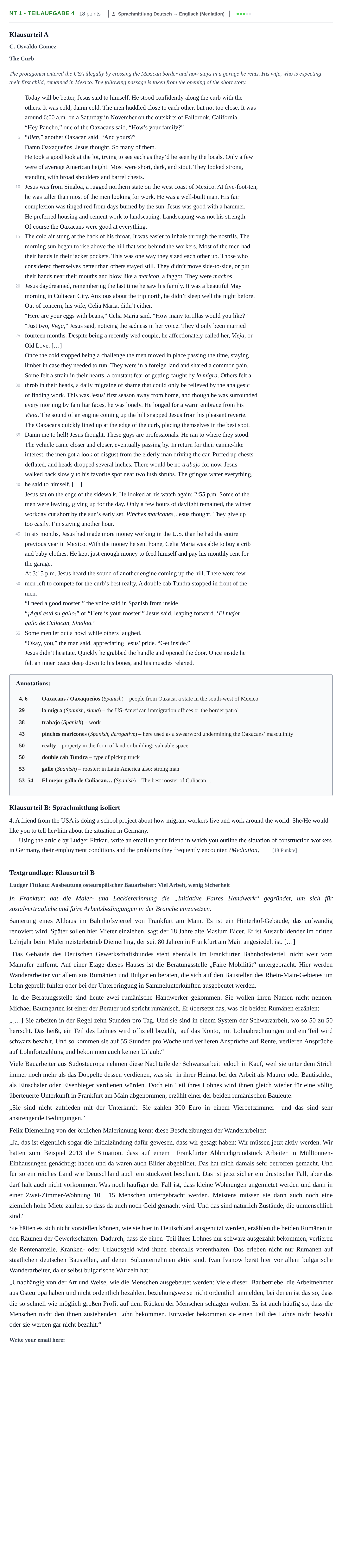
Klausurteil A
C. Osvaldo Gomez
The Curb
The protagonist entered the USA illegally by crossing the Mexican border and now stays in a garage he rents. His wife, who is expecting their first child, remained in Mexico. The following passage is taken from the opening of the short story.
Today will be better, Jesus said to himself. He stood confidently along the curb with the
others. It was cold, damn cold. The men huddled close to each other, but not too close. It was
around 6:00 a.m. on a Saturday in November on the outskirts of Fallbrook, California.
“Hey Pancho,” one of the Oaxacans said. “How’s your family?”
5 “ Bien,” another Oaxacan said. “And yours?”
Damn Oaxaqueños, Jesus thought. So many of them.
He took a good look at the lot, trying to see each as they’d be seen by the locals. Only a few
were of average American height. Most were short, dark, and stout. They looked strong,
standing with broad shoulders and barrel chests.
10 Jesus was from Sinaloa, a rugged northern state on the west coast of Mexico. At five-foot-ten,
he was taller than most of the men looking for work. He was a well-built man. His fair
complexion was tinged red from days burned by the sun. Jesus was good with a hammer.
He preferred housing and cement work to landscaping. Landscaping was not his strength.
Of course the Oaxacans were good at everything.
15 The cold air stung at the back of his throat. It was easier to inhale through the nostrils. The
morning sun began to rise above the hill that was behind the workers. Most of the men had
their hands in their jacket pockets. This was one way they sized each other up. Those who
considered themselves better than others stayed still. They didn’t move side-to-side, or put
their hands near their mouths and blow like a maricon, a faggot. They were machos.
20 Jesus daydreamed, remembering the last time he saw his family. It was a beautiful May
morning in Culiacan City. Anxious about the trip north, he didn’t sleep well the night before.
Out of concern, his wife, Celia Maria, didn’t either.
“Here are your eggs with beans,” Celia Maria said. “How many tortillas would you like?”
“Just two, Vieja,” Jesus said, noticing the sadness in her voice. They’d only been married
25 fourteen months. Despite being a recently wed couple, he affectionately called her, Vieja, or
Old Love. […]
Once the cold stopped being a challenge the men moved in place passing the time, staying
limber in case they needed to run. They were in a foreign land and shared a common pain.
Some felt a strain in their hearts, a constant fear of getting caught by la migra. Others felt a
30 throb in their heads, a daily migraine of shame that could only be relieved by the analgesic
of finding work. This was Jesus’ first season away from home, and though he was surrounded
every morning by familiar faces, he was lonely. He longed for a warm embrace from his
Vieja. The sound of an engine coming up the hill snapped Jesus from his pleasant reverie.
The Oaxacans quickly lined up at the edge of the curb, placing themselves in the best spot.
35 Damn me to hell! Jesus thought. These guys are professionals. He ran to where they stood.
The vehicle came closer and closer, eventually passing by. In return for their canine-like
interest, the men got a look of disgust from the elderly man driving the car. Puffed up chests
deflated, and heads dropped several inches. There would be no trabajo for now. Jesus
walked back slowly to his favorite spot near two lush shrubs. The gringos water everything,
40 he said to himself. […]
Jesus sat on the edge of the sidewalk. He looked at his watch again: 2:55 p.m. Some of the
men were leaving, giving up for the day. Only a few hours of daylight remained, the winter
workday cut short by the sun’s early set. Pinches maricones, Jesus thought. They give up
too easily. I’m staying another hour.
45 In six months, Jesus had made more money working in the U.S. than he had the entire
previous year in Mexico. With the money he sent home, Celia Maria was able to buy a crib
and baby clothes. He kept just enough money to feed himself and pay his monthly rent for
the garage.
At 3:15 p.m. Jesus heard the sound of another engine coming up the hill. There were few
50 men left to compete for the curb’s best realty. A double cab Tundra stopped in front of the
men.
“I need a good rooster!” the voice said in Spanish from inside.
“ ¡Aquí está su gallo! ” or “Here is your rooster!” Jesus said, leaping forward. ‘ El mejor
gallo de Culiacan, Sinaloa. ’
55 Some men let out a howl while others laughed.
“Okay, you,” the man said, appreciating Jesus’ pride. “Get inside.”
Jesus didn’t hesitate. Quickly he grabbed the handle and opened the door. Once inside he
felt an inner peace deep down to his bones, and his muscles relaxed.
Annotations:
4, 6 · Oaxacans / Oaxaqueños ( Spanish) – people from Oaxaca, a state in the south-west of Mexico
29 · la migra ( Spanish, slang) – the US-American immigration offices or the border patrol
38 · trabajo ( Spanish) – work
43 · pinches maricones ( Spanish, derogative) – here used as a swearword undermining the Oaxacans’ masculinity
50 · realty – property in the form of land or building; valuable space
50 · double cab Tundra – type of pickup truck
53 · gallo ( Spanish) – rooster; in Latin America also: strong man
53–54 · El mejor gallo de Culiacan… ( Spanish) – The best rooster of Culiacan…
Klausurteil B: Sprachmittlung isoliert
4. A friend from the USA is doing a school project about how migrant workers live and work around the world. She/He would like you to tell her/him about the situation in Germany.
Using the article by Ludger Fittkau, write an email to your friend in which you outline the situation of construction workers in Germany, their employment conditions and the problems they frequently encounter.
(Mediation) [18 Punkte]
Textgrundlage: Klausurteil B
Ludger Fittkau: Ausbeutung osteuropäischer Bauarbeiter: Viel Arbeit, wenig Sicherheit
In Frankfurt hat die Maler- und Lackiererinnung die „Initiative Faires Handwerk“ gegründet, um sich für sozialverträgliche und faire Arbeitsbedingungen in der Branche einzusetzen.
Sanierung eines Altbaus im Bahnhofsviertel von Frankfurt am Main. Es ist ein Hinterhof-Gebäude, das aufwändig renoviert wird. Später sollen hier Mieter einziehen, sagt der 18 Jahre alte Maslum Bicer. Er ist Auszubildender im dritten Lehrjahr beim Malermeisterbetrieb Diemerling, der seit 80 Jahren in Frankfurt am Main angesiedelt ist. […]
5 Das Gebäude des Deutschen Gewerkschaftsbundes steht ebenfalls im Frankfurter Bahnhofsviertel, nicht weit vom Mainufer entfernt. Auf einer Etage dieses Hauses ist die Beratungsstelle „Faire Mobilität“ untergebracht. Hier werden Wanderarbeiter vor allem aus Rumänien und Bulgarien beraten, die sich auf den Baustellen des Rhein-Main-Gebietes um Lohn geprellt fühlen oder bei der Unterbringung in Sammelunterkünften ausgebeutet werden.
10 In die Beratungsstelle sind heute zwei rumänische Handwerker gekommen. Sie wollen ihren Namen nicht nennen. Michael Baumgarten ist einer der Berater und spricht rumänisch. Er übersetzt das, was die beiden Rumänen erzählen:
„[…] Sie arbeiten in der Regel zehn Stunden pro Tag. Und sie sind in einem System der Schwarzarbeit, wo so 50 zu 50 herrscht. Das heißt, ein Teil des Lohnes wird offiziell bezahlt, 15 auf das Konto, mit Lohnabrechnungen und ein Teil wird schwarz bezahlt. Und so kommen sie auf 55 Stunden pro Woche und verlieren Ansprüche auf Rente, verlieren Ansprüche auf Lohnfortzahlung und bekommen auch keinen Urlaub.“
Viele Bauarbeiter aus Südosteuropa nehmen diese Nachteile der Schwarzarbeit jedoch in Kauf, weil sie unter dem Strich immer noch mehr als das Doppelte dessen verdienen, was sie 20 in ihrer Heimat bei der Arbeit als Maurer oder Bautischler, als Einschaler oder Eisenbieger verdienen würden. Doch ein Teil ihres Lohnes wird ihnen gleich wieder für eine völlig überteuerte Unterkunft in Frankfurt am Main abgenommen, erzählt einer der beiden rumänischen Bauleute:
„Sie sind nicht zufrieden mit der Unterkunft. Sie zahlen 300 Euro in einem Vierbettzimmer 25 und das sind sehr anstrengende Bedingungen.“
Felix Diemerling von der örtlichen Malerinnung kennt diese Beschreibungen der Wanderarbeiter:
„Ja, das ist eigentlich sogar die Initialzündung dafür gewesen, dass wir gesagt haben: Wir müssen jetzt aktiv werden. Wir hatten zum Beispiel 2013 die Situation, dass auf einem 30 Frankfurter Abbruchgrundstück Arbeiter in Mülltonnen-Einhausungen genächtigt haben und da waren auch Bilder abgebildet. Das hat mich damals sehr betroffen gemacht. Und für so ein reiches Land wie Deutschland auch ein stückweit beschämt. Das ist jetzt sicher ein drastischer Fall, aber das darf halt auch nicht vorkommen. Was noch häufiger der Fall ist, dass kleine Wohnungen angemietet werden und dann in einer Zwei-Zimmer-Wohnung 10, 35 15 Menschen untergebracht werden. Meistens müssen sie dann auch noch eine ziemlich hohe Miete zahlen, so dass da auch noch Geld gemacht wird. Und das sind natürlich Zustände, die unmenschlich sind.“
Sie hätten es sich nicht vorstellen können, wie sie hier in Deutschland ausgenutzt werden, erzählen die beiden Rumänen in den Räumen der Gewerkschaften. Dadurch, dass sie einen 40 Teil ihres Lohnes nur schwarz ausgezahlt bekommen, verlieren sie Rentenanteile. Kranken- oder Urlaubsgeld wird ihnen ebenfalls vorenthalten. Das erleben nicht nur Rumänen auf staatlichen deutschen Baustellen, auf denen Subunternehmen aktiv sind. Ivan Ivanow berät hier vor allem bulgarische Wanderarbeiter, da er selbst bulgarische Wurzeln hat:
„Unabhängig von der Art und Weise, wie die Menschen ausgebeutet werden: Viele dieser 45 Baubetriebe, die Arbeitnehmer aus Osteuropa haben und nicht ordentlich bezahlen, beziehungsweise nicht ordentlich anmelden, bei denen ist das so, dass die so schnell wie möglich großen Profit auf dem Rücken der Menschen schlagen wollen. Es ist auch häufig so, dass die Menschen nicht den ihnen zustehenden Lohn bekommen. Entweder bekommen sie einen Teil des Lohns nicht bezahlt oder sie werden gar nicht bezahlt.“
Lösung
Nach den offiziellen Korrekturhinweisen
Using the article by Ludger Fittkau, write an email to your friend in which you outline the situation of construction workers in Germany, their employment conditions and the problems they frequently encounter.
Lösung: An email to a US-American friend outlining the following aspects based on Ludger Fittkau's article: - Appropriate email format (salutation, reference to the friend's school project, clear structure, closing formula). - Situation on German construction sites: Skilled construction workers and craftsmen from Eastern Europe (e.g. Romania, Bulgaria) are frequently employed via subcontractors. - Working and employment conditions: Earnings are often significantly higher than in their home countries (up to more than double), leading workers to accept harsh terms; long weekly working hours (typically around 10 hours a day, 55 hours per week); widespread mix of official contract employment and illegal undeclared work ('Schwarzarbeit', often 50/50); deduction of wage portions for accommodation. - Problems and exploitation: Substandard, inhumane, and overpriced housing (e.g. paying €300 for a shared four-bed room, 10–15 people in small two-room apartments, sleeping in trash can enclosures); loss of legal rights such as paid leave/vacation pay, sick pay, and pension claims due to undeclared work; companies aiming to maximize rapid profit by withholding portions of wages or completely failing to pay workers.
Die ausführliche Erklärung Schritt für Schritt (mit KI) gibt es mit Premium. Premium
Löse sie direkt hier: automatische Korrektur, Hinweise und Lösung Schritt für Schritt.
‹ Aufgabe HT 3 - Aufgabe 4 · GK · Haupttermin · Weiterbildungskolleg 2021 · Aufgabe NT 2 - Teilaufgabe 4 · GK · Nachtermin 2021 ›
Mehr Aufgaben zu Sprachmittlung Deutsch → Englisch (Mediation)
- Aufgabe HT 2 - 4 · GK · Haupttermin · Weiterbildungskolleg 2021
- Aufgabe HT 3 - 4 · GK · Haupttermin · Weiterbildungskolleg 2021
- Aufgabe HT 1 - Aufgabe 4 · GK · Haupttermin · Weiterbildungskolleg 2021
- Aufgabe HT 2 - Aufgabe 4 · GK · Haupttermin · Weiterbildungskolleg 2021
- Aufgabe HT 3 - Aufgabe 4 · GK · Haupttermin · Weiterbildungskolleg 2021
- Aufgabe NT 2 - Teilaufgabe 4 · GK · Nachtermin 2021
- Aufgabe NT 3 - Teilaufgabe 4 · GK · Nachtermin 2021
- Aufgabe NT 1 - Aufgabe 4 · GK · Nachtermin · Weiterbildungskolleg 2021
- Aufgabe NT 2 - Aufgabe 4 · GK · Nachtermin · Weiterbildungskolleg 2021
- Aufgabe NT 3 - Aufgabe 4 · GK · Nachtermin · Weiterbildungskolleg 2021